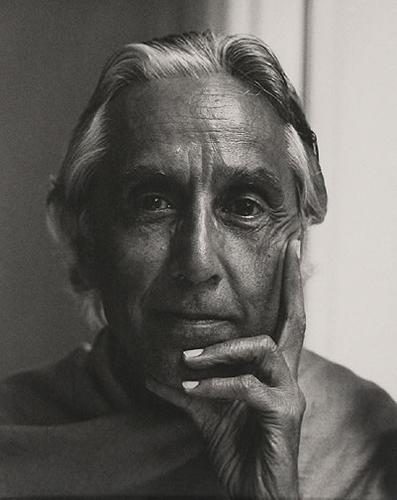
Raimon Panikkar
Personal Information
Description
There is no description yet, we will add it soon.
Books
The cosmotheandric experience
Raimon Panikkar has lived on the boundaries between Euro-America and Asia; Hinduism, Buddhism, and Christianity; philosophy, science, and theology; mysticism and prophecy. For him, our old habits of mind have been dying for several generations, outmoded by the arrival of a new way of intuiting reality. Panikkar calls this intuition the cosmotheandric experience. This cosmotheandric experience enables us today to enter into the hermeneutic circles that for thousands of years have hindered persons of different faith traditions from truly understanding the central experience of "other" religious families. The term denotes an intertwining of the "cosmic," the "human," and the "divine" -- all interpenetrating one another as different dimensions of the Whole.
Buddhism
The world’s premier authority on religious traditions and his premier successor present a concise and timely guide to the history, teachings, and practice of Buddhism.
Christianity
Lineaments - an outline, feature, or contour of a body or figure, especially of a face. In this culmination of his life's work, the popular Orthodox lay theologian and translator of the Philokalia draws from the depths of tradition the "face" of Christianity as a world religion. Through a critique of the modern scientific and rationalist paradigm, Sherrard seeks to restore the foundations of Christian cosmology and ecology, and to reaffirm the prime importance of sacred symbolism and art. The book includes a creative engagement with non-Christian traditions, with the "metaphysical logic" of Rene Guenon, and with distinctively modern thinkers such as Nietzsche and Jung.
Hinduism
This series uses a selection of exciting and compelling stories from many different faiths, for all faiths. Vibrant artwork and photographs help to bring age-old stories to life. Each story is linked with a panel that explains how the story affects the way the faith is practised today. Suitable for middle primary.
Religion and religions
This second volume of Raimon Panikkar's Opera Omnia offers Panikkar's reflections on religion in our era as well as in many other historical epochs. Because no particular religion can claim to exhaust the universal range of human experience, Panikkar argues that in a globalized world, a kind of religious pluralism is a necessary reality, and dialogue between different religions, cultures, and worldviews is an imperative of our time. The first section of this volume expands on the concept of religion from different viewpoints and develops some of the most universal aspects of religiosity. The second deals with comparative religion and with the religious philosophy of encounter, while the third section includes more specific topics, among which are the body and medicine, because religion reconnects not just humanity to God, but also the spirit to the body. Raimon Panikkar (1918-2010) made pioneering contributions to interreligious dialogue, comparative theology, and the phenomenology of religion while bridging different religions and cultures (Christianity, Buddhism, Hinduism), and advanced the global conversation between the so-called sacred and secular worlds. These diverse contributions were tied together in a unifying vision he called his cosmotheandric intuition, the deep interconnection of the Divine, the Cosmic, and the Human. (Publisher).