
UNITED STATES AUTHOR · FOREIGN RELATIONS · POLITICS AND GOVERNMENT
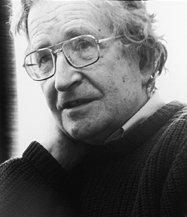
Noam Chomsky
Also known as: Noan CHOMSKY, Naom Chomsky
Avram Noam Chomsky (born December 7, 1928) is an American intellectual, philosopher, linguist, political activist, and social critic. Sometimes called "the father of modern linguistics", Chomsky is also a major figure in analytic philosophy and one of the founders of the field of cognitive science. He is a laureate professor of linguistics at the University of Arizona and an institute professor emeritus at the Massachusetts Institute of Technology (MIT). Among the most cited living authors, Chomsky has written more than 150 books on topics such as linguistics, war, and politics. In addition to his work in linguistics, since the 1960s, Chomsky has been an influential voice on the American Left as a consistent critic of the foreign policy of the United States, contemporary capitalism, and corporatocracy.
In these lectures, I would like to focus attention on the question.
— from Language and mind
Most acclaimed

Manufacturing consent
1988
Discusses the ways in which the mass media are manipulated to present the news according to an underlying elite consenus which affects the manner in which similar events in different parts of the world are presented.
Language and mind
This is the long-awaited third edition of Chomsky's outstanding collection of essays on language and mind. The first six chapters, originally published in the 1960s, made a groundbreaking contribution to linguistic theory. This new edition complements them with an additional chapter and a new preface, bringing Chomsky's influential approach into the twenty-first century. Chapters 1-6 present Chomsky's early work on the nature and acquisition of language as a genetically endowed, biological system (Universal Grammar), through the rules and principles of which we acquire an internalized knowledge (I-language). Over the past fifty years, this framework has sparked an explosion of inquiry into a wide range of languages, and has yielded some major theoretical questions. The final chapter revisits the key issues, reviewing the 'biolinguistic' approach that has guided Chomsky's work from its origins to the present day, and raising some novel and exciting challenges for the study of language and mind.
Understanding Power
"A major new collection from "arguably the most important intellectual alive" (The New York Times). Noam Chomsky is universally accepted as one of the preeminent public intellectuals of the modern era. Over the past thirty years, broadly diverse audiences have gathered to attend his sold-out lectures. Now, in Understanding Power, Peter Mitchell and John Schoeffel have assembled the best of Chomsky's recent talks on the past, present, and future of the politics of power. In a series of enlightening and wide-ranging discussions, all published here for the first time, Chomsky radically reinterprets the events of the past three decades, covering topics from foreign policy during Vietnam to the decline of welfare under the Clinton administration. And as he elucidates the connection between America's imperialistic foreign policy and the decline of domestic social services, Chomsky also discerns the necessary steps to take toward social change. With an eye to political activism and the media's role in popular struggle, as well as U.S. foreign and domestic policy, Understanding Power offers a sweeping critique of the world around us and is definitive Chomsky. Characterized by Chomsky's accessible and informative style, this is the ideal book for those new to his work as well as for those who have been listening for years."