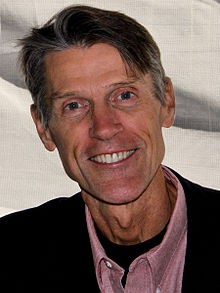
Henry William Brands
Personal Information
Description
Henry William Brands (born August 7, 1953) is an American educator, historian, and author of 25 books on U.S. history and biography. He is the Dickson Allen Anderson Centennial Professor of History and a Professor of Government at the University of Texas at Austin, where he earned his Ph.D. in history in 1985. His works have twice been selected as finalists for the Pulitzer Prize. - Wikipedia
Books
Traitor to his class
A sweeping biography of the life and political career of Franklin Delano Roosevelt draws on archival materials, public speeches, interviews with family and colleagues, and personal correspondence to examine FDR's political leadership in a dark time of Depression and war, his championship of the poor, his revolutionary New Deal legislation, and his legacy for the future.
The Money Men
"H. W. Brands recounts the century-long battle for the lifeblood of American commerce and power, focusing on five men whose lives and actions indelibly affected the course of American financial history. The story of these men is the story of how America transformed itself from a squabbling collection of small states into the foremost economic power in the world."--Jacket.
Lone Star Nation
From bestselling historian and long-time Texan H. W. Brands, a richly textured history of one of the most fascinating and colorful eras in U.S. history--the Texas Revolution and the forging of a new America."For better or for worse, Texas was very much like America. The people ruled, and little could stop them. If they ignored national boundaries, if they trampled the rights of indigenous peoples and of imported bondsmen, if they waged war for motives that started from base self-interest, all this came with the territory of democracy, a realm inhabited by ordinarily imperfect men and women. The one saving grace of democracy--the one that made all the difference in the end--was that sooner or later, sometimes after a terrible strife, democracy corrected its worst mistakes."--from Lone Star NationLone Star Nation is the gripping story of Texas's precariousjourney to statehood, from its early colonization in the 1820s to the shocking massacres of Texas loyalists at the Alamo and Goliad by the Mexican army, from its rough-and-tumble years as a land overrun by the Comanches to its day of liberation as an upstart republic. H. W. Brands tells the turbulent story of Texas through the eyes of a colorful cast of characters who have become a permanent fixture in the American landscape: Stephen Austin, the state's reluctant founder; Sam Houston, the alcoholic former governor who came to lead the Texas army in its hour of crisis and glory; William Travis, James Bowie, and David Crockett, the unforgettable heroic defenders of the doomed Alamo; Santa Anna, the Mexican generalissimo and dictator whose ruthless tactics galvanized the colonists against him; and the white-haired President Andrew Jackson whose expansionist aspirations loomed large in the background. Beyond these luminaries, Brands unearths the untold stories of the forgotten Texans--the slaves, women, unknown settlers, and children left out of traditional histories--who played crucial roles in Texas's birth. By turns bloody and heroic, tragic and triumphant, this riveting history of one of our greatest states reads like the most compelling fiction, and further secures H. W. Brands's position as one of the premier American historians.
Andrew Jackson
Reveals why Jackson's bold leadership as a general cemented "Old Hickory"'s reputation for being tough and ultimately led to his election as President of the United States in 1828.
The age of gold
By the Author of the Bestselling Pulitzer Prize Finalist THE FIRST AMERICANTHEY WENT WEST TO CHANGE THEIR LIVES AND IN THE BARGAIN THEY CHANGED THE WORLD. THIS IS THE EXTRAORDINARY STORY OF THE MEN AND WOMEN OF THE GOLD RUSH.When gold was first discovered on the American River above Sutter's Fort in January 1848, California was sparsely populated frontier territory not yet ceded to the United States from Mexixo. The discovery triggered a massive influx as hundreds of thousands of people scrambled to California in search of riches, braving dangerous journeys across the Pacific, around Cape Horn, and through the Isthmus of Panama, as well as across America's vast, unsettled wilderness. Cities sprang up overnight, in response to the demand for supplies and services of all kinds. By 1850, California had become a state -- the fastest journey to statehood in U.S. history. It had also become a symbol of what America stood for and of where it was going.In The Age of Gold, H. W. Brands explores the far-reaching implications of this pivotal point in U.S. history, weaving the politics of the times with the gripping stories of individuals that displays both the best and the worse of the American character. He discusses the national issues that exploded around the ratification of California's statehood, hastening the clouds that would lead to the Civil War. He tells the stories of the great fortunes made by such memorable figures as John and Jessie Fremont, Leland Stanford and George Hearst -- and of great fortunes lost by hundreds now forgotten by history. And he reveals the profound effect of the Gold Rush on the way Americans viewed their destinies, as the Puritan ethic of hard work and the gradual accumulation of worldly riches gave way to the notion of getting rich quickly.From the Hardcover edition.
The strange death of American liberalism
"In this book, H. W. Brands confronts the vital question of why an ever-increasing number of Americans do not trust the federal government to improve their lives and to heal major social ills. How is it that government has come to be seen as the source of many of our problems, rather than the potential means of their solution? How has the word liberal become a term of abuse in American political discourse?". "From the Revolution on, argues Brands, Americans have been chronically skeptical of their government. This book succinctly traces this skepticism, demonstrating that it is only during periods of war that Americans have set aside their distrust and looked to their government to defend them. The Cold War, Brands shows, created an extended - and historically anomalous - period of dependence, thereby allowing for the massive expansion of the American welfare state. Since the 1970s, and the devastating blow dealt to Cold War ideology by America's defeat in Vietnam, Americans have returned to their characteristic distrust of government. With the collapse of the Soviet Union in 1991, Brands contends, the fate of American liberalism was sealed - and we continue to live with the consequences of its demise."--BOOK JACKET.
The First American
He was the foremost American of his day, yet today he is little more than a mythic caricature in the public imagination. Benjamin Franklin, perhaps the pivotal figure in colonial and revolutionary America, comes vividly to life in this masterly biography.Wit, diplomat, scientist, philosopher, businessman, inventor, and bon vivant, Benjamin Franklin was in every respect America's first Renaissance man. From penniless runaway to highly successful printer, from ardently loyal subject of Britain to architect of an alliance with France that ensured America's independence, Franklin went from obscurity to become one of the world's most admired figures, whose circle included the likes of Voltaire, Hume, Burke, and Kant. Drawing on previously unpublished letters and a host of other sources, acclaimed historian H. W. Brands has written a thoroughly engaging biography of the eighteenth-century genius. A much needed reminder of Franklin's greatness and humanity, The First American is a work of meticulous scholarship that provides a magnificent tour of a legendary historical figure, a vital era in American life, and the countless arenas in which the protean Franklin left his legacy.From the Trade Paperback edition.
What America owes the world
For two hundred years, Americans have believed that they have an obligation to improve the lot of humanity. This belief has consistently shaped U.S. foreign policy. Yet within this consensus, two schools of thought have contended: the "exemplarist" school (Brands's term), which holds that what America chiefly owes the world is the benign example of a well-functioning democracy, and the "vindicationist" school, which asserts that force must sometimes supplement a good example. In this book, H. W. Brands traces the evolution of these two schools as they emerged in the arguments of the most important public thinkers of the last two centuries. This book is both an intellectual and moral history of U.S. foreign policy and a guide to the fundamental question of America's relations with the rest of the world - a question more pressing than ever in the confusion that has succeeded the Cold War: What does America owe the world?
T.R
In his time there was no national figure more popular than Theodore Roosevelt. It was not only the energy he brought to political office that made him so popular, or his unshakable moral convictions, or even his stature as an authentic war herothe colonel who led the Rough Riders up San Juan Hill during the Spanish-American War. Though scion of a privileged New York family, he was a man with an uncommon common touch. Theodore Roosevelt was loved by the American people because he loved them. Yet, as H.W. Brands shows in this biography, an examination of the private life of Roosevelt reveals an individual whose great public strengths hid troubling personal deficiencies. His uncompromising moralism frequently dismayed friends and alienated those who might have been allies. His speeches and writings, reflecting a temperament obsessively full of itself, became targets of fierce satire. His historical works, paeans to heroism, typically displayed a fierce and belligerent nationalism. Even more revealing is Roosevelt as son, brother, husband, and father. The compelling drama of Theodore Roosevelt's life continues to fascinate readers, and H.W. Brands, employing a wealth of private letters and previously unpublished material, tells his story as no biographer before him has.
Since Vietnam
The story of American foreign relations since Vietnam is the story of how Americans came to terms - and, more frequently, failed to come to terms - with the muddy complexity of life in the late twentieth century. The aftereffects of Vietnam were one cause of the failures; American history and American politics were two others. Between the politics of reductionism and the yearning for simplicity, Americans after Vietnam had great difficulty accepting the complexity of the world they lived in. Sometimes they overcame the difficulty; sometimes the difficulty overcame them. What follows is the tale of both outcomes.
The reckless decade
A period every bit as turbulent as our own age, the 1890s saw vast changes in the economy, politics, and society of the United States, while giving birth to a technological revolution that would profoundly alter the lives of all Americans. Those who knew how to exploit this new world - Carnegie, Morgan, Rockefeller - prospered handsomely; those who did not became icons of how the other half lives. The chilling violence of the Homestead steelworkers' strike and other labor conflicts underscored the tension that such disparity produced. The economic elite ensured that the currency of capital would remain gold and not free silver, yet technology transformed everyday life as alternating current began to light the nation. That new frontier came just when the Western one on which America prided itself closed. No longer could America expand internally; imperialism was the way of the future. But even as the United States became a colonial power, Jim Crow laws ensured that only whites could reap the harvest of empire. In The Reckless Decade, Brands captures the essence - whimsical, tragic, and intrinsically contradictory - of the 1890s, when for the first time America turned its face outward to the world and geared up for the "American Century." Evocative and fascinating, this remarkable book looks back over that amazing time and, in the telling, teaches us much about ourselves and our own reckless decade.
Into the labyrinth
In this volume of the America in Crisis series, Professor H. W. Brands provides a comprehensive and balanced overview of American policy in the Middle East since 1945. Defining the region broadly, he covers both familiar topics such as the dangerous Suez crisis of 1956, the embarrassing Iranian hostage episode, and the triumphant Gulf War, as well as less well-known incidents like the Cyprus crisis and the civil war in Yemen in the 1960s... In describing the last half-century of American experience in the Middle East, Professor Brands offers insight and perspective on the issues the United States still faces in this troubled area.
