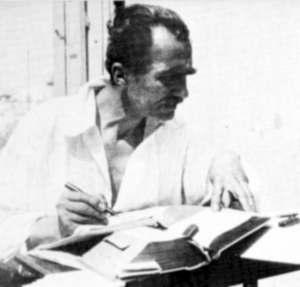
Nikos Kazantzakis
Personal Information
Description
There is no description yet, we will add it soon.
Books
Vios ke Politia tou Alexi Zorba
An Englishman discovers that he has come into a small inheritance in Crete and sets out to claim it. When he arrives, he meets Alexis Zorba, a middle-aged Greek with a zest for life. As their relationship develops, the Englishman is persuaded to change his outlook on life
O Christos xanastavronetai
The inhabitants of a Greek village, ruled by the Turks, plan to enact the life of Christ in a mystery play but are overwhelmed by their task. A group of refugees, fleeing from the ruins of their plundered homes, arrive asking for protection - and suddenly the drama of the Passion becomes reality.
Ho kapetan Michalēs
Freedom and Death is Kazantzakis's modern Iliad. The context is Crete in the late nineteenth century, the epic struggle between Greeks and Turks, between Chrisianity and Islam. A new uprising takes place to rival those of 1854, 1866 and 1878, and the island is thrown into confusion yet again. In the village of Megalokastro a Cretan resistance fighter, Captain Michales, is matched by the Turkish bey, his blood-brother. The life of the local community continues shakily, but is disrupted by explosions of violence.
Toda-Raba
[Translated by Amy Mims.] Toda Raba was written in 1929, after Kazantzakis’ return from his journeys through the Soviet Union. It is a novel — strange, surging, mystical and, in the final analysis, terrifyingly prophetic. The characters are — with one exception — reflections of Kazantzakis himself, and represent his own deeply conflicting views of the Revolution. They are all wanderers, searchers, drawn by the force of Lenin (who has already died) to the Soviet Union, at a time when Russia is still living in the aftermath of the Civil War. There is Rahel, a Polish-Jewish girl, drawn to Communism and working for the secret police; there is Azad, the ex-Cheka murderer, who believes in the necessity for a new and purer revolution, and thinks Communism must come from a change of man’s soul, not from the machines and the materialism of Europe and America; there is Geranos, a Cretan like Kazantzakis, by far the most rational and comprehensible of the characters, who admires the Revolution but is too old to join in its works, too set in his mental habits to abandon himself to it; there is Sou-ki, a Chinese from California; and Amita, a Japanese writer; and Ananda, an Indian monk — all these meet, talk, think, analyze the Revolution and the Soviet Union. Towering over them all, in a mysterious way, is Toda Raba, an African Negro who abandons his tribe and his savage god to make a pilgrimage to Russia. And it is he, with his violence, his paganism and his humanity, who represents the wave of the future, not the others, who represent, each in his or her own way, the old races and the old civilizations. Toda Raba is the man of the future, and the Russian Revolution releases his energy and his sense of his own destiny. There is a terrifying scene at an Asian Congress in the U.S.S.R., in which the Asians cry out for revenge and declare that the future of the world is with them and with Africa, not with the West, not even with the new Russia. In this sense the novel is prophetic, and Kazantzakis understood even in 1929 that the Russian Revolution’s importance was far greater than the effects it had on Russia herself, and that the echoes of it would awake the vast areas of Africa and Asia that had been silent for centuries.
The Greek passion
The tragic opera based on Nikos Kazantzakis's novel about a Small Greek village where the town's people re-enact the Passion of Christ.
Sta palatia tis Knosou
With the help of the princess Ariadne and other friends in the palace at Crete, Theseus enters the Labyrinth and slays the hideous Minotaur, thus spearheading the resistance of the Athenian people against King Minos.
Two Plays
David Almond turns his talents to drama in these two plays. Skellig is the dramatization of his highly acclaimed novel. What has Michael found in the derelict garage? What is this creature that lies in the darkness? Is it human, or a strange beast never seen before? And what will happen in the world when he carries it out into the light? Wild Girl, Wild Boy is an original play produced in London by the Pop-Up Theatre company. Young Elaine has recently lost her father, and now she spends her days dreaming in the family's garden, skipping school, unable to read or write. One day, Elaine conjures up a Wild Boy from spells and fairy seed. No one else can see him, and Elaine disappears into a world of fantasy where she and Wild Boy remember the teachings of her father. Will her mother ever come to understand? These two plays introduce a new talent from the remarkable David Almond.
Odysseia
Twenty-four book sequel to the Homeric poem that continues the story of Odysseus from his return to Greece to his death. written in 33,333 17-syllable lines and divided into 24 books.
