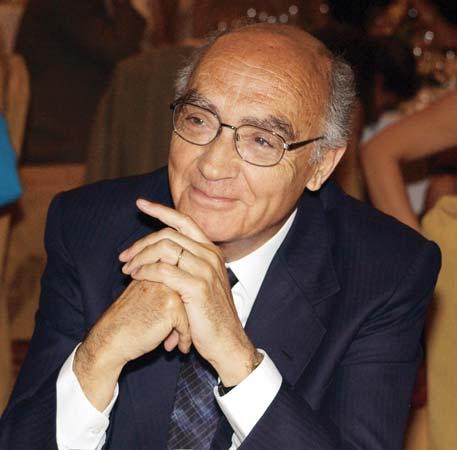
José Saramago
Personal Information
Description
José de Sousa Saramago, GColSE ComSE GColCa (Portuguese: [ʒuˈzɛ ðɨ ˈso(w).zɐ sɐɾɐˈmaɣu]; 16 November 1922 – 18 June 2010), was a Portuguese writer and recipient of the 1998 Nobel Prize in Literature for his "parables sustained by imagination, compassion and irony [with which he] continually enables us once again to apprehend an elusory reality." His works, some of which can be seen as allegories, commonly present subversive perspectives on historic events, emphasizing the theopoetic human factor. [source](
Books
Ensaio sobre a lucidez
During the town elections of a nameless city, most of its inhabitants, by their own individual choices, decide to exert their voting rights in an unexpected way. The dirty and sneaky officials in power start making arrangements to eliminate the guilty parties; and if they cannot find any, they will have to make them up.
Todos os nomes
Senhor Jose is a clerk at the Central Registry, where records are stored on the birth, marriage and death of all of the city's populace. Jose stumbles across a record for a woman he has never met and becomes consumed with finding out more about her. His quest for knowledge pushes him to perform in ways he never thought possible.
Ensaio Sobre a Cegueira
Uma cegueira branca se espalha de forma fulminante. Internados em quarentena ou perdidos pela cidade, os cegos devem enfrentar o que há de mais primitivo na espécie humana: a vontade de sobreviver à qualquer custo. José Saramago, vencedor do Prêmio Nobel de Literatura de 1998, tece uma aterrorizante parábola sobre o ser humano, que revela o que há de pior em nós mesmos.
Viagem a Portugal
When Jose Saramago decided some twenty years ago to write a book about Portugal, his only desire was that it be unlike any other book on the subject, and in this he certainly has succeeded. Recording the events and observations of a journey across the length and breadth of the country he loves dearly, Saramago brings Portugal to life as only a writer of his brilliance can. Forfeiting sources of information such as tourist guides and road maps, he scours the country with the eyes and ears of an observer fascinated by the ancient myths and history of his people. Whether an inaccessible medieval fortress set on a cliff, a wayside chapel thick with cobwebs, or a grand mansion in the city, the extraordinary places of this land come alive with kings, warriors, painters, explorers, writers, saints, and sinners. Always meticulously attentive to those elements of ancient Portugal that persist today, Saramago examines the country in its current period of rapid transition and growth.
Baltasar and Blimunda
In eighteenth-century Portugal, fifty thousand laborers carry stones on their backs across mountains to build the king's convent, a heretical priest devises a magic flying machine-the Passarola-and two lovers' dream of flight sets them apart.
Raised from the ground
Contemporary fiction. Following the changing fortunes of the Mau-Tempo family - poor, landless peasants not unlike the author's own grandparents, this book charts the family's lives in Alentjo, southern Portugal, as national and international events rumble on in the background - the coming of the republic in Portugal, and the First and Second World Wars.
The double
"Every man has his dark side ... Spero Lucas confronts his own in the most explosive thriller yet from one of America's best-loved crime writers. The job seems simple enough: retrieve the valuable painting--"The Double"--Grace Kinkaid's ex-boyfriend stole from her. It's the sort of thing Spero Lucas specializes in: finding what's missing, and doing it quietly. But Grace wants more. She wants Lucas to find the man who humiliated her--a violent career criminal with a small gang of brutal thugs at his beck and call. Lucas is a man who knows how to get what he wants, whether it's a thief on the run--or a married woman. In the midst of a steamy, passionate love affair that he knows can't last, in pursuit of a dangerous man who will stop at nothing to get what he wants, Lucas is forced to decide what kind of man he is--and how far he'll go to get what he wants"-- "The job seems simple enough: retrieve the valuable painting--"The Double"--Grace Kinkaid's ex-boyfriend stole from her. It's the sort of thing Spero Lucas specializes in: finding what's missing, and doing it quietly. But Grace wants more. She wants Lucas to find the man who humiliated her--a violent career criminal with a small gang of brutal thugs at his beck and call. Lucas is a man who knows how to get what he wants, whether it's a thief on the run--or a married woman. In the midst of a steamy, passionate love affair that he knows can't last, in pursuit of a dangerous man who will stop at nothing to get what he wants, Lucas is forced to decide what kind of man he is--and how far he'll go to get what he wants"--
Cain
"In this, his last novel, Saramago daringly reimagines the characters and narratives of the Bible through the story of Cain. Condemned to wander forever after he kills Abel, he is whisked around in time and space. He experiences the almost-sacrifice of Isaac by Abraham, the Tower of Babel, the destruction of Sodom and Gomorrah, Joshua at the battle of Jericho, Job's ordeal, and finally Noah's ark and the Flood. And over and over again Cain encounters an unjust, even cruel God. A startling, beautifully written, and powerful book, in all ways a fitting end to Saramago's extraordinary career"--
Claraboya
"Amanece en Lisboa. En una mañana de mediados del siglo XX, la mirada del novelista se asoma a la ventana de un vecindario. Se anuncia un día no muy diferente de los demás: el zapatero Silvestre, que abre su taller; Adriana, que parte hacia el trabajo mientras en su casa tres mujeres inician otra jornada de costura; Justina, que tiene ante sí un largo día jalonado por las disputas con su brutal marido; la mantenida Lidia; y la española Carmen, sumida en nostalgias. Discretamente, la mirada del novelista va descendiendo y, de repente, deja de ser simple testigo para ver con los ojos de cada uno de los personajes. Capítulo a capítulo, salta de casa en casa, de personaje en personaje, abriéndonos un mundo gobernado por la necesidad, las grandes frustraciones, las pequeñas ilusiones, la nostalgia de tiempos que ni siquiera fueron mejores."--Page 3 of cover. "Dawn breaks over Lisbon one mid-20th century morning. The novelist looks out the window in a neighborhood; there is nothing to indicate this day will be any different: Silvestre, the shoe-maker, opens the door to his workshop, Adriana leaves for work while in her home three woman begin another full day of sewing, Justina is looking at another long bout of fighting with her brutal husband; Lidia, the kept woman, and Carmen, the Spaniard, lost in nostalgic thoughts. Discreetly, the novelist's gaze travels downward. Suddenly, he stops being a humble witness to become each one of the neighborhood's characters. With each chapter he jumps from one house to the next, from one person to another, to reveal a world ruled by need, by great frustrations and small illusions, by a longing for a time that wasn't any better than this one."--Amazon.com.
Death at intervals
On the first day of the new year, no one dies. This understandably causes great consternation amongst religious leaders - if there's no death, there can be no resurrection and therefore no reason for religion - and what will be the effect on pensions, the social services, hospitals? Funeral directors are reduced to arranging funerals for dogs, cats, hamsters and parrots. Life insurance policies become meaningless. Amid the general public, on the other hand, there is initially celebration: flags are hung out on balconies and people dance in the streets. They have achieved the great goal of humanity - eternal life. But will death's disappearance benefit the human race, or will this sudden abeyance backfire? How long can families cope with malingering elderly relatives who scratch at death's door while the portal remains firmly shut? Then, seven months later, death returns, heralded by purple envelopes informing the recipients that their time is up. Death herself is not writing personal notes giving one week's notice. However, when an envelope is unexpectedly returned to her death begins to experience strange, almost human emotions.
The Cave
Les intermittences de la mort
Dans un pays sans nom où plus personne ne meurt, l'euphorie cède rapidement sa place au chaos car l'immortalité tant désirée se révèle être une douloureuse vieillesse : les hôpitaux regorgent de malades en phase terminale, l'Etat est menacé de faillite et l'Eglise de disparition. Mais un jour, la mort décide de reprendre du service en commençant à informer ceux qui vont mourir.