Discover

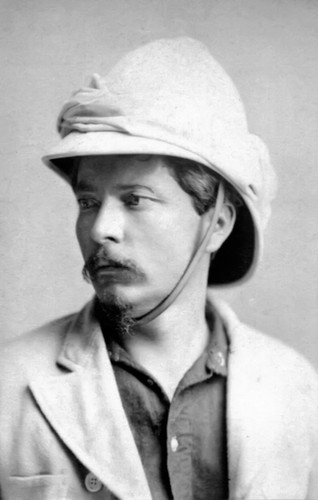
Henry M. Stanley

Personal Information

Born January 1, 1841
Died January 1, 1904 (63 years old)
Denbigh, United Kingdom of Great Britain and Ireland
Also known as: Henry M Stanley, Henry Morton Stanley
30 books
0.0 (0)
17 readers

Description

There is no description yet, we will add it soon.

Books

Newest First

The autobiography of Sir Henry Morton Stanley

0.0 (0)
1

Henry Morton Stanley is one of the most famous 19th century British explorers; he is best known for finding Dr. Livingstone and for his subsequent exploration in Africa and establishment of the Congo Free State. However, most people are not familiar with this illustrious man's early life or his private thoughts. As he stated in a letter to his wife: Were I suddenly to be called away, how little, after all, the world would know of me! My African life has been fairly described, but only as it affected those whom I served, or those who might be concerned. The inner existence, the me, what does anybody know of?Stanley's purpose in writing the autobiography was to inspire young boys growing up under such difficult circumstances as he himself experienced. Stanley's early life was painful and bleak -- an illegitimate child, he was sent to a workhouse at a young age because his family found him too much of a burden. There he was beaten and abused, but nevertheless received a fairly good education. While the circumstances of his childhood are certainly sad, it is amusing to hear this famous explorer's dramatic flair for self-pity: "...I was not sent into the world to be happy, nor to search for happiness." The first nine chapters are dedicated to Stanley's early life, and help to illuminate the events of his later distinguished career. He escaped the workhouse, travelled around the U.K. a bit, and then went off to sea and became a soldier in America.In the second part of the book, Stanley's wife edits together the threads of narrative contained in his later journals. In these chapters we get a more immediate account of the events as they happened than we get in his other books. Some of these stories are brief but telling, and his wife fills them out with notes afterwards: "Judge drunk; tried to kill his wife with hatchet; attempted three times. -- I held him down all night. Next morning, exhausted; lighted a cigar in parlour; wife came down -- insulted and raved at me for smoking in her house!" Other anecdotes are more detailed, as when Stanley tells of the Indian wars in Western America or when he describes his time on the Greek island of Syra. Regardless of how he recorded it in journals, Stanley always found adventure in his many years of wandering.For those who know something of Stanley's other work (such as In Darkest Africa, also available from The Narrative Press), his autobiography will be fascinating, and provides much different perspective from what we already know. Find out what was really going on in his mind as he journeyed through Africa in search of Dr. Livingstone: "Fatal Africa! One after another, travellers drop away. It is such a huge continent, and each of its secrets is environed by...the bitterness which each day heaps upon the poor white man's head, in that land of blackness..."So why, one must ask, did Stanley spend so much of his life exploring this "land of blackness"? Find out in this truly compelling autobiography.

Sir Henry Morton Stanley, confederate

0.0 (0)
1

"This section of Stanley's complete autobiography contains his exuberant, vivid recollections - an entertaining mix of fact and occasional fabrication - of commerce, manners, individuals, and attitudes in the late antebellum South, as well as his graphic, sobering descriptions of combat and captivity.". "Stanley recounts some of the details of his childhood torments to contrast them with the freedom he finds in America and his sonlike relationship to his mentor. He eventually moves to the Arkansas frontier, living on two plantations, and from there is swept up by the excitement of the war, enlisting with the "Dixie Grays," 6th Arkansas Infantry.". "Stanley's narrative then resembles the writing of a young Stephen Crane - gripping accounts of the battles of Belmont and Shiloh, his capture by the Union army, the deplorable prison conditions at Camp Douglas, and his ultimate defection to the northern side. His autobiography abruptly breaks off in August 1862, but through notes, an introduction, and an epilogue, Civil War historian Nathaniel Hughes achieves a rounded picture of this phase in Stanley's life, relating it to his career as a whole. Hughes interprets and clarifies Stanley's writing as needed, explaining edits imposed by his widow and verifying its authenticity of detail."--BOOK JACKET.