Henry Kissinger
Personal Information
Description
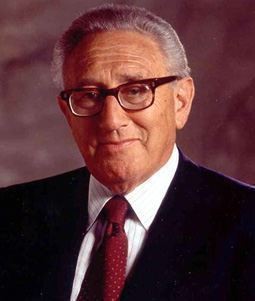
"Henry Alfred Kissinger (born Heinz Alfred Kissinger) is an American diplomat and political scientist. He served as National Security Advisor and later concurrently as United States Secretary of State in the administrations of presidents Richard Nixon and Gerald Ford. For his actions negotiating the ceasefire in Vietnam (though never realised), Kissinger received the 1973 Nobel Peace Prize under controversial circumstances, with two members of the committee resigning in protest. After his term, his advice has been sought by world leaders including subsequent U.S. presidents." - Wikipedia
Books
Crisis
Nadat een arts is aangeklaagd wegens foutief medisch handelen, komt zijn zwager hem en zijn gezin te hulp om de waarheid boven tafel te krijgen.
Ending the Vietnam War
The former Secretary of State describes America's involvement in Southeast Asia, the events of the war, the peace negotiations, the domestic unrest over the war, and the diplomats, politicians, military leaders, and others who became part of history.
Does America need a foreign policy?
The former Secretary of State under Richard Nixon argues that a coherent foreign policy is essential and lays out his own plan for getting the nation's international affairs in order.
The troubled partnership
Based on 3 lectures delivered at the Council on Foreign Relations in March, 1964.
Nuclear Security
"Concern about the threat posed by nuclear weapons has preoccupied the United States and presidents of the United States since the beginning of the nuclear era. Nuclear Security draws from papers presented at the 2013 meeting of the American Nuclear Society examining worldwide efforts to control nuclear weapons and ensure the safety of the nuclear enterprise of weapons and reactors against catastrophic accidents. The distinguished contributors, all known for their long-standing interest in getting better control of the threats posed by nuclear weapons and reactors, discuss what we can learn from past successes and failures and attempt to identify the key ingredients for a road ahead that can lead us toward a world free of nuclear weapons. The authors review historical efforts to deal with the challenge of nuclear weapons, with a focus on the momentous arms control negotiations between U.S. president Ronald Reagan and Mikhail Gorbachev. They offer specific recommendations for reducing risks that should be adopted by the nuclear enterprise, both military and civilian, in the United States and abroad. Since the risks posed by the nuclear enterprise are so high, they conclude, no reasonable effort should be spared to ensure safety and security."--Back cover.
Kissinger on Kissinger
"In a series of riveting interviews, America's senior statesman discusses the challenges of directing foreign policy during times of great global tension. As National Security Advisor to Richard Nixon, Henry Kissinger transformed America's approach to diplomacy with China, the USSR, Vietnam, and the Middle East, laying the foundations for geopolitics as we know them today. Nearly fifty years later, escalating tensions between the US, China, and Russia are threatening a swift return to the same diplomatic game of tug-of-war that Kissinger played so masterfully. Kissinger on Kissinger is a series of faithfully transcribed interviews overseen by the elder statesman's longtime associate, Winston Lord, which captures Kissinger's thoughts on the specific challenges that he faced during his tenure as national security advisor, his general advice on leadership and international relations, and stunning portraits of the larger-than-life world leaders of the era. The result is a frank and well-informed overview of US foreign policy in the first half of the 1970s--essential reading for anyone hoping to understand tomorrow's global challenges." --
The Kissinger transcripts
Now we have the unvarnished record of Henry Kissinger's high-stakes diplomacy during the Nixon years. Here are the transcripts, formerly classified "Top/Secret/Sensitive/Exclusive Eyes Only," of Kissinger's talks with Mao Zedong, Zhou Enlai, Deng Xiaoping, Leonid Brezhnev, Andrei Gromyko, Richard Nixon, Gerald Ford, George Bush, and others. When Henry Kissinger left the State Department in January 1977, he took with him "personal papers" as well as copies of government papers that he had worked on and reviewed, and attempted to close off all access to them until five years after his death. However, transcripts of some of his most important conversations found their way into other files, where National Security Archive staffers tracked them down. The Kissinger Transcripts offers an unparalleled view of American diplomacy as conducted by one of the most controversial Secretaries of State in modern U.S. history. With the record unmediated by Kissinger's spin, readers can begin to make up their own minds about the merits or flaws of a major effort to transform U.S. Cold War strategy.
