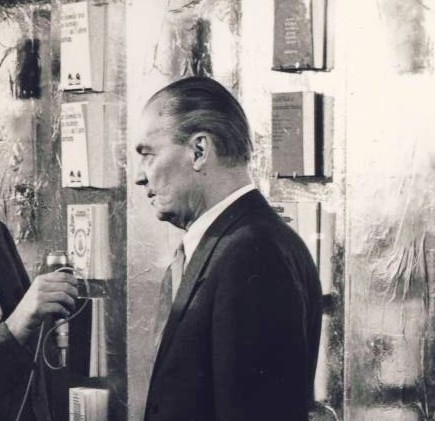
Hans Erich Nossack
Personal Information
Description
deutscher Schriftsteller
Books
An offering for the dead
"Hans Erich Nossack's work is a link between the titans of early 20th-century German fiction - Mann, Musil and Broch - and the later generation of Boll and Grass. An Offering for the Dead is a small, hard gem set in the crown of that tradition."--BOOK JACKET. ""It was raining again," the narrator of this haunting novel begins. He has survived some unmentionable, perhaps worldwide cataclysm - a biblical flood? nuclear war? - that has stripped him of his memory and most everything else. A woman's room, a notebook, a mirror, her comb - these artifacts in a void are all that remain: his first clues to the past, his own and the world's. His errant musings, reminiscent of the guilt-driven wanderings of Orestes, gradually piece together a history he must both remember and create in order to regain his identity, and, like Noah, repopulate a world in which he may be the only survivor."--BOOK JACKET. "In a delicately allusive prose that resonates with overtones of man's ancient past and darkly apocalyptic warnings, Nossack, like Joyce and Proust before him, exposes the mythical undercurrents of contemporary life. Past, present and future blend into an eternal return of archetypal figures whose stories transform human history into a timeless parable of creative memory and immemorial destruction."--BOOK JACKET.
Dem unbekannten Sieger
This novel by the once highly famous German author Hans Erich Nossack is a gem for times of trouble. Nossack, 1901-1977, writes about a father son meeting where they discuss a revolution. Some man helped highly intellectual revolutionaries, who, alas, had no clue how to use a canon in around 1919^^. Ah, that? The man, passing by, says, and shows them how to shoot. "Where to?" They show him. "This window?". He does it, and the revolution begins... The father son discussion, decades later, tells you all about this revolution. It is a highly intelligent novel with lots of surprises that gives a hint or many how to act in times of trouble when dictators or wanna-be dictators are endangering us. And this all in a wonderful novel. Nossack wrote in an "understated" way, so to speak, and by reading his books twice or more often you always learn something new. This is an underrated gem, highly recommended. I read the German original, and can just hope the American translation is as good as Nossack's German. He succeeds in giving the most "banal" every day words a shining, a new way to see the world. If you can find it second hand - get it.
Geben Sie bald wieder ein Lebenszeichen: Briefwechsel 1943-1956 (2 B ande). Bd. 1: Briefe Bd. 2: Kommentar
The end
The notion of ‘the end’ has long occupied philosophical thought. In light of the horrors of the twentieth century, some writers have gone so far as to declare the end of philosophy itself, emphasizing the impossibility of thinking after Auschwitz. In this book the distinguished philosopher Alain Badiou, in dialogue with Giovanbattista Tusa, argues that we must renounce ‘the pathos of completion’ and continue to think philosophically. To accept the atrocities of the twentieth century as marking the end of philosophy is intolerable precisely because it buys into the totalizing doctrines of the perpetrators. Badiou contends that philosophical thinking is needed now more than ever to counter the totalizing effects of globalized capitalism, which prescribes no objective for human life other than integration into its system, giving rise to a widespread sense of hopelessness and nihilism.