
UNITED KINGDOM AUTHOR · POLITICS AND GOVERNMENT · HISTORY
Ian Kershaw
Also known as: Ian Kershaw
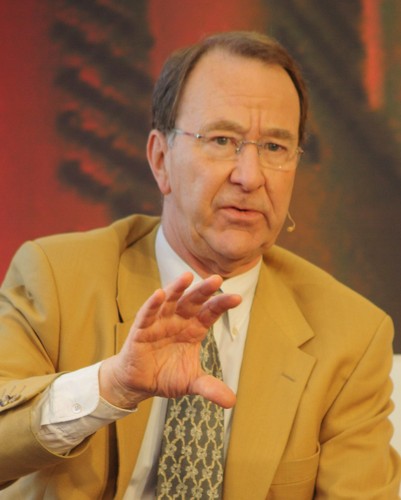
Sir Ian Kershaw (born 29 April 1943) is an English historian whose work has chiefly focused on the social history of 20th-century Germany. He is regarded by many as one of the world's foremost experts on Nazi Germany and noted for his biography of Adolf Hitler. Kershaw worked at the University of Sheffield. He has called German historian Martin Broszat an "inspirational mentor" who did much to shape his understanding of Nazi Germany. Kershaw has served as historical adviser on numerous BBC documentaries, notably The Nazis: A Warning from History and War of the Century.
'After three years, I believe that, with the present day, the struggle for German equal rights can be regarded as closed.
— from Hitler 1936-1945, 2000
Most acclaimed

Hitler (Profiles in Power)
1991
Hailed as the most compelling biography of the German dictator yet written, Ian Kershaw's Hitler brings us closer than ever before to the heart of its subject's immense darkness. From his illegitimate birth in a small Austrian village to his fiery death in a bunker under the Reich chancellery in Berlin, Adolf Hitler left a murky trail, strewn with contradictory tales and overgrown with self-created myths. One truth prevails: the sheer scale of the evils that he unleashed on the world has made him a symbol, like Stalin and Mao, of the unparalleled barbarism of the 20th century. Ian Kershaw's Hitler brings us closer than ever before to the character of the bizarre misfit in his thirty-year ascent from a Viennese shelter for the indigent to uncontested rule over the German nation that had tried and rejected democracy in the crippling aftermath of World War I. With extraordinary vividness, Kershaw recreates the settings that made Hitler's rise possible: the virulent anti-Semitism of prewar Vienna, the crucible of a war with immense casualties, the toxic nationalism that gripped Bavaria in the 1920s, the undermining of the Weimar Republic by extremists of the Right and the Left, the hysteria that accompanied Hitler's seizure of power in 1933 and then mounted in brutal attacks by his storm troopers on Jews and others condemned as enemies of the Aryan race. In an account drawing on many previously untapped sources, Hitler metamorphoses from an obscure fantasist, a "drummer" sounding an insistent beat of hatred in Munich beer halls, to the instigator of an infamous failed putsch and, ultimately, to the leadership of a ragtag alliance of right-wing parties fused into a movement that enthralled the German people. This volume, the first of two, ends with the promulgation of the infamous Nuremberg laws that pushed German Jews to the outer fringes of society, and with the march of the German army into the Rhineland, Hitler's initial move toward the abyss of war. - Publisher.
Hitler 1936-1945
2000
The climax and conclusion of one of the best-selling biographies of our time. In this volume, Ian Kershaw introduces Adolf Hitler at the apex of his power, idolized by millions of Germans for bringing the nation out of economic catastrophe. The Nazi party, the armed forces, the industrial cartels, and the civil servants are all "working towards the Führer." Meanwhile, Hitler is poised to realize his Mephistophelean vision : the subjugation of Europe under the Thousand Year Reich and, in the process, the annihilation of the Jews. For three years, Hitler and his relentless armies pluge the European continent into a bloodbath, as German soldiers, accompanied by fanatical SS units, slaughter conquered troops and civilians alike. Then, as Allied might prevails, Kershaw reveals a Hitler transformed from invincible warlord to desperate gambler, ultimately bringing destruction to his country and ending his life in a bunker under the ruins of Berlin. This book is based on immense research, including the use of many previously untapped sources. - Publisher.
The Nazi dictatorship
1985
"As an exploration of the interpretational issues that eddy around the Third Reich, Ian Kershaw's Nazi Dictatorship has become a classic account. But if its core remains unchanged, its contents must necessarily reflect both new public controversies and the onrush of fresh research. In the forth edition there are many changes of detail to accommodate this need and substantial rewritings of two chapters. No subject among those dealt with in earlier editions has been the subject of such intensive research - and bringing such rapidly changing interpretations - as 'Hitler and the Jews' and, accordingly, that chapter has been considerably changed. The book's final chapter has also undergone significant revision, to take account of the 'Goldhagen phenomenon', and also to glance back over the changing trends of research on the Third Reich as, with the passing of the generations, Hitler and his regime themselves pass into history."--Jacket.