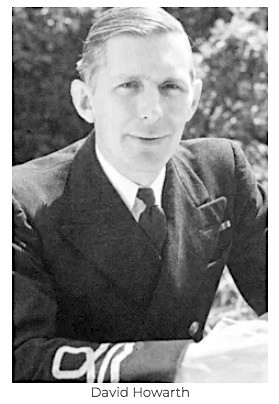
David Howarth
Description
David Armine Howarth (28 July 1912 – 2 July 1991) was a British naval officer, boatbuilder, historian and author.
Books
We Die Alone
Jan Baalsrud's escape from Nazi-occupied arctic Norway is one of the most exciting escape narratives to emerge from the challenges and miseries of World War II chronicles . In March 1943, a team of expatriate Norwegian commandos sailed from northern England for Nazi-occupied arctic Norway to organize and supply the Norwegian resistance. But they were betrayed and the Nazis ambushed them. Only one man survived - Jan Baalsrud. This is the incredible and gripping story of his escape. Frostbitten and snowblind, pursued by the Nazis, he dragged himself on until he reached a small arctic village. He was near death, delirious, and a virtual cripple. But the villagers, at mortal risk to themselves, were determined to save him, and - through impossible feats - they did. We Die Alone is an astonishing true story of heroism and endurance. Like Salvomir Rawicz's, The Long Walk, it is also an unforgettable portrait of the determination of the human spirit.
Images of rule
Images of Rule offers a fascinating, authoritative, and highly readable account of the vital role the visual arts played in Great Britain during the Tudor and early Stuart monarchies. David Howarth examines the intersection of art and political power in Great Britain between the accession of the Tudors and the outbreak of civil war. The images of the Royal court constitute the raw material from which he fashions a cultural and political history of Renaissance Britain. Howarth concentrates on the public uses and political exploitation of Renaissance art, rather than its quality or the creative process behind it. He argues that the English ruling class used and manipulated works of art in order to reinforce its own power. Portraiture, architecture, the decorative arts, and spectacle all served to preserve England's political status quo.
Trafalgar the Nelson Touch
The battle of Trafalgar decided a nation's fate, and this fascinating account tells the story of that crucial confrontation as it has never been told before. Many people know the facts about Nelson's death, but far less of the battle in which he died: a single afternoon's fighting that forever ended Napoleon's hope of invading England.
Ernesto Laclau
"Ernesto Laclau has blazed a unique trail in political theory and philosophy since the early 1970s. In so doing, he has articulated a range of philosophical and theoretical currents into a coherent alternative to mainstream models and practices of conducting social and political science"--
The French road to European monetary union
"The logic behind European monetary cooperation and integration can only be understood through an examination of French efforts to maximize their monetary power in relation to Germany and America. This book provides a detailed and historically informed study of the motives and economic and political attitudes that shaped French policy on European developments over a thirty-year period, from the collapse of the International Monetary System in the late 1960s and early 1970s through to the start of EMU on 1 January 1999. French governments sought to reduce the impact of American and German monetary policies on the French economy and maximize their influence over the formulation of these policies. However, given the asymmetry of European exchange rate mechanisms and the 'sound money' bias of the EMU project, the willingness and ability of French governments to participate in these arrangements depended on their pursuit of low inflationary economic policies."--BOOK JACKET.