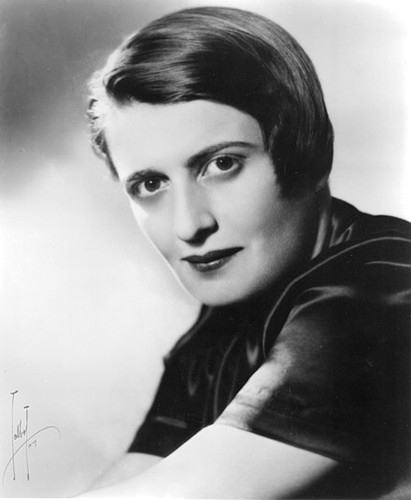
Ayn Rand
Personal Information
Description
Alice O'Connor (born Alisa Zinovyevna Rosenbaum;[a] February 2, [O.S. January 20] 1905 – March 6, 1982), better known by her pen name Ayn Rand (/aɪn/), was a Russian-American writer and philosopher. She is known for her fiction and for developing a philosophical system she named Objectivism. Born and educated in Russia, she moved to the United States in 1926. She wrote a play that opened on Broadway in 1935. After two early novels that were initially unsuccessful, she achieved fame with her 1943 novel, The Fountainhead. In 1957, Rand published her best-known work, the novel Atlas Shrugged. Afterward, until her death in 1982, she turned to non-fiction to promote her philosophy, publishing her own periodicals and releasing several collections of essays. Rand advocated reason as the only means of acquiring knowledge; she rejected faith and religion. She supported rational and ethical egoism and rejected altruism. In politics, she condemned the initiation of force as immoraland opposed collectivism, statism, and anarchism. Instead, she supported laissez-faire capitalism, which she defined as the system based on recognizing individual rights, including property rights. Although Rand opposed libertarianism, which she viewed as anarchism, she is often associated with the modern libertarian movement. In art, Rand promoted romantic realism. She was sharply critical of most philosophers and philosophical traditions known to her, except for Aristotle, Thomas Aquinas and classical liberals. Rand's fiction received mixed reviews from literary critics.[ Although academic interest in her ideas has grown since her death, academic philosophers have generally ignored or rejected her philosophy because of her polemical approach and lack of methodological rigor.Her writings have influenced some libertarians and conservatives politically. The Objectivist movement attempts to spread her ideas, both to the public and in academic settings
Books
Capitalism
The Journals of Ayn Rand
Rarely has a writer and thinker of the stature of Ayn Rand afforded us access to her most intimate thoughts and feelings. From Journals of Ayn Rand, we gain an invaluable new understanding and appreciation of the woman, the artist, and the philosopher, and of the enduring legacy she has left us. Rand comes vibrantly to life as an untried screenwriter in Hollywood, creating stories that reflect her youthful vision of the world. We see her painful memories of communist Russia and her struggles to convey them in We the Living. Most fascinating is the intricate, step-by-step process through which she created the plots and characters of her two masterworks, The Fountainhead and Atlas Shrugged, and the years of painstaking research that imbued the novels with their powerful authenticity. Complete with reflections on her legendary screenplay concerning the making of the atomic bomb and tantalizing descriptions of projects cut short by her death, Journals of Ayn Rand illuminates the mind and heart of an extraordinary woman as no biography or memoir ever could. On these vivid pages, Ayn Rand lives.
The Fountainhead
The Fountainhead is a 1943 novel by Ayn Rand. It was Rand's first major literary success and brought her fame and financial success. More than 6.5 million copies of the book have been sold worldwide.
The Art of Fiction
Introduction to Objectivist Epistemology
Today man's mind is under attack by all the leading schools of philosophy. We are told that we cannot trust our senses, that logic is arbitrary, that concepts have no basis in reality. Ayn Rand opposes that torrent of nihilism, and she provides the alternative in this eloquent presentation of the essential nature--and power--of man's conceptual faculty. She offers a startlingly original solution to the problem that brought about the collapse of modern philosophy: the problem of universals. This brilliantly argued, superbly written work, together with an essay by philosophy professor Leonard Peikoff, is vital reading for all those who seek to discover that human beings can and should live by the guidance of reason.
Letters of Ayn Rand
The publication of the letters of Ayn Rand is a cause for celebration, not only among the countless millions of Ayn Rand admirers the world over, but also among all those interested in the key political, philosophical, and artistic issues of our century. For there is no separation between Ayn Rand the vibrant, creative woman and Ayn Rand the intellectual dynamo, the rational thinker, who was also a passionately committed champion of individual freedom. These remarkable letters begin in 1926, with a note from the twenty-year-old Ayn Rand, newly arrived in Chicago from Soviet Russia, an impoverished unknown determined to realize the promise of the land of opportunity. They move through her struggles and successes as a screenwriter, a playwright, and a novelist, her sensational triumph as the author of The Fountainhead and Atlas Shrugged, and her eminence as founder and shaper of Objectivism, one of the most challenging philosophies of our time. They are written to such famed contemporaries as Cecil B. DeMille, Frank Lloyd Wright, H.L. Mencken, Alexander Kerensky, Barry Goldwater and Mickey Spillane. There are letters to philosophers, priests, publishers, and political columnists; to her beloved husband, Frank O' Connor; and to her intimate circle of friends and her growing legion of followers. Her letters range in tone from warm affection to icy fury, and in content from telling commentaries on the events of the day to unforgettably eloquent statements of her philosophical ideas. They are presented chronologically, with explanatory notes by Michael S. Berliner, who identifies the recipients of the letters and provides relevant background and context. Here is a chronicle that captures the inspiring drama of a towering literary genius and seminal thinker, and -- often day-by-day -- her amazing life. - Back cover.
For the New Intellectual
This is Ayn Rand's challenge to the prevalent philosophical doctrines of our time and the "atmosphere of guilt, of panic, of despair, of boredom, and of all-pervasive evasion" that they create. One of the most controversial figures on the intellectual scene, Ayn Rand was the proponent of a moral philosophy--and ethic of rational self-interest--that stands in sharp opposition to the ethics of altruism and self-sacrifice. The fundamentals of this morality--"a philosophy for living on Earth"--are here vibrantly set forth by the spokesman for a new class, For the New Intellectual.
Out of this world
SOS!...SOS!...SOS! The first humans to set foot on Venus make a fatal discovery. The strange creature appears to be growing — into something eerily familiar! The air is leaking from a Martian city's protective dome. To escape death, all the people flee into space... All but one. A space ship is crippled beyond repair. Will the crew remain lost in space forever? Of if anyone answers their distress call — will it be friend or foe? Meet the fearless inhabitants of alien worlds. Travel with bold explorers who dare to face the perils of unknown planets. Strap yourself in for a ride into adventure. You're in for a time that is Out of This World!
Atlas Shrugged (Centennial Ed. HC)
The year 2005 marks Ayn Rand's Centennial Year.The astounding story of a man that said that he would stop the motor of the world-and did. Tremendous in scope, breathtaking in its suspense, Atlas Shrugged is unlike any other book you have ever read.“A writer of great power. She has a subtle and ingenious mind and the capacity of writing brilliantly, beautifully, bitterly.”-The New York Times
We the living
This book is about a young woman named Kira Argounova who is trying to live during the Soviet takeover of Russia. Kira wants to be an engineer, but the lack of freedom in Soviet Russia oppresses her. She becomes involved in a love triangle with Comrade Taganov and the mysterious Leo. The book is a philosophical exposition of the crushing nature of the collectivist philosophy, which oppresses the producers. “Can you sacrifice a few? When those few are the best? Deny the best its right to the top--and you have no best left. What are your masses but millions of dull, shriveled, stagnant souls that have no thoughts of their own, no dreams of their own, no will of their own, who eat and sleep and chew helplessly the words others put into their brains? And for those you would sacrifice the few who know life, who are life? I loathe your ideals because I know no worse injustice than the giving of the undeserved. Because men are not equal in ability and one can't trust them as if they were.”
