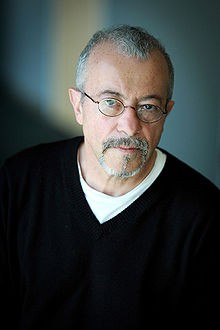
Andrei Codrescu
Personal Information
Description
Andrei Codrescu is a Romanian-born American poet, novelist, essayist, screenwriter, and commentator for National Public Radio. - Wikipedia
Books
Wakefield
Wakefield is a divorced, dispirited motivation speaker. He's Mr. Average until the Devil makes a deal with him.
Casanova in Bohemia
"In his national bestseller The Blood Countess, Andrei Codrescu brought to life the bloodthirsty royal Elizabeth Bathory, who embodied nearly all the contradictions of the seventeenth century. Now he depicts the astonishing life of the legendary Casanova, as the old adventurer relives his life while writing his memoirs in a provincial Bohemian castle at the end of the eighteenth century. Far from being defeated by age, Casanova delights in the maidservants, reacts with intellectual vigor to the unfolding of the French Revolution, and collaborates with Mozart on Don Giovanni. Long considered the rhapsodist of an age of aristocratic mirth, scandal, and innumerable affairs, Casanova was also a first-rate intellect who corresponded and argued with Voltaire and Rousseau. His published work, besides the celebrated History of My Life, includes a multivolume fantasy fiction novel that predates and anticipates Jules Verne; translations of Italian classics into French; and a number of plays that were produced on the great stages of Europe.". "In Codrescu's retelling of the Casanova legend, readers are introduced to an age far less inhibited than our own, and far more interesting in its vices. At once a libertine, a defender of women, a reactionary, a revolutionary, a brilliant observer, and a visionary, Casanova was a man ahead of his time both in thought and in action. Finally, in this inventive and absorbing work, Casanova is given due credit for his writings, his philosophies, and, of course, for the amorous magic that has been made known to so many."--BOOK JACKET.
Ay, Cuba!
During a Historic visit to Cuba - on the eve of Pope John Paul ll's own trip - National Public Radio's Andrei Codrescu and photographer David Graham turned an unsparing but compassionate gaze upon Cuba. Registering the architecture, the bizarre two-tier economy of peso and dollar, the revivals of both Catholicism and the Afro-Cuban religion of santeria, and the sexual and social mores of a post-cold war communist society, Codrescu's words and Graham's photographs offer a vision of Cuba's brutally stark and sometimes-tragic reality, as seen through the fascinating prism of Codrescu's own eccentric genius. Through interviews with Cuban architects, writers, hustlers, prostitutes, and common working folk, Ay, Cuba! reveals a passionate society deeply in conflict with itself. This is not a cold, cross-sectioned study of Cuba, but rather a highly personal, human portrait of a proud, musical, smart, and sexy people.
Hail Babylon!
Andrei Codrescu, longtime observer and commentator on things odd and American, takes us on a personal tour through our withered yet increasingly alluring urban landscapes. Our trusted, if sometimes irreverent, guide visits New York, Baltimore, New Orleans, Little Rock, San Antonio, Albuquerque, Las Vegas, San Francisco, and Portland, Oregon (and points beyond, including Oxford, Mississippi; Salem, Oregon; and California's seaside jewel, La Jolla). Codrescu - while recognizing that cities are under attack by the political right, buffeted by the ever-proliferating prefab town house, beset by crime, and questioned from within - shows us that they are also still flourishing, in fact becoming invaluable models of multiethnic, multicultural living. Taken together, these striking urban portraits sound an extremely hopeful message as Codrescu astutely considers "the city as wilderness," a place where the ecology of human desires and the work of the mind find their optimum conditions.
The Blood Countess
Countess Elizabeth Bathory of Hungary (1560-1613) was beautiful, well educated in the best traditions of the Renaissance, and wealthy beyond measure. Upon assuming her seat of power at the age of sixteen, the Countess set out upon a course of revelry and debauchery, aided by her spiritual adviser, Darvulia, and by her faithful bevy of overwrought maids. Eventually, time and an excess of increasingly bizarre pleasures led the Countess to fear the loss of her beauty. She was advised by her witches to take baths in the blood of virgins to regenerate her body. A long procession of young girls were "chosen" to spend the night with Elizabeth. Six hundred and fifty young women are said to have died in the Countess's castles. Countess Elizabeth Bathory's direct descendant, Drake Bathory-Kereshtur, is a Hungarian emigre living in New York near the end of the twentieth century. He considers himself a failure at life. His relationships with women have been disasters. He is haunted by the Hungary of his youth, which he had to flee during the Hungarian revolution of 1956. After the collapse of Communism, he returned to Hungary to find his youth, but found instead something a lot more horrifying: the pervasive presence of his ancestor, Countess Bathory. When he returns to the United States, he confesses to a hideous crime before a New York magistrate. This exquisite novel is told through Drake's eyes, as he searches for his roots and comes to terms with this gruesome part of his family history.
Road scholar
Inspired by the classic Kerouac tradition of mixing writing with wanderlust, poet and National Public Radio regular Andrei Codrescu chronicles his own picaresque trek through America in this raucous, resonant memoir. A New York Times Notable Book of the Year in Hyperion hardcover.
The disappearance of the outside
"This cultural-literary-social critique examines the paradoxes of repression and artistic freedom in both totalitarian and democratic societies. Beginning with his Stalinist childhood and later exile from a national-communist state, Codrescu considers the status of oppositional writers as diverse as Tristan Tzara, the Dadaist; Gabriel Garcia Marquez, the magical realist; Milan Kundera, the acerbic rationalist; Czeslaw Milosz, the Catholic dissident; and William Burroughs, the technodystopian. This crucial work calls for an imaginative reach beyond a benign reality founded in technology and commercialism, by striving for a better, evolutionary existence through art."--BOOK JACKET.
Thomas Mann
Jealous witness
Born in Romania, Andrei Codrescu understands the spirit of his adopted New Orleans, a city that steadfastly “refuses to conform to anything that is known about it.” When Hurricane Katrina blew through, the New Orleans landscape changed yet again and Codrescu, like his hero, “tolstoy exhausted having just written russia,” recorded it all. His “Maelstrom: Songs of Storm and Exile,” performed by the New Orleans Klezmer AllStars on the accompanying CD, form the heart of this collection honoring the dispossessed and the artists, lovers, and cultural icons who have influenced his life. As John Freeman wrote in the Minneapolis Star Tribune, Codrescu’s poetry sounds like what would happen if “Tom Waits and Muddy Waters collaborated on a book of verse” and shows why this celebrated National Public Radio commentator is such a memorable and fearless cultural critic.
The posthuman Dada guide
"The Posthuman Dada Guide is an impractical handbook for practical living in our posthuman world - all by way of examining the imagined 1916 chess game between Tristan Tzara, the daddy of Dada, and V.I. Lenin, the daddy of communism. This epic game at Zurich's Cafe de la Terrasse - a battle between radical visions of art and ideological revolution - lasted for a century and may still be going on, although communism appears dead and Dada stronger than ever. As the poet faces the future mass murderer over the chessboard, neither realizes that they are playing for the world. Taking the match as metaphor for two poles of twentieth- and twenty-first-century thought, politics, and life, Andrei Codrescu has created his own brilliantly Dadaesque guide to Dada - and to what it can teach us about surviving our ultraconnected present and future. Here dadaists Duchamp, Ball, and von Freytag-Loringhoven and communists Trotsky, Radek, and Zinoviev appear live in company with later incarnations, including William Burroughs, Allen Ginsberg, Gilles Deleuze, and Newt Gingrich. The Posthuman Dada Guide is arranged alphabetically for quick reference and (some) nostalgia for order, with entries such as "eros (women)," "internet(s)," and "war." Throughout, it is written in the belief "that posthumans lining the road to the future (which looks as if it exists, after all, even though Dada is against it) need the solace offered by the primal raw energy of Dada and its inhuman sources.""--Jacket.
