Discover

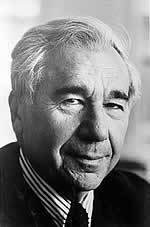
Alfred Kazin

Personal Information

Born June 5, 1915
Died June 5, 1998 (83 years old)
Brooklyn, United States
Also known as: A. Kazin
26 books
3.3 (3)
35 readers

Description

Alfred Kazin was an American writer and literary critic, many of whose writings depicted the immigrant experience in early twentieth century America. - Wikipedia

Books

Newest First

Writing Was Everything (Repr of 1995 Ed)

0.0 (0)
0

A deft blend of autobiography, history, and criticism that moves from New York in the 1930s to wartime England to the postwar South, Writing Was Everything emerges as a reaffirmation of literature in an age of deconstruction and critical dogma. In his encounters with books, Kazin shows us how great writing matters and how it involves us morally, socially, and personally on the deepest level. Whether reflecting on modernism, southern fiction, or black, Jewish, and New Yorker writing, or sharing anecdotes about Richard Wright, Saul Bellow, and John Cheever, he gives a penetrating, moving account of literature observed and lived. In his life as a critic, Kazin personifies the lesson that living and writing are necessarily intimate.

God and the American Writer

0.0 (0)
2

The author of On Native Grounds sheds new light on the meaning of God in the life and works of American writers, from the New England Calvinists, through the Civil War, to the novels of William Faulkner.

A Lifetime Burning in Every Moment

0.0 (0)
0

While leading an active life, Kazin has faithfully kept diaries from the late 1930s up to the present. A Lifetime Burning in Every Moment offers readers the best of thousands of pages of his journals, comprising an extraordinary picture of intellectual, social, political, and even celebrity life - including such figures as Bernard Berenson, Josephine Herbst, Saul Bellow, Bernard Malamud, Hannah Arendt - during the past five and a half decades. Kazin candidly reflects on his four marriages, his feelings about the Holocaust, his criticism of American society, the pleasure and stimulation of reading good writers (Simone Weil, Ignazio Silone, Joseph Conrad, and Saul Bellow, among others), his need to pray, his travels abroad and within the United States, and more.

An American procession

0.0 (0)
1

In this illuminating study of the "crucial century" (1830-1930), Alfred Kazin views the major figures in American writing, beginning when Ralph Waldo Emerson left the church and inspired a national literature on the basis of a religious revolution, and ending with the triumph of modernism - Eliot, Pound, Hemingway, Fitzgerald - and with the revelation after World War I of the "postponed power" of those who had been modern before their time: Henry Adams, Melville, Whitman, Dickinson.

New York Jew

3.0 (1)
1

Alfred Kazin, one of the central figures of America's intellectual life in the 20th century, takes us into his own life and times. His autobiography encompasses, within a single large, fluent narrative, a personal story openly told; an inside look at New York's innermost intellectual circles; and brilliantly astute observations of the literary accomplishments, atmosphere, and fads of the 1940's, '50's, and '60's in the context of America's shifting political gales. Every image and incident is filtered through Kazin's own strong sensibility'powerfully informed by his Russian immigrant-socialist background, by the resurgent sense of his own Jewishness, and by the "raw power, mass, and volume" of the city he is unfailingly drawn to. New York is itself a central character in his book as in his life'a life superbly told, in a book that will be of fascination to everyone interested in American writing and writers.

The walker and the city

4.0 (1)
8

The acclaimed story of a soul awakening to the ecstasy of the senses, the power of language, and the meaning of existence. Kazin's memorable description of his life as a young man as he makes the journey from Brooklyn to "Americanca"--The larger world that begins at the other end of the subway in Manhattan. A classic portrayal of the Jewish immigrant culture of the 1930s.

Contemporaries

0.0 (0)
0

Includes essays on Herman Melville and Moby Dick, Henry David Thoreau, Stephen Crane, Theodore Dreiser, Gertrude Stein, Sinclair Lewis, John P. Marquand, William Faulkner, Graham Greene, John O'Hara, Nelson Algren, James Agee, Lawrence Durrell, Dylan Thomas, Bernard Malamud, Saul Bellow, J.F. Powers, Robert Lowell, J.D. Salinger, Brendan Behan, Norman Mailer, Truman Capote, James Baldwin, Philip Roth, Sholom Aleichem, Thomas Mann, and Albert Camus, among others. Includes five essays on Sigmund Freud.

Specimen days

3.0 (1)
8

Published in 1882, Whitman's uniquely revealing impressions of the people, places, and events of his time, principally the Civil War era and its aftermath, offer a rare excursion into the mind and heart of one of America's greatest poets. His intimate observations and reflections have profoundly deepened understanding of 19th-century American life.

Bright Book of Life

0.0 (0)
1

"In his first book devoted exclusively to narrative fiction, America's most original and controversial literary critic and legendary Yale professor writes trenchantly about fifty-two masterworks spanning the Western tradition"-- Bloom offers meditations on forty-eight essential works of fiction that span the Western canon. While considering each novels' strengths and shortcomings, he also explains where and why he differs with other critics' assessments. In doing so, he guides readers to a new understanding of the novels, and in the importance and power of fiction. -- adapted from jacket and from reviews on Amazon
