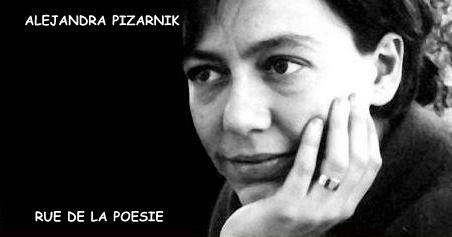
Alejandra Pizarnik
Personal Information
Description
There is no description yet, we will add it soon.
Books
From the forbidden garden
"The letters in this collection form a self-portrait of one of the greatest Latin American poets of the twentieth century. They display her insight, the forcefulness of her language, and humorous use of wordplay and puns, offering us a much more intimate portrait than any biographer could achieve. We see Pizarnik's process of self-discovery and artistic exploration in her literary life, as well as the development of her work in progress." "This selection of thirty letters and two postcards, written between September 2, 1969, and September 12, 1972, includes most of Pizarnik's correspondence with Spanish writer-editor-artist Antonio Beneyto. From these informative letters we learn about her influences, the artists, poets, and writers she preferred, and her reactions to them. She collaborated on various projects and cultivated many literary and personal ties with writers of the stature of Julio Cortazar, Olga Orozco, Octavio Paz, Pieyre de Mandiargues, Silvina Ocampo, and Luisa Sofovich, among others." "Although the corpus of Pizarnik's writing available in English has expanded in the last twelve years, it is still far from adequate. This is the first time that a selection of letters from Alejandra Pizarnik to Antonio Beneyto has been published in English. The translators hope that this volume will serve English-speaking audiences as a new bridge to her work."--Jacket.
The Oxford Book of Gothic Tales
Part 1 Beginnings: "Sir Bertrand - A Fragment" (1773), Anna Laetitia Aiken "The Poisoner of Montremos" (1791), Richard Cumberland "The Friar's Tale" (1792), Anonymous "Raymond - A Fragment (1799), "Juvenis" "The Parricide Punished" (1799), Anonymous "The Ruins of the Abbey of Fitz-Martin" (1801), Anonymous "The Vindictive Monk, or The Fatal Ring" (1802), Isaac Crookenden. Part 2 The 19th century: "The Astrologer's Prediction or the Maniac's Fate" (1826), Anonymous "Andreas Vesalius the Anatomist" (1833), Petrus Borel "Lady Eltringham or The Castle of Ratcliffe Cross" (1836), J. Wadham "[The Fall of the House of Usher]( (1839), Edgar Allan Poe "A Chapter in the History of the Tyrone Family" (1839), Sheridan Le Fanu "[Rappacini's Daughter]( (1844), Nathaniel Hawthorne "Selina Sedilia" (1865), Bret Harte "Jean-Ah Poquelin" (1875), George Washington Cable "Olalla" (1885), Robert Louis Stevenson "Barbara of the House of Grebe" (1891), Thomas Hardy "Bloody Blanche" (1892), Marcel Schwob "The Yellow Wall-Paper" (1892), Charlotte Perkins Stetson "[The Adventure of the Speckled Band]( (1892), Arthur Conan Doyle "Hurst of Hurstcote" (1893), E. Nesbit. Part 3 The 20th century: "A Vine on the House" (1905), Ambrose Bierce "Jordan's End" (1923), Ellen Glasgow "The Outsider" (1926), H.P. Lovecraft "[A Rose for Emily]( (1930), William Faulkner "A Rendezvous in Averoigne" (1931), Clark Ashton Smith "The Monkey" (1934), Isak Dinesen "Miss De Mannering of Asham" (1935), F.M. Mayor "The Vampire of Kaldenstein" (1938), Frederick Cowles "Clytie" (1941), Eudora Welty "Sardonicus" (1961), Ray Russell "The Bloody Countess" (1968), Alejandra Pizarnik "The Gospel According to Mark" (1970), Jorge Luis Borges "The Lady of the House of Love" (1979), Angela Carter "Secret Observations of the Goat-Girl" (1988), Joyce Carol Oates "Blood Disease" (1988), Patrick McGrath "If You Touched My Heart" (1991), Isabel Allende.
A tradition of rupture
"Since the publication of her 1955 debut poetry collection, The Most Foreign Country, Alejandra Pizarnik has captivated the imaginations of many of Latin America's most celebrated twentieth-century writers, from Octavio Paz and Julio Cortázar to Roberto Bolaño and Raúl Zurita. Over the last several years, the majority of Pizarnik's poetry has been translated into English, garnering enormous acclaim in the U.S. and abroad, yet her extraordinary critical writings--including commentaries on figures such as Artaud, Borges, Breton, Michaux, and Pessoa, as well as intimate accounts of her own working methods--remain almost entirely unknown outside the Spanish-speaking world. A Tradition of Rupture makes these writings available to English-speaking readers for the first time, offering indispensable insight into the range of Pizarnik's reading and the principle influences on her poetics. The works collected in this volume also provide a rare glimpse of the famously introverted poet in her capacity as public intellectual and critic, revealing a voracious intelligence turned outward toward the world in vital dialogue with the words of others."--supplied by publisher.