Discover

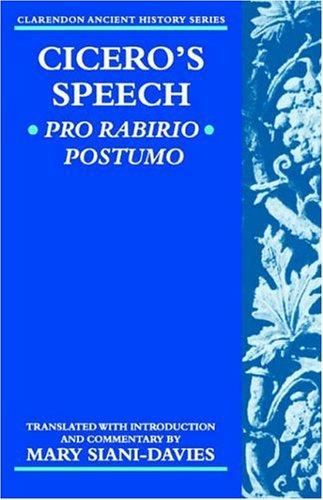
Pro Rabirio Postumo

Minsik readers
0.0
0 ratings
Other platforms
0.0
0 ratings
282
PAGES
~4h 42min
READING TIME
English
LANGUAGE
Clarendon Press 3 views
ISBN
0199240965
3 views
Minsik want to read: 0
Minsik reading: 0
Minsik read: 0
Open Library want to read: 0
Open Library reading: 0
Open Library read: 0

About Author

Cicero

Marcus Tullius Cicero (pronounced /ˈsɪsɨroʊ/; Classical Latin: [ˈkikeroː]; January 3, 106 BC – December 7, 43 BC) was a Roman philosopher, statesman, lawyer, political theorist, and Roman constitutionalist. He came from a wealthy municipal family of the equestrian order, and is widely considered one of Rome's greatest orators and prose stylists. He introduced the Romans to the chief schools of Greek philosophy and created a Latin philosophical vocabulary (with neologisms such as humanitas, qualitas, quantitas, and essentia) distinguishing himself as a linguist, translator, and philosopher. An impressive orator and successful lawyer, Cicero thought that his political career was his most important achievement. Today, he is appreciated primarily for his humanism and philosophical and political writings. His voluminous correspondence, much of it addressed to his friend Atticus, has been especially influential, introducing the art of refined letter writing to European culture. Cornelius Nepos, the 1st-century BC biographer of Atticus, remarked that Cicero's letters contained such a wealth of detail "concerning the inclinations of leading men, the faults of the generals, and the revolutions in the government" that their reader had little need for a history of the period. Cicero's speeches and letters remain some of the most important primary sources that survive on the last days of the Roman Republic. During the chaotic latter half of the first century B.C. marked by civil wars and the dictatorship of Gaius Julius Caesar, Cicero championed a return to the traditional republican government. However, his career as a statesman was marked by inconsistencies and a tendency to shift his position in response to changes in the political climate. His indecision may be attributed to his sensitive and impressionable personality; he was prone to overreaction in the face of political and private change. "Would that he had been able to endure prosperity with greater self-control and adversity with more fortitude!" wrote C. Asinius Pollio, a contemporary Roman statesman and historian. Cicero became an enemy of Mark Antony, attacking him in a series of speeches. He was proscribed an enemy of the state by the Second Triumvirate and subsequently murdered in 43 BC. Source: Wikipedia

Description

"Cicero's speech delivered in the mid '50s BC in defence of Gaius Rabirius Postumus was the last of a series of trials which followed the restoration of the Egyptian king, Ptolemy XII Auletes, to his throne. This had been secured through the services of a Roman army which had acted on the promise of a huge illegal bribe. Rabirius Postumus, a leading financier, had travelled to Egypt to collect the promised money acting on behalf of himself and other creditors of the king, including Caesar and Pompey. On his return political opponents placed him, among others, on trial. This book provides a translation of the speech and a commentary in English of a work which is a major source for Roman and Egyptian history at a time of the late Republic. The introduction furnishes a review of the events surrounding the trial as well as a significant reappraisal of the career of Rabirius Postumus who is shown to be a major actor on the Roman political stage. The commentary discusses historical and legal points and also includes a number of important textual emendations. This book is intended for academics and post-graduate students interested in the study of Cicero and in Late Republican Roman literature, especially Roman historians, those interested in Ptolemaic Egypt, and Roman law."--Jacket.

Detailed Ratings

0.0Emotional Impact
No ratings yet
0.0Intellectual Depth
No ratings yet
0.0Writing Quality
No ratings yet
0.0Rereadability
No ratings yet
0.0Pacing
No ratings yet
0.0Readability
No ratings yet
0.0Plot Complexity
No ratings yet
0.0Humor
No ratings yet