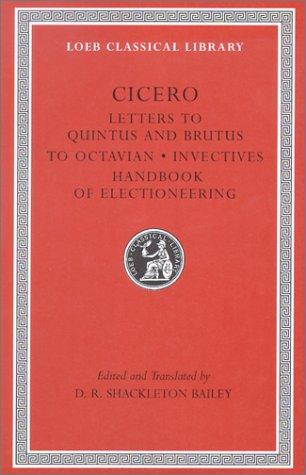
Letters to Quintus and Brutus ; Letter fragments ; Letter to Octavian ; Invectives ; Handbook of electioneering
More from Loeb Classical Library
#13
Aeschylus
#59
Letters, and Panegyricus
#267
The Geography of Strabo
#280
De architectura
#331
Ammianus Marcellinus
#397
Meteorologica
#402
Alexandrian, African and Spanish wars
#482
Hippocrates
Pausanias Description of Greece
Xenophon
Minor works ...
Appian's Roman history
Enquiry into plants
The lives of the sophists
The Homeric hymns and Homerica
Ἀνάβασις
Livy, with an English translation
Quintus Curtius
De inventione
Ad C. Herrenium de ratione dicendi
Description of Greece
Historical miscellany
The works of the Emperor Julian
Plutarch's Moralia in fifteen volumes
The odes of Pindar, including the principal fragments
Letters to Quintus and Brutus ; Letter fragments ; Letter to Octavian ; Invectives ; Handbook of electioneering
The speeches of Aeschines
The Stratagems
The Life. Against Apion
Questions and answers on Exodus
The Roman antiquities of Dionysius of Halicarnassus, with an English translation by Earnest Cary, Ph. D., on the basis of the version of Edward Spelman
Apology
The orator's education
Generation of animals, with an English translation by A.L. Peck
Minsik readers
0.0
0 ratings
Other platforms
0.0
0 ratings
483
PAGES~8h 3min
READING TIMEEnglish
LANGUAGEDescription
"Cicero had an affectionate relationship with his only brother, Quintus, down to the closing years of their lives. The letters from Cicero to him in this collection offer an intimate look at their world. Cicero's close friendship with the intensely intellectual Brutus was signalized by Cicero's dedication of his prized Orator to Brutus. The correspondence between the two collected here dates from the spring and summer of 43, and it conveys some of the drama of the period following the assassination of Julius Caesar."--BOOK JACKET.
Detailed Ratings
0.0Emotional Impact
No ratings yet
0.0Intellectual Depth
No ratings yet
0.0Writing Quality
No ratings yet
0.0Rereadability
No ratings yet
0.0Pacing
No ratings yet
0.0Readability
No ratings yet
0.0Plot Complexity
No ratings yet
0.0Humor
No ratings yet