
UNITED STATES AUTHOR · HISTORY · CIVILIZATION
William Hardy McNeill
Also known as: William H. McNeill, William Hardy McNEILL
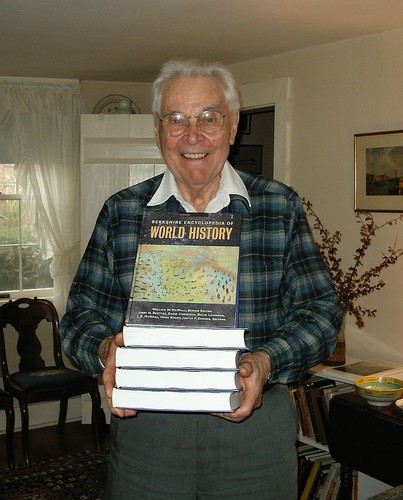
William Hardy McNeill (October 31, 1917 – July 8, 2016) was an American historian and author, noted for his argument that contact and exchange among civilizations is what drives human history forward, first postulated in The Rise of the West (1963). He was the Robert A. Millikan Distinguished Service Professor Emeritus of History at the University of Chicago, where he taught from 1947 until his retirement in 1987. In 1980-81 he held the George Eastman Professorship at the University of Oxford.
Before fully human populations evolved, we must suppose that like other animals our ancestors fitted into an elaborate, self-regulating ecological balance.
— from Plagues and peoples
Most acclaimed

Venice
1973
"In this sumptuous vision of Venice, Peter Ackroyd turns his unparalleled skill at evoking place from London and the River Thames, to Italy and the city of myth, mystery and beauty, set like a jewel in its glistening lagoon. His account is at once romantic and packed with facts, conjuring up the atmosphere of the canals, bridges and sunlit squares, the churches and the markets, the fiestas and the flowers. He leads us through the history of the city, from the first refugees arriving in the mists of the lagoon in the fourth century to the rise of a great mercantile state and a trading empire, the wars against Napoleon and the tourist invasions of today. Everything is here: the merchants on the Rialto and the Jews in the ghetto; the mosaics of St Mark's and the glass blowers of Murano; the carnival masks and the sad colonies of lepers; the doges and the destitute and the artists with their passion for colour and form - Bellini, Titian, Tintoretto, Tiepolo. There are wars and sieges, scandals and seductions, fountains playing in deserted squares and crowds thronging the markets. And there is a dark undertone too, of shadowy corners and dead ends, prisons and punishment. The language and way of thinking of the Venetians sets them aside from the rest of Italy. They are an island people, linked to the sea and to the tides rather than the land. This book, like a magic gondola, transports its readers to that sensual, surprising realm. We could have no better guide - reading Ackroyd's Venice is, in itself, a glorious journey and the perfect holiday."--Publisher's description.
The pursuit of power
Examines the century between the fall of Napoleon and the outbreak of World War I, discussing events ranging from the crumbling of the Spanish, Ottoman, and Mughal empires and the rise of British imperial ambition to the violent revolution in Spain and the unifications of Germany and Italy. "In the nineteenth century, Europe experienced unprecedented economic and technological growth, social change, and cultural transformation. It was the dawn of the railway, the telegraph, the steamship, the phonograph, the cinema, and the motor car. Covering every part of the continent from Iceland to Sicily, Ireland to Russia, Richard J. Evans delivers a masterly survey that pays due attention to the wars, revolutions, and political upheavals of the age, and sets the politics of power in a broad context of social, economic, and cultural change. This was the age of industrialization, when huge cities sprang up virtually overnight and confronted society with manifold new problems--from crime and deviance to environmental degradation and pollution--that are still with us today. Major figures from Bismarck to Beethoven, Monet to Marx, bestrode the continent, leaving an indelible impression for the future. In the period bound by the Battle of Waterloo and the outbreak of World War I, Europe dominated the rest of the world as never before or since. This book breaks new ground by showing how the continent shaped, and was shaped by, interactions with other parts of the globe. Drawing on a lifetime of thinking about nineteenth-century Europe, Evans has created an extraordinarily rich, surprising, and entertaining panorama of a continent undergoing drastic transformation."--Dust jacket.
The Great Frontier
The Great Frontier represents a daring attempt to interpret the settlement of the American West in the global context of the expansion of European civilization between the fifteenth and twentieth centuries. According to Webb's boom hypothesis, the expansion of Europe's Great Frontier into the Western Hemisphere energized a static society and made possible the development of such fundamental institutions of the modern era as individualism, capitalism, and political democracy. Webb contends that the closing of the global frontier at the end of the nineteenth century, with the end of easily available empty land and readily exploited natural resources, was responsible for the crises and violence of the twentieth century and boded ill for the future of the United States's treasured democracy.