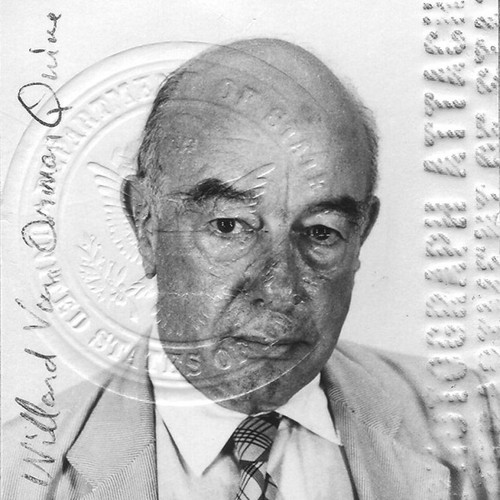
Willard Van Orman Quine
Personal Information
Description
American philosopher and logician in the analytic tradition
Books
The time of my life
In vivid detail, the thirty-year veteran of stage and screen describes his Texas upbringing, his personal struggles, his rise to fame with "North and South", his commercial breakthroughs in "Dirty Dancing" and "Ghost," and the soul mate who's stood by his side through it all: his wife, writer and director Lisa Niemi.
Confessions of a Confirmed Extensionalist and Other Essays
"W. V. Quine created a new way of looking at the eternal questions of philosophy and their interconnections. His investigations into semantics and epistemology, ontology and causality, natural kinds, time, space, and individuation transformed the philosophical landscape for generations to come. In the twenty years between his last collection of essays and his death in 2000, Quine continued his work, producing a number of impressive essays in which he deepened, elaborated, and occasionally modified his position on central philosophical issues. The last of these essays, which gives this collection its name, appeared in 2002." "This volume collects the main essays from this last, productive period of Quine's prodigious career. It also includes some notable earlier essays that were not included in the previous collections although they contain illuminating discussions and are quite often referred to by other philosophers and also by Quine himself in his later writings. These essays, along with several manuscripts published here for the first time, offer a more complete and highly defined picture than ever before of one of the twentieth century's greatest thinkers working at the height of his powers."--Jacket.
From stimulus to science
In this short book, based on lectures delivered in Spain in 1990, Quine begins by locating his work historically. He provides a lightning tour of the history of philosophy (particularly the history of epistemology), beginning with Plato and culminating in an appreciative sketch of Carnap's philosophical ambitions and achievements. This leads, in the second chapter, to an introduction to Quine's attempt to naturalize epistemology, which emphasizes his continuities with Carnap rather than the differences between them. The next chapters develop the naturalistic story of the development of science to take account of how our conceptual apparatus is enhanced so that we can view the world as containing re-identifiable objects. . Having explained the role of observation sentences in providing a checkpoint for assessing scientific theories, and having despaired of constructing an empirical criterion to determine which sentences are meaningful, Quine in the remaining chapters takes up a variety of important issues about knowledge. He concludes with an extended treatment of his views about reference and meaning and his attitudes toward psychological and modal notions.
Selected logic papers
A collection of 23 papers on mathematical logic covering such subjects as set theory, proof theory, truth functions, techniques of deduction, and other topics, written between 1934 and 1960.
From a Logical Point of View
This volume of essays has a unity and bears throughout the imprint of Quine's powerful and original mind. It is written with the felicity in the choice of words which makes everything that Quine writes a pleasure to read, and which ranks him among the best contemporary writers on abstract subjects.
Word and object
Language consists of dispositions, socially instilled, to respond observably to socially observable stimuli. This book examines the linguistic mechanisms of objective reference. Topics covered include the difficulties involved in translation, the anomalies and conflicts implicit in our language's referential apparatus, the semantic problems connected with the imputation of existence, and the reasons for admitting or repudiating each of various categories of supposed objects. Conclusions reached include rejecting the notion of a language-transcendent "sentence-meaning", and meaningful studies in the semantics of reference can only be directed toward substantially the same language in which they are conducted. (From publisher's copy)
I, six nonlectures
"Six marvelously unconventional lectures...an aesthetic self-portrait and a definition of Mr. Cummings' 'stance' as a writer. Full of originality, high spirits, and aphoristic dicta, they express a credo of intense individualism." --Atlantic