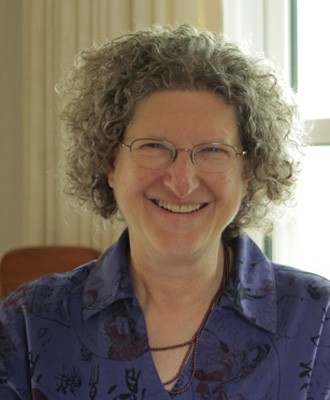
Wendy Leeds-Hurwitz
Description
Wendy Leeds-Hurwitz is Director of the Center for Intercultural Dialogue, supported by the Council for Communication Associations, Professor Emerita of Communication at the University of Wisconsin-Parkside, and Associate Faculty at Royal Roads University, Victoria, BC, Canada. She has been Chercheur invité at the Ecole normale supérieure de Lyon, France, Senior Fellow at the Collegium de Lyon Institut d'études avancées, Fulbright Senior Specialist at the Instituto Politécnico de Coimbra, Portugal; and Harron Family Endowed Chair of Communication at Villanova University, Pennsylvania. She has served UNESCO as an expert on intercultural dialogue, presented at the World Forum on Intercultural Dialogue in Baku, Azerbaijan, organized a conference on intercultural dialogue held in Istanbul, Turkey, and a roundtable on intercultural dialogue in Asia held in Macau, China. Leeds-Hurwitz is interested in how people construct meanings for themselves and others through interaction; how cultural identity is constructed and maintained; and how conflicting identities or meanings can be conveyed simultaneously. She studies disciplinary history to learn why scholars examine particular topics in specific ways; often stops to consider particular research methods or theories; and always takes an interdisciplinary approach to problems. She earned her B.A. from the State University of New York at Binghamton, and her M.A. and Ph.D. degrees from the University of Pennsylvania.
Books
From generation to generation
This book applies various social approaches to investigations of real people as they function in a specific context, the family. Of all the social facts we construct, identity is probably the most critical. And of all our identities, cultural identity is one of the most central to who we think we are. We learn our cultural identities first within families. The authors all examine the families they know best, their own. The chapters examine four critical issues: how family members jointly work to construct identity; how parents convey that identity to their children; the conflict between mainstream expectations and the traditions of discrete cultural groups; and the range of possible ways to display identity within and across groups.
Mapping Goffman's invisible college
"Mapping Goffman's Invisible College offers new insight into how academic communities take shape and how ideas move through informal networks"--
Semiotics and Communication
Communication is, among other things, about the study of meaning -- how people convey ideas for themselves and to one another in their daily lives. Designed to close the gap between what we are able to do as social actors and what we are able to describe as social analysts, this book introduces the language of semiotics -- a language that provides some of the words necessary for discussion of these communication issues. Presenting the basics of semiotic theory to communication scholars, this volume summarizes those aspects most relevant to the study of social interaction, in particular, signs (the smallest elements of meaning in interaction) and codes (sets of related signs and rules for their use) -- explaining how they come together within cultures. Three common social codes -- food, clothing, and objects -- serve as primary examples throughout the book.
Communication and the Evolution of Civilization
A collection of readings designed for an introductory course of the same title. Focus is on the history and development of the major forms of communication: language, writing, and printing.
Communication in Everyday Life
(This book) is a clearly written and well-documented review of social communication theory, and an alternative to texts which focus primarily on the psychology of interpersonal communication and tend to exclude the social perspective on understanding interpersonal communication. Leeds-Hurwitz provides a welcome addition to introductory texts on the study of human communication. (This) is for teachers who have searched for an introductory textbook which presents a comprehensive argument for a social interactionist perspective on communication in a way understandable to students. Most refreshing is that Leeds-Hurwitz does not talk down to the reader, integrates (not just cites) original sources, and illustrates the concepts with ethnographic research…. Mark Kuhn, University of Maine, Orono in Communication Education
Learning Matters
Higher education in the United States of America, considered by many to set a worldwide standard for broad access and high levels of excellence, has for many decades seen massive changes in its approaches to teaching and learning. Redesigning and transforming the way colleges and universities teach their students has been likened to reconstructing an airplane while it remains aloft. More than 4,000 US colleges and universities have met the challenge by analyzing major changes in student populations and introducing new instructional techniques that recognize the primacy of learning over teaching. This seemingly innocent but powerful transformation, acknowledging that teaching only matters as a means to the real end - learning - is powering a pedagogical revolution. The Learning Revolution in US higher education began when World War II veterans flooded university classrooms, soon to be followed by their children, the American «Baby Boom.» Overwhelming numbers of new students from new kinds of backgrounds flooded colleges and universities, forcing professors to rethink how they went about teaching these new generations. To handle the numbers, many new universities were created, and many established centers for teaching excellence to help professors adapt to new populations with new techniques. In the 1990s, higher education further professionalized the teaching craft via the Scholarship of Teaching and Learning. Research into how students learn and how to help them learn took its place alongside traditional academic research. Aided by a wave of new technologies, teaching centers and the scholarship of teaching and learning are transforming the university classroom as well as many new venues outside the classroom where learning now takes place. The resulting new pedagogical architecture now embraces every dimension of US higher education.
Rolling in Ditches with Shamans
Rolling in Ditches with Shamans charts American anthropology in the 1920s through the life and work of one of the amateur scholars of the time, Jaime de Angulo (1887–1950). Despite earning a medical degree, de Angulo chose instead to live on an isolated ranch in Big Sur, California, where he participated fully in the lives of the people who were his ethnographic informants. The period of his most extensive research coincides almost perfectly with the professionalization of anthropology, and de Angulo provides a link between those who are generally recognized as the most important figures of the day: Franz Boas, Alfred Kroeber, and Edward Sapir. The fields of salvage ethnography and linguistics, which Boas emphasized, were aimed at recording the culture, language, and myths of the Native groups before they became completely acculturated. In keeping with these dictates, de Angulo recorded data from thirty groups, mostly in California, which otherwise might have been lost. In an unusual move for that time, he also wrote fiction and poetry describing the modern lives of the people he studied, something of little interest to Boas but of great interest today. His most enduring work is Indian Tales, a fictional synthesis of myths learned from various California Indians. De Angulo’s range of interests, originality, and expertise exemplified the curiosity and brilliance of those who pioneered American anthropology at this time.
