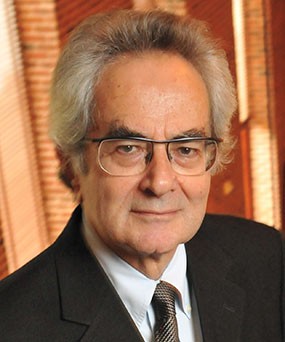
Thomas Nagel
Personal Information
Description
American moral and political theorist. Born in the former Yugoslavia, Nagel was educated at Cornell, Oxford, and Harvard. He taught at Princeton from 1966 to 1980, and subsequently at New York University. His work is centrally concerned with the nature of moral motivation and the possibility of a rational theory of moral and political commitment, and has been a major stimulus to interest in realistic and Kantian approaches to these issues. One of the most discussed papers of modern philosophy of mind has been his ‘What is it Like to Be a Bat?’, arguing that there is an irreducible, subjective aspect of experience that cannot be grasped by the objective methods of natural science, or by philosophies such as functionalism that confine themselves to those methods. Works include The Possibility of Altruism (1970), Mortal Questions (1979), The View from Nowhere (1986), and Equality and Partiality (1991). Source: The Oxford Dictionary of Philosophy
Books
The last word
If there is such a thing as reason, it has to be universal. Reason must reflect objective principles whose validity is independent of our point of view - principles that anyone with enough intelligence ought to be able to recognize as correct. But this universality of reason is what relativists and subjectivists deny in ever-increasing numbers. And such subjectivism is not just an inconsequential intellectual flourish or badge of theoretical chic. It is exploited to deflect argument and to belittle the pretensions of the arguments of others. The continuing spread of this relativistic way of thinking threatens to make public discourse increasingly difficult and unproductive. . In The Last Word, Thomas Nagel, one of the most influential philosophers writing in English, presents a sustained defense of reason against the attacks of subjectivism, delivering systematic rebuttals of relativistic claims with respect to language, logic, science, and ethics. He shows that the last word in disputes about the objective validity of any form of thought must lie in some unqualified thoughts about how things are - thoughts that we cannot regard from outside as mere psychological dispositions. His work sets a new standard in the debate on this crucially important question and should generate intense interest both within and outside the philosophical community.
Concealment and Exposure
"Thomas Nagel is widely recognized as one of the leading American philosophers working today. This collection of recent essays and reviews reflects the unusually broad range of his philosophical interests."--BOOK JACKET.
Other Minds
Other Minds gathers Nagel's most important critical essays and reviews on the philosophy of mind, ethics, and political philosophy. The pieces here discuss philosophers from Aristotle to Wittgenstein, as well as contemporary legal and political theorists like Robert Nozick and Ronald Dworkin. Also included are essays tracing Nagel's ongoing participation in debates surrounding the mind-body problem - lucid, opinionated responses to Daniel Dennett, John Searle, and others. Running through Other Minds is Nagel's overriding conviction that the most compelling intellectual issues of our day - from the scientific foundations of Freudian theory to the vicissitudes of judicial interpretation - are essentially philosophical problems. Vital, accessible, and controversial, these writings represent the best of one of our leading thinkers.
What does it all mean?
Most people think about philosophical problems without realizing it. Introducing the uninitiated to the world of philosophical inquiry, this book examines nine philosophical problems fundamental to everyday living. It contains short introduction to the methods of philosophy for those with a taste for abstract ideas and theoretical arguments.
The Myth of Ownership
BLURB: In a capitalist economy, taxes are more than a method of payment for government and public services. They are the most significant instrument by which the political system puts into practice a conception of economic justice. Yet there has been little effort to bring together important recent philosophical work on justice with vigorous debates about tax policy going on in national politics and public circles, in economics and law. The Myth of Ownership bridges this gap, offering the first book to explore tax policy from the standpoint of contemporary moral and political philosophy.