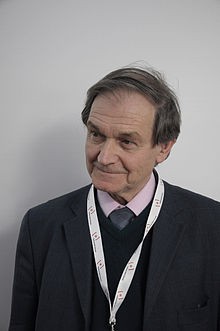
Roger Penrose
Personal Information
Description
Sir Roger Penrose OM FRS is a British mathematical physicist, mathematician, philosopher of science and Nobel Laureate in Physics. He is Emeritus Rouse Ball Professor of Mathematics in the University of Oxford and Emeritus Fellow of Wadham College, Oxford. Penrose has made contributions to the mathematical physics of general relativity and cosmology. He has received several prizes and awards, including the 1988 Wolf Prize for physics, which he shared with Stephen Hawking for the Penrose–Hawking singularity theorems. Source: [Roger Penrose]( on Wikipedia.
Books
The Road to Reality
Un libro definitivo e imprescindible para tener en la mano, en un solo volumen, todo el saber acumulado hasta la actualidad sobre el universo, el espacio, las leyes que lo rigen y los conceptos esenciales.
The large, the small and the human mind
This volume provides an accessible, illuminating & stimulating introduction to Penrose's vision of theoretical physics for the 21st century. His enthusiasm & insight shine through this brilliant account of the problems of modern physics.
The nature of space and time
Het verslag van een zeldzame confrontatie tussen twee kosmologische kopstukken. De twee eminente Britse natuurkundigen Stephen Hawking en Roger Penrose hebben een tegengestelde visie op de toekomst van het heelal, hoewel beide proberen de algemene relativiteitstheorie te verenigen met de kwantummechanica. In dit boek komt naar voren hoezeer hun standpunten over het uiteindelijke lot van het heelal botsen, en hoe zij op verschillende wijze proberen het onbegrijpelijke proberen te begrijpen.
Shadows of the mind
A New York Times bestseller when it appeared in 1989, Roger Penrose's The Emperor's New Mind was universally hailed as a marvelous survey of modern physics as well as a brilliant reflection on the human mind, offering a new perspective on the scientific landscape and a visionary glimpse of the possible future of science. Now, in Shadows of the Mind, Penrose offers another exhilarating look at modern science as he mounts an even more powerful attack on artificial intelligence. But perhaps more important, in this volume he points the way to a new science, one that may eventually explain the physical basis of the human mind. Penrose contends that some aspects of the human mind lie beyond computation. This is not a religious argument (that the mind is something other than physical) nor is it based on the brain's vast complexity (the weather is immensely complex, says Penrose, but it is still a computable thing, at least in theory). Instead, he provides powerful arguments to support his conclusion that there is something in the conscious activity of the brain that transcends computation - and will find no explanation in terms of present-day science. To illuminate what he believes this "something" might be, and to suggest where a new physics must proceed so that we may understand it, Penrose cuts a wide swathe through modern science, providing penetrating looks at everything from Turing computability and Godel's incompleteness, via Schrodinger's Cat and the Elitzur-Vaidman bomb-testing problem, to detailed microbiology. Of particular interest is Penrose's extensive examination of quantum mechanics, which introduces some new ideas that differ markedly from those advanced in The Emperor's New Mind, especially concerning the mysterious interface where classical and quantum physics meet. But perhaps the most interesting wrinkle in Shadows of the Mind is Penrose's excursion into microbiology, where he examines cytoskeletons and microtubules, minute substructures lying deep within the brain's neurons. (He argues that microtubules - not neurons - may indeed be the basic units of the brain, which, if nothing else, would dramatically increase the brain's computational power.) Furthermore, he contends that in consciousness some kind of global quantum state must take place across large areas of the brain, and that it is within microtubules that these collective quantum effects are most likely to reside.
The Emperor's New Mind
Advances the theory that despite burgeoning computer technologies, there will remain facets of human thinking that cannot be emulated by a machine.
What is life? The physical aspect of the living cell
What Is Life? is a 1944 non-fiction science book written for the lay reader by physicist Erwin Schrödinger. The book was based on a course of public lectures delivered by Schrödinger in February 1943 at Trinity College, Dublin. Schrödinger's lecture focused on one important question: "how can the events in space and time which take place within the spatial boundary of a living organism be accounted for by physics and chemistry?" In the book, Schrödinger introduced the idea of an "aperiodic crystal" that contained genetic information in its configuration of covalent chemical bonds. In the 1950s, this idea stimulated enthusiasm for discovering the genetic molecule and would give both Francis Crick and James Watson initial inspiration in their research.
Analytical and numerical approaches to mathematical relativity
Contains a representative collection of surveys by experts in mathematical relativity writing about the status of, and problems in, their fields. This book includes four contributions for each of the mathematical areas: differential geometry and differential topology, analytical methods and differential equations, and numerical methods.
The Best Writing on Mathematics 2013
This anthology brings together the year's finest writing on mathematics from around the world. Featuring promising new voices alongside some of the foremost names in mathematics, it makes available to a wide audience many articles not easily found anywhere else - and you don't need to be a mathematician to enjoy them.
Fashion, Faith, and Fantasy in the New Physics of the Universe
What can fashionable ideas, blind faith, or pure fantasy possibly have to do with the scientific quest to understand the universe? Surely, theoretical physicists are immune to mere trends, dogmatic beliefs, or flights of fancy? In fact, acclaimed physicist and bestselling author Roger Penrose argues that researchers working at the extreme frontiers of physics are just as susceptible to these forces as anyone else. In this provocative book, he argues that fashion, faith, and fantasy, while sometimes productive and even essential in physics, may be leading today's researchers astray in three of the field's most important areas—string theory, quantum mechanics, and cosmology. Arguing that string theory has veered away from physical reality by positing six extra hidden dimensions, Penrose cautions that the fashionable nature of a theory can cloud our judgment of its plausibility. In the case of quantum mechanics, its stunning success in explaining the atomic universe has led to an uncritical faith that it must also apply to reasonably massive objects, and Penrose responds by suggesting possible changes in quantum theory. Turning to cosmology, he argues that most of the current fantastical ideas about the origins of the universe cannot be true, but that an even wilder reality may lie behind them. Finally, Penrose describes how fashion, faith, and fantasy have ironically also shaped his own work, from twistor theory, a possible alternative to string theory that is beginning to acquire a fashionable status, to "conformal cyclic cosmology," an idea so fantastic that it could be called "conformal crazy cosmology." The result is an important critique of some of the most significant developments in physics today from one of its most eminent figures.
Cycles of Time
"A groundbreaking book providing a new take on three of cosmology's most profound questions: What, if anything, came before the Big Bang? What is the source of order in our universe? What is the universe's ultimate future? Current understanding of our universe dictates that all matter will eventually thin out to zero density, with huge black holes finally evaporating away into massless energy. Roger Penrose--one of the most innovative mathematicians of our time--turns around this predominant picture of the universe's "heat death," arguing how the expected ultimate fate of our accelerating, expanding universe can actually be reinterpreted as the "Big Bang" of a new one. Along the way to this remarkable cosmological picture, Penrose sheds new light on basic principles that underlie the behavior of our universe, describing various standard and nonstandard cosmological models, the fundamental role of the cosmic microwave background, and the key status of black holes. Intellectually thrilling and accessible, Cycles of Time is another essential guide to the universe from one of our preeminent thinkers"--
