Discover

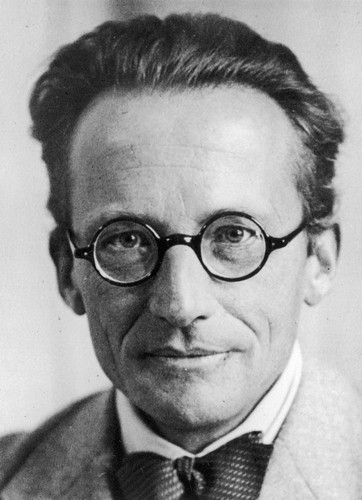
Erwin Schrödinger

Personal Information

Born August 12, 1887
Died January 4, 1961 (73 years old)
Vienna, Cisleithania
Also known as: Erwin Schrödinger, E. Schrödinger
17 books
4.3 (11)
161 readers

Description

Erwin Rudolf Josef Alexander Schrödinger, sometimes written as Erwin Schroedinger or Erwin Schrodinger, was a Nobel Prize-winning Austrian and naturalized Irish physicist who developed a number of fundamental results in quantum theory: the Schrödinger equation provides a way to calculate the wave function of a system and how it changes dynamically in time. --Wikipedia

Books

Newest First

What is life? The physical aspect of the living cell

4.7 (6)
110

What Is Life? is a 1944 non-fiction science book written for the lay reader by physicist Erwin Schrödinger. The book was based on a course of public lectures delivered by Schrödinger in February 1943 at Trinity College, Dublin. Schrödinger's lecture focused on one important question: "how can the events in space and time which take place within the spatial boundary of a living organism be accounted for by physics and chemistry?" In the book, Schrödinger introduced the idea of an "aperiodic crystal" that contained genetic information in its configuration of covalent chemical bonds. In the 1950s, this idea stimulated enthusiasm for discovering the genetic molecule and would give both Francis Crick and James Watson initial inspiration in their research.

'Nature and the Greeks' and 'Science and Humanism' (Canto original series)

0.0 (0)
0

Nobel laureate Erwin Schrodinger was one of the most distinguished scientists of the twentieth century; his lectures on the history and philosophy of science are legendary. 'Nature and the Greeks and Science and Humanism' makes available for the first time in many years the text of two of Schrodinger's most famous lecture series. Nature and the Greeks offers a comprehensive historical account of the twentieth-century scientific world picture, tracing modern science back to the earliest stages of Western philosophic thought. Science and Humanism addresses some of the most fundamental questions of the century: what is the value of scientific research; and how do the achievements of modern science affect the relationship between material and spiritual matters? A foreword by Roger Penrose sets the lectures in a contemporary context, and affirms that they are as relevant today as when they were first published.
