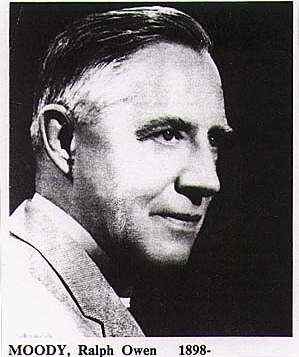
Ralph Moody
Personal Information
Description
There is no description yet, we will add it soon.
Books
Man of the Family (The Little Britiches Series)
When Ralph's father passes away, his whole life turns upside down--as does that of Ralph's oldest sister and his younger siblings. Ralph strives to be the man of the family and provide for his mother, while trying to get the schooling his mother is determined he will have.
The Home Ranch
Ralph Moody turns again to Colorado, the scene of those two delightful earlier books about his boyhood, Little Britches and Man of the Family. This is an extension of Mr. Moody's recollections of his twelfth year, and fits withing the framework of Man of the Family between chapters 25 and 26. The Home Ranch has all the warm and wonderful ingredients which made his first two books such universal favorites with readers of all ages. The book teems with exciting and poignant incidents and with memorable characters, most of them good, kindly, generous people--though there is a villain. Mr. Moody is at his best in picturing a young boy's struggles with economic and other adversities, and having lived through them himself, he writes with such convincing honesty that the reader knows that this is the way things were.
Horse of a different color
Ralph Moody's story is a perfect example of rural American enterprise in the early 1920s. He found himself with mountainous debts through collapse of the livestock market. In the process of digging himself out of debt, he also saved a town from total bankruptcy. The reader lives through a flash flood, admires his sanitary slaughter house, and weeps over a forced farm auction. This book is a glorious recollection of Pre-Dust Bowl, pre-Depression days.
Come on Seabiscuit
From the back cover of this book: A RACING CHAMPION No one thought much of Seabiscuit when he was born. He was knobby-kneed; his head was too big; his legs were too short. He looked as if he would be a disgrace to his thoroughbred ancestors. Considered an outcast by his stable, his owners did not recognize the heart, intelligence and drive of a potential winner. Not until Tom Smith bought him for Howard stables could Seabiscuit break the odds against him and surge ahead to greatness. With affection and care, his new trainer and jockey brought out the best in this gallant horse. Seabiscuit went on to make dramatic racing history! “The amazing success story of Seabiscuit... Woven into the well-written, exciting account is a great deal of information about the care, handling, and training of thoroughbreds. For horse lovers of any age.” ~ A.L.A Booklist
The dry divide
Ralph Moody, just turned twenty, had only a dime in his pocket when he was put off a freight in western Nebraska. It was the Fourth of July in 1919. Three months later he owned eight teams of horses and rigs to go with them. Everyone who worked with him shared in the prosperity - the widow whose wheat crop was saved and the group of misfits who formed a first-rate harvesting crew. But sometimes fickle Mother Nature and frail human nature made sure that nothing was easy. The tension between opposing forces never lets up in this book. Without preaching, The Dry Divide warmly illustrates the old-time virtues of hard work, ingenuity, and respect for others. The Ralph Moody who was a youngster in Little Britches and who grew up without a father and with early responsibilities in Man of the Family, The Fields of Home, The Home Ranch, Mary Emma & Company, and Shaking the Nickel Bush (all Bison Books) has become a man to reckon with in The Dry Divide.
Shaking the nickel bush
Skinny and suffering from diabetes, Ralph Moody is ordered by a Boston doctor to seek a more healthful climate. Going west again is a delightful prospect. His childhood adventures on a Colorado ranch were described in Little Britches and Man of the Family, also Bison Books. Now nineteen years old, he strikes out into new territory hustling odd jobs, facing the problem of getting fresh milk and leafy green vegetables. He scrapes around to survive, risking his neck as a stunt rider for a movie company. With an improvident buddy named Lonnie, he camps out in an Arizona canyon and "shakes the nickel bush" by sculpting plaster of paris busts of lawyers and bankers. This is 1918, and the young men travel through the Southwest not on horses but in a Ford aptly named Shiftless. New readers and old will enjoy this entry in the continuing saga of Ralph Moody.
Riders of the Pony express
An account of the young men, who carried the mail by pony express almost two thousand miles in ten days, over blizzard-swept mountains, across hot desserts, and through hostile Indian country, from San Francisco to St. Joseph, Missouri.
Geronimo, wolf of the warpath
A biography of the Apache Indian chief who led one of the last great Indian uprisings in the 19th century.
Kit Carson and the Wild Frontier
In 1826 an undersized sixteen-year-old apprentice ran away from a saddle maker in Franklin, Missouri, to join one of the first wagon trains crossing the prairie on the Santa Fe Trail. Kit Carson (1809?68) wanted to be a mountain man, and he spent his next sixteen years learning the paths of the West, the ways of its Native inhabitants, and the habits of the beaver, becoming the most successful and respected fur trapper of his time. From 1842 to 1848 he guided John C. Främont's mapping expeditions through the Rockies and was instrumental in the U.S. military conquest of California during the Mexican War. In 1853 he was appointed Indian agent at Taos, and later he helped negotiate treaties with the Apaches, Kiowas, Comanches, Arapahos, Cheyennes, and Utes that finally brought peace to the southwestern frontier. Ralph Moody's biography of Kit Carson, appropriate for readers young and old, is a testament to the judgment and loyalty of the man who had perhaps more influence than any other on the history and development of the American West.
Little Britches
The author shares his family's experience living on a Colorado ranch in the early twentieth century.
Geronimo
"In this, one of Native American history's most extraordinary documents, a legendary warrior and shaman recounts the beliefs and customs of his people. Completely and utterly authentic, its captivating narrator is the most famous member of the Apache tribe: Geronimo. The spiritual and intellectual leader of the American Indians who defended their land from both Mexico and the United States for many years, Geronimo surrendered in 1886. Two decades later, while under arrest, he told his story through a native interpreter to S. M. Barrett, an Oklahoma school superintendent. Barrett explains in his introduction, "I wrote to President Roosevelt that here was an old Indian who had been held a prisoner of war for twenty years and had never been given a chance to tell his side of the story, and asked that Geronimo be granted permission to tell for publication, in his own way, the story of his life." This remarkable testament is the result. It begins with Geronimo's retelling of an Apache creation myth and his descriptions of his youth and family. He explains his military tactics as well as traditional practices, including hunting and religious rituals, and reflects upon his hope for the survival of his people and their culture."--back cover.
