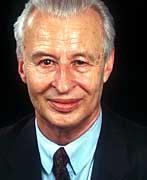
Krockow, Christian Graf von
Description
Christian Graf von Krockow, (May 26, 1927 - March 17, 2002) was a German writer and political scientist, Christian Count of Krockow was the son of a historic Pomeranian noble family. He was born in Rumbske (Rumsko) near the city of Stolp (Słupsk). In 1945, as the Red Army advanced into the Province of Pomerania, he became a refugee and fled to Hamburg. Krockow studied sociology, philosophy and law at the University of Göttingen in 1947-54, where he earned his doctoral degree, and the University of Durham, England. In 1961-69 he was a professor of political science at the universities of Göttingen, Saarbrücken and Frankfurt. In 1970-73 he served as a founding regent of the University of Oldenburg, which in 1995 named him an honorary professor. He was named professor emeritus by the University of Göttingen in 1981. After resigning from his tenured position, he moved to Nikolausberg near Göttingen, where he made a name and a living as in independent writer and speaker. He also worked as speechwriter and political advisor to Chancellor Helmut Schmidt and the Dutch royal family. Towards the end of his life, he moved to Hamburg, where he continued to publish books and articles, albeit living in near seclusion. Krockow received several German literary prizes. His biographies of Frederick the Great, Kaiser Wilhelm II and the resistance fighter Claus Schenk von Stauffenberg, who attempted to assassinate Hitler on July 20, 1944, won wide readership. His book "Stunde der Frauen" (Hour of the Women), which he wrote with his sister Libussa Fritz-Krockow, describes her ordeal fleeing Pomerania in 1945. When Germany collapsed, it was the hour of the German women, who rebuilt Germany from its ruins. The book remained a national bestseller for almost a decade and ushered in a period in which Germans began to rethink the immediate post-war time and deal with the loss of Pomerania, East Prussia, and Silesia. The book was translated into Polish, French, English, and Japanese. Krockow died on March 13, 2002, in Hamburg, aged 74. He was buried at Ohlsdorf cemetery in Ohlsdorf. [Wikipedia]
Books
Churchill
Essays examine Churchill's family life, foreign policy, social reforms, economic ideas, views on Zionism, and relationship with the monarchy and fellow statesmen.
Porträts berühmter deutscher Männer. Von Martin Luther bis zur Gegenwart
Die Stunde der Frauen
The story, written in the first person, begins with her wedding as part of the Pomeranian lower nobility in the countryside of their villages in the spring of 1944. The family has their estate near Stolp, east of Stettin, in the Duchy of Pomerania. By the time the Russians are fifteen miles away, she is nine months pregnant. The coachman drives the wagon to escape, but they are too late. They are ordered to return home to experience the destruction of the Russians, who among other things, burn their castle to the ground. The men are all gone and it is the hour of the women. They do well. She scavenges and her mother's hymnbook and the poems they had to memorize in school get them through the long darkness of winter and privation. By February of 1946, as conditions continue to deteriorate, plans to "go home to the empire" (which she says with sarcasm) begin. Some of the harrowing details of her exploratory flight alone are not related. She makes it over and then is one of the few who actually return from the rest of the family. Life as a refugee in the occupation zones is not easy, but she can do it. The italicized texts inserted by the author throughout the story seem to get in the way of the story.
Porträts berühmter deutscher Frauen. Von Königin Luise bis zur Gegenwart
Stunde der Frauen
"A young mother's fight to survive at the close of World War II."