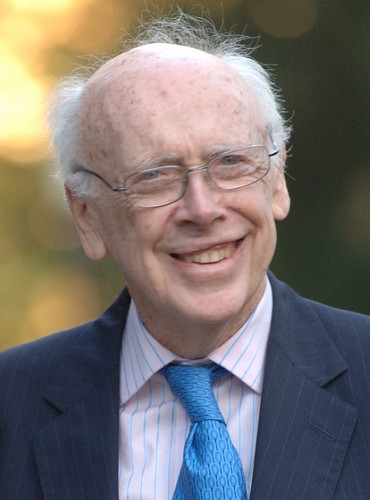
James D. Watson
Personal Information
Description
Watson, James Dewey, 1928-, American biologist and educator, b. Chicago, Ill., grad. Univ. of Chicago, 1947, Ph.D. Univ. of Indiana, 1950. With F. H. C. Crick he began (1951) research on the molecular structure of deoxyribonucleic acid (DNA) at the Cavendish Laboratory at Cambridge. Their findings, published in 1953, resulted in the joint award to them and to M. H. F. Wilkins (on whose laboratory's in X-ray diffraction their studies were partly based) of the 1962 Nobel Prize in Physiology or Medicine. Watson joined the faculty at Harvard in 1955 and in 1968 became director of the Cold Spring Harbor Laboratory in New York. From 1989 to 1992 he was director of the National Center for Human Genome Research, which undertook the Human Genome Project. His chief researches have been in the fields of genetics, bacteriophage reproduction, and cancer. Remarks in a published interview in 2007 that persons of African descent were inherently less intelligent than Europeans led to his suspension and subsequent retirement as Cold Spring Harbor Laboratory director. (Columbia Encyclopedia)
Books
Avoid boring people
From a living legend--James D. Watson, who shared the Nobel Prize for having revealed the structure of DNA--a personal account of the making of a scientist. In Avoid Boring People, the man who discovered "the secret of life" shares the less revolutionary secrets he has found to getting along and getting ahead in a competitive world.Recounting the years of his own formation--from his father's birding lessons to the political cat's cradle of professorship at Harvard--Watson illuminates the progress of an exemplary scientific life, both his own pursuit of knowledge and how he learns to nurture fledgling scientists. Each phase of his experience yields a wealth of age-specific practical advice. For instance, when young, never be the brightest person in the room or bring more than one date on a ski trip; later in life, always accept with grace when your request for funding is denied, and--for goodness' sake--don't dye your hair. There are precepts that few others would find occasion to heed (expect to gain weight after you win your Nobel Prize, as everyone will invite you to dinner) and many more with broader application (do not succumb to the seductions of golf if you intend to stay young professionally). And whatever the season or the occasion: avoid boring people.A true believer in the intellectual promise of youth, Watson offers specific pointers to beginning scientists about choosing the projects that will shape their careers, the supreme importance of collegiality, and dealing with competitors within the same institution, even one who is a former mentor. Finally he addresses himself to the role and needs of science at large universities in the context of discussing the unceremonious departure of Harvard's president Larry Summers and the search for his successor.Scorning political correctness, this irreverent romp through Watson's life and learning is an indispensable guide to anyone plotting a career in science (or most anything else), a primer addressed both to the next generation and those who are entrusted with their minds.From the Hardcover edition.
Genes, girls and gamow
"How Jim Watson and Francis Crick deduced the double-helical structure of DNA first became known to the general public in 1968 through Watson's watershed The Double Helix.". "Genes, Girls and Gamow takes up the story of Watson's life from where The Double Helix finishes, the announcement of the double helix in the journal Nature in April 1953. The diary-like entries describe with freshness and immediacy Watson adjusting to new-found fame, carrying out tantalizing experiments on the role of RNA in biology, and falling in love. The book is enlivened by copies of hand-written letters from the larger-than-life, Russian-born theoretician George Gamow, who had made major contributions to physics but, in this period, was also intrigued by genes, RNA, and the elusive genetic code."--BOOK JACKET.
The DNA story
Reproduces articles, commentary, and correspondence generated by scientific discoveries on genetics and gene cloning, with a final section detailing the scientific background.
The involvement of RNA in the synthesis of proteins
Reproduction of typescript of speech delivered by James Dewey Watson at the Royal Caroline Institute upon receipt of his Nobel Prize.
The Frontiers of Knowledge
First series, 1972-73, Technology and the frontiers of knowledge Saul Bellow: Literature in the age of technology. Daniel Bell: Technology, nature, and society. Edmundo O'Gorman: History, technology, and the pursuit of happiness. Sir Peter Medawar: Technology and evolution. Arthur C. Clarke: Technology and the limits of knowledge. Second series, 1973-74, Creativity and collaboration: Akio Morita: Creativity in modern industry. James D. Watson: The dissemination of unpublished information. Huw Wheldon: Creativity and collaboration in television programs. Moshe Safdie: Collective consciousness in making environment. Caspar W. Weinberger: Creativity and collaboration in government - The Budget Process Third series, 1974-75, The modern explorers Sir Edmund Hillary: South Pole - Continent of Adventure. Sir Fred Hoyle: On the origin of the universe. Willard F. Libby: Radiocarbon dating. Isaac Asimov: The moon as threshold.
A Passion for DNA
A principal architect and visionary of the new biology, a Nobel Prize-winner at 34 and best-selling author at 40 (The Double Helix), James D. Watson had the authority, flair, and courage to take an early and prominent role as commentator on the march of DNA science and its implications for society. In essays for publications large and small, and in lectures around the world, he delivered what were, in effect, dispatches from the front lines of the revolution. Outspoken and sparkling with ideas and opinions, a selection of them is collected for the first time in this volume. Their resonance with today's headlines is striking.