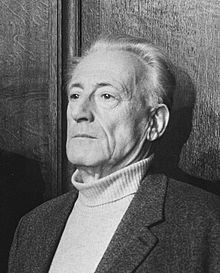
Henri Lefebvre
Personal Information
Description
Henri Lefebvre (16 June 1901 – 29 June 1991) was a French Marxist philosopher and sociologist, best known for pioneering the critique of everyday life, for introducing the concepts of the right to the city and the production of social space, and for his work on dialectics, alienation, and criticism of Stalinism, existentialism, and structuralism. In his prolific career, Lefebvre wrote more than sixty books and three hundred articles. Source: Wikipedia
Books
Rhythmanalysis
Rhythmanalysis displays all the characteristics which made Lefebvre one of the most important Marxist thinkers of the twentieth century. In the analysis of rhythms -- both biological and social -- Lefebvre shows the interrelation of space and time in the understanding of everyday life.With dazzling skills, Lefebvre moves between discussions of music, the commodity, measurement, the media and the city. In doing so he shows how a non-linear conception of time and history balanced his famous rethinking of the question of space. This volume also includes his earlier essays on "The Rhythmanalysis Project" and "Attempt at the Rhythmanalysis of Mediterranean Towns"
L' irruption de Nanterre au sommet / Henri Lefebrve ; préface, postface et prolongements par René Lourau, René Mouriaux et Pierre Cours-Salies
Writings on cities
This book presents the most major Lefebvre's works which deal with the Every day experiences, the city, urban, space, and politic. Lefebvre was a real Marxist and also got influenced from Nietzche, particularly his philosophy on every day lives. As a Marxian, Henri Lefebvre perceived the human relations as dominated by the powerful class, economical one in particular. Therefore, the urban social spaces are constructed and created and changed according to their economic and political interests. The struggles and strategies of dominating and utilize the urban spaces are full of conflics between the powerfull and the poor ones. It is common and real urban phenomena nowadays in the globalization era, in most of the cities.
La production de l'espace
Henri Lefebvre has considerable claims to be the greatest living philosopher. His work spans some sixty years and includes original work on a diverse range of subjects, from dialectical materialism to architecture, urbanism and the experience of everyday life. The Production of Space is his major philosophical work and its translation has been long awaited by scholars in many different fields. The book is a search for a reconciliation between mental space (the space of the philosophers) and real space (the physical and social spheres in which we all live). In the course of his exploration, Henri Lefebvre moves from metaphysical and ideological considerations of the meaning of space to its experience in the everyday life of home and city. He seeks, in other words, to bridge the gap between the realms of theory and practice, between the mental and the social, and between philosophy and reality. In doing so, he ranges through art, literature, architecture and economics, and further provides a powerful antidote to the sterile and obfuscatory methods and theories characteristic of much recent continental philosophy. This is a work of great vision and incisiveness. It is also characterized by its author's wit and by anecdote, as well as by a deftness of style which Donald Nicholson-Smith's sensitive translation precisely captures.--Publisher description.