Discover

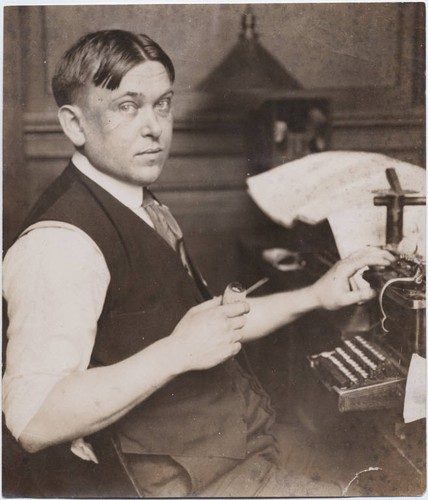
H. L. Mencken

Personal Information

Born January 1, 1880
Died January 1, 1956 (76 years old)
Baltimore, United States
Also known as: Henry L. Mencken, Henry Louis Mencken
84 books
4.0 (28)
219 readers

Description

There is no description yet, we will add it soon.

Books

Newest First

A Religious Orgy in Tennessee

0.0 (0)
2

Searing dispatches from the first confrontation between American fundamentalism and science that so galvanized the nationi they inspired the hit play and movie Inherit the Wind. With the rise of "intelligent design," H. L. Mencken's legendary coverage of the Scopes "Monkey" Trial - collected here for the first time as a single volume - has never seemed more timely ... or timeless. -- Book Cover

Mencken's America

0.0 (0)
2

"Mencken was prolific; much of his best work lies buried in the newspapers and magazines in which it originally appeared. Mencken's America is a sampling of uncollected work, arranged to present the wide-ranging treatise on American culture that Mencken himself never wrote." "The core of the book is a series of six articles on "The American" published in the Smart Set in 1913 and 1914. Never before reprinted, they embody the essence of Mencken's views on the deficiencies of his countrymen."--BOOK JACKET.

From Baltimore to Bohemia

0.0 (0)
0

"H. L. Mencken was one of the most prolific letter-writers in American literature, and many of his letters were written to fellow authors. Aside from those to Theodore Dreiser, few of these letters have been published. This volume presents the joint correspondence of Mencken and George Sterling, an unjustly forgotten California poet who, under the initial tutelage of Ambrose Bierce, gained celebrity for such volumes as The Testimony of the Suns (1903) and A Wine of Wizardry (1909). The correspondence of H. L. Mencken and George Sterling - by turns amusing, outrageous, and illuminating - casts a vivid light into the literary, social, and cultural milieu of the Jazz Age, as seen through the eyes of two of its most distinctive figures."--BOOK JACKET.

In defense of Marion

0.0 (0)
1

This documentary history chronicles what in duration and volatile intensity was the most important love relationship in H.L. Mencken's life, one that he tried to obscure and hoped would remain buried within the copious record of his achievements as author and editor. The love between Marion Bloom and Mencken flourished during a period when he wrote frequently about women's issues. In Defense of Marion both illuminates Mencken's ambivalent attitudes toward the "New Woman" and presents a particularized social history of the intellectual and personal aspirations of many women during the early twentieth century. Bloom and Mencken met in 1914 and became lovers within a few months. Their intimacy continued, on and off, until about a year before Mencken's marriage to Sara Haardt in 1930. Edward A. Martin, who supplies a wealth of interpretive notes and commentary, tells of the Mencken-Bloom affair not only through selections from their letters and diaries but also through excerpts from the personal writings of others who were close to the two and who often complicated their relationship. Such relevant figures include Sara Haardt; Estelle Bloom, Marion's sister; Theodore Dreiser, Estelle's lover and employer as an editorial assistant; and the movie star Aileen Pringle, with whom Mencken was infatuated.

Do you remember?

0.0 (0)
28

Tess Strebel can’t recognize her own face. She can’t recognize her home. Her bedroom is unfamiliar. And she can’t remember the handsome stranger lying next to her in bed. A stranger who claims he’s her husband. Tess reads a letter in her own handwriting, composed during a rare lucid day, explaining her life as it now exists: She was in a terrible car accident one year ago. Every morning, she wakes up unable to remember most of the last decade. Including her own wedding. Tess has no choice but to accept her new life and hope her memory will return. After all, why should she doubt the letter she wrote to herself? Or the kind man from the wedding photos on her dresser who seems to genuinely care about her well-being? And then Tess receives a text message on her phone. One that changes everything: "Don’t trust the man who calls himself your husband."

Thirty-five Years of Newspaper Work

0.0 (0)
1

In January 1991 the Enoch Pratt Free Library opened the sealed manuscript of H. L. Mencken's "Thirty-five Years of Newspaper Work." Written in 1941-42 and bequeathed to the library under time-lock upon Mencken's death in 1956, it is among the very last of his papers opened to the public. Thirty-five Years of Newspaper Work, a one-volume abridgement of Mencken's much longer memoir, vividly pictures the excitement of newspaper life in the heyday of print journalism. Here Mencken colorfully recalls his years - mostly with the Baltimore Evening Sun - as a reporter and a writer of editorials that always caused a stir among the public and uproars of indignation among his enemies. The volume includes important new material on his coverage of presidential candidates from 1912 to 1940 (Mencken on Harding's inaugural address: "a string of wet sponges") and the 1925 trial of the man he called the "infidel Scopes." Mencken also describes his brief stint as a war correspondent on Germany's subzero Eastern Front in 1917 and the perilous voyage back, which took him through Havana just as a revolution was breaking out. (He stayed to cover it.) He writes, with curious detachment, about the "inevitable" war and likely fate of Germany's Jews during a final visit to his ancestral homeland in summer 1938.

My life as author and editor

0.0 (0)
1

After thirty-five years in a sealed vault, the autobiography of America's great social and literary critic now comes to light, edited and with an introduction by Jonathan Yardley. H.L. Mencken stipulated in his will that the manuscript not be read for thirty-five years so that no one mentioned in its pages would still be alive on publication, thus giving the author the freedom to write what he pleased. The narrative contains many profiles and reminiscences covering Mencken's years in the magazine world, particularly with the Smart Set, which he co-edited with George Jean Nathan. The heart of the book, however, lies in the descriptions of the relationships - rivalries, feuds, friendships and mentorships - that Mencken carried on with many of the significant writers of the twentieth century, including Theodore Dreiser, James Joyce, Willa Cather, Ezra Pound, Eugene O'Neill, Frank Harris, F. Scott Fitzgerald, Aldous Huxley and Sinclair Lewis. Full of wonderfully revealing anecdotes and biting observations, these pages are spiked with his trademark outrageous and pugnacious wit, as well as his alarming frankness. Although the memoir breaks off in the early 1920's because of a stroke he suffered in 1948, it contributes significantly to our understanding of the legendary literary era of which he was at the center. It also makes abundantly clear - if proof were ever needed - why he was our greatest social commentator, and why he has had an enduring impact on American society and letters.

The diary of H.L. Mencken

0.0 (0)
3

Selections cover the years 1930-1948. Provides observations on American society by the American newspaper columnist.
