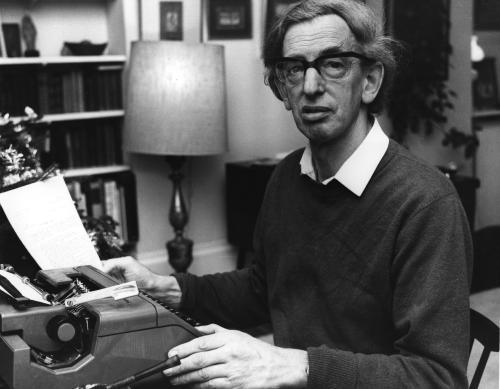
Eric Hobsbawm
Personal Information
Description
Eric Ernest Hobsbawm was a British academic historian and Marxist historiographer.
Books
Interesting times
"May you live in interesting times" is the worst thing one can wish on a citizen of Discworld -- especially on the distinctly unmagical sorcerer Rincewind, who has had far too much perilous excitement in his life. But when a request for a "Great Wizzard" arrives in Ankh-Morpork via carrier albatross from the faraway Counterweight Continent, it's he who's sent as emissary. Chaos threatens to follow the impending demise of the Agatean Empire's current ruler. And, for some incomprehensible reason, someone believes Rincewind will have a mythic role in the war and wholesale bloodletting that will surely ensue. (Carnage is pretty much a given, since Cohen the Barbarian and his extremely elderly Silver Horde are busily formulating their own plan for looting, pillaging, and, er, looking wistfully at girls.) However, Rincewind firmly believes there are too many heroes already in the world, yet only one Rincewind. And he owes it to the world to keep that one alive for as long as possible.
America, the new imperialism
This pioneering study provides unparalleled insight into the history, culture, and politics of American imperialism.
The Age of Capital
The Age of Capital: 1848–1875 is a book by Eric Hobsbawm, first published in 1975. It is the second in a trilogy of books about "the long 19th century" (coined by Hobsbawm), preceded by The Age of Revolution: Europe 1789–1848 and followed by The Age of Empire: 1875–1914. A fourth book, The Age of Extremes: The Short Twentieth Century, 1914–1991, acts as a sequel to the trilogy. (from [Wikipedia](
The lords of human kind: European attitudes towards the outside world in the Imperial Age
When European explorers went out into the world to open up trade routes and establish colonies, they brought back much more than silks and spices, cotton and tea. Inevitably, they came into contact with the peoples of other parts of the world and formed views of them, occasionally admiring, more often hostile or contemptuous. Using a stunning array of sources - missionaries' memoirs, the letters of diplomats' wives, explorers' diaries and the work of writers as diverse as Voltaire, Thackeray, Oliver Goldsmith and, of course, Kipling - Victor Kiernan teases out the full range of European attitudes to other peoples. Erudite, ironic and global in its scope, The Lords of Human Kind has been a major influence on a generation of historians and cultural critics and is a landmark in the history of Eurocentrism. The legacy of colonial attitudes to other cultures is, of course, an integral part of the modern world, and the history of their formation is one which cannot be ignored.
Primitive Rebels
Primitive Rebels is a 1959 book by Eric Hobsbawm on pre-modern European social movements and social banditry. (Source: [Wikipedia](
Uncommon people
This engaging collection features twenty-six Hobsbawm essays covering the history of working men and women between the late eighteenth century and today, bringing back into print Hobsbawm's pioneering studies in labor history along with more recent, previously unpublished pieces. Uncommon People shows the range of Hobsbawm's work, on such subjects as the formation of the British working class, revolution and sex, and socialism and the avant garde. From essays on Mario Puzo and the mafia, to the Sicilian bandit Salvatore Giuliano and the cultural consequences of Christopher Columbus, Hobsbawm's passionate concern for the lives and struggles of ordinary men and women shines through.
Nations and nationalism since 1780
Eric Hobsbawm's brilliant enquiry into the question of nationalism won further acclaim for his 'colossal stature ...his incontrovertible excellence as an historian, and his authoritative and highly readable prose'. Recent events in Eastern Europe and the former Soviet republics have since reinforced the central importance of nationalism in the history of political evolution and upheaval. This second edition has been updated in the light of those events, with a final chapter addressing the impact of the dramatic changes that have taken place. It also includes additional maps to illustrate nationalities, languages and political divisions across Europe in the nineteenth and twentieth centuries.
Tempos interessantes
Apresenta autobiografia subdividida em ordem cronológica, de 1920 aos anos 90, esboçando a sua carreira como historiador profissional, e os países ou regiões com os quais teve ligações: Europa Central, Inglaterra, França, Espanha e Itália, América Latina e outras partes do Terceiro Mundo e Estados Unidos.
