Discover

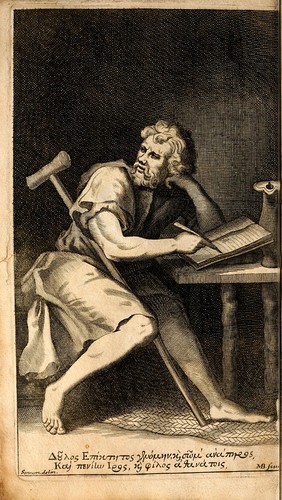
Epictetus

Personal Information

Born March 7, 2055
Died March 7, 135 (-1920 years old)
Hierapolis, Ancient Rome
Also known as: Epicteto, Epiktet
40 books
4.2 (23)
597 readers

Description

Epictetus (c. 55 – 135 AD) was a Greek Stoic philosopher. He was born a slave at Hierapolis, Phrygia (present day Pamukkale, Turkey) and lived in Rome until his banishment, when he went to Nicopolis in northwestern Greece for the rest of his life. His teachings were written down and published by his pupil Arrian in his Discourses and Enchiridion. Source: [Epictetus]( on Wikipedia.

Books

Newest First

Manual

3.7 (6)
44

The Enchiridion

4.0 (1)
12

Born a slave and lamed by his master, Epictetus studied Stoic philosophy while in captivity. Once freed, he survived Domitian’s banishment of all philosophers from Rome to settle in Greece, where he founded a school of philosophy. He quickly rose to prominence as a renowned Stoic scholar and teacher, and even though he was personally friendly with emperors, he kept a simple life. The Enchiridion is a summary of practical advice compiled by Epictetus’ student Arrian. While based on Epictetus’ Discourses, it’s not a philosophical treatise as much as it is a short handbook with practical suggestions on how to live a good and satisfying life. It remained popular for centuries with translations to different languages completed as early as 1493, and was even a common school text in Scotland during the 18th century.

Discourses and Selected Writings

0.0 (0)
34

Epictetus, a Greek stoic and freed slave, ran a thriving philosophy school in Nicropolis in the early second century AD. His animated discussions were celebrated for their rhetorical wizardry and were written down by Arrian, his most famous pupil. Together with the Enchiridion, a manual of his main ideas, and the fragments collected here, The Discourses argue that happiness lies in learning to perceive exactly what is in our power to change and what is not, and in embracing our fate to live in harmony with god and nature. In this personal, practical guide to the ethics of stoicism and moral self-improvement, Epictetus tackles questions of freedom and imprisonment, illness and fear, family, friendship and love, and leaves an intriguing document of daily life in the classical world.

Art of Living

4.8 (4)
90

Presents a new interpretation of first century's Epictetus' clearly stated guidelines for moral progress and personal character development.
