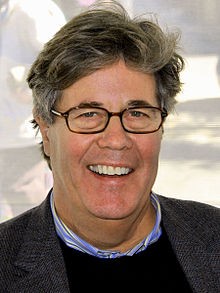
David Maraniss
Personal Information
Description
David Maraniss is an American journalist and author, currently serving as an associate-editor for The Washington Post. - Wikipedia
Books
The Prince of Tennessee
"In The Prince of Tennessee, David Maraniss and Ellen Nakashima explore in detail the forces that have shaped Al Gore's life, and the ways that his past offers clues to what kind of president he would be. The Gore who comes to life in these pages is an intelligent and competent man, struggling with self-doubt and insecurity that explain his bureaucratic obsession with fact and his tendency to exaggerate his accomplishments."--BOOK JACKET.
Barack Obama
This is the children's biography about the forty-fourth president of the United States. Containing up-to-the-minute information, including President Obama's November victory.
When pride still mattered
This book "is the quintessential story of the American family: how Vince Lombardi, the son of an immigrant Italian butcher, rose to the top, and how his character and will to prevail transformed him, his wife, his children, his players, his sport, and ultimately the entire country. It is also a vibrant football story as well as a study of national myths and an absorbing account of mythmakers"--Dust jacket.
First in his class
Drawing on letters, documents, and interviews with several hundred people whose paths intersected with Clinton's at every level - family, friends, girlfriends, classmates, teachers, campaign workers, staff, and associates - Maraniss explores the evolution of the personality whose greatest strengths are also his greatest weaknesses: his talent for politics and careful networking, his perseverance and optimism, his ever eagerness to please, his tendency to shade the truth, and his insatiable appetite for life and ideas. It is a definitive study of Clinton's rise from obscure, provincial Arkansas, of the clear development of his ambitions, and of the Faustian bargains he made along the way. Maraniss looks at the split personality of Hot Springs, where Baptist churches and gambling casinos, all-American ideals and vaporous spas, were next-door neighbors - and how these childhood influences worked their way into Clinton's persona. The Georgetown-to-Oxford-to-Yale years reveal Clinton as a remarkably quick study, a smooth and astute operator, and an unrivaled magnet, drawing many of the brightest people of his generation, first and foremost his wife and closest adviser, Hillary Rodham, and others who are now key members of his administration and circle. His career in Arkansas provided the important learning experiences and stepping stones that propelled him to the Oval Office - and the stumbling blocks that threaten his stay there. Still, Maraniss shows, Clinton is not a man to count out of any fight. There have been numerous defeats along the way - in "dress-rehearsal" elections for student council president, "out-of-town runs" for state office, and even now that he is on center stage - but Bill Clinton has learned and bounced back, stronger after every setback.
Rome 1960
Author Maraniss weaves sports, politics, and history into a tour de force about the 1960 Olympics. Along with the unforgettable characters and dramatic contests, there was a deeper meaning to those days at the dawn of the sixties. Change was everywhere. Old-boy notions of Olympic amateurism were crumbling. Rome saw the first doping scandal, the first commercially televised Summer Games, the first athlete paid for wearing a certain brand. In the heat of the Cold War, the city teemed with spies and rumors of defections, and every move was judged for propaganda value. While East and West Germans competed as a unified team, less than a year before the Berlin Wall, there was a dispute over the two Chinas. Fourteen nations were being born in sub-Saharan Africa. There was increasing pressure to provide equal rights for blacks and women. The world as we know it was coming into view.--From publisher description.
Tell Newt to Shut Up
PRIZE-WINNING WASHINGTON POST JOURNALISTS REVEAL HOW REALITY GAGGED THE GINGRICH REVOLUTION. Speaker Newt Gingrich and his troops promised a revolution when they seized power in January 1995. The year that followed was one of the most fascinating and tumultuous in modern American history. After stunning early success with the Contract with America, the Republicans began to lose momentum; by year's end Gingrich was isolated and uncertain, and his closest allies were telling him to shut up. Here is an unprecedented, fly-on-the-wall look at the successes, sellouts, and perhaps fatal mistakes of Newt Gingrich's Republican Revolution. Based on the award-winning Washington Post series that documented the Republicans' day-to-day attempts to revolutionize the American government, "Tell Newt to Shut Up!" gets to the heart of the political process.
Clemente
On New Year's Eve, 1972, following eighteen magnificent seasons in the major leagues, Roberto Clemente died a hero's death, killed in a plane crash as he attempted to deliver supplies to Nicaragua after an earthquake. Journalist Maraniss now brings the great baseball player back to life. Anyone who saw Clemente play will never forget him--he was a work of art in a game too often defined by statistics. But Clemente was that rare athlete who rose above sports to become a symbol of larger themes. Born in rural Puerto Rico, at a time when there were no blacks or Puerto Ricans playing organized ball in the United States, Clemente went on to become the greatest Latino player in the major leagues, a ballplayer of determination, grace, and dignity who paved the way and set the highest standard for waves of Latino players who followed in later generations.--From publisher description.
A Good American Family
"A personal story of the author's father's involvement in HUAC that offers a rich portrait of McCarthy era America"-- Elliott Maraniss, a WWII veteran who had commanded an all-black company in the Pacific, was spied on by the FBI, named as a communist by an informant, called before the House Un-American Activities Committee in 1952, fired from his newspaper job, and blacklisted for five years. Yet he never lost faith in America and emerged on the other side with his family and optimism intact. David Maraniss weaves his father's story through the lives of his inquisitors and defenders as they struggle with the vital twentieth-century issues of race, fascism, communism, and first amendment freedoms. -- adapted from jacket