
UNITED STATES AUTHOR · PHILOSOPHY · PRAGMATISM
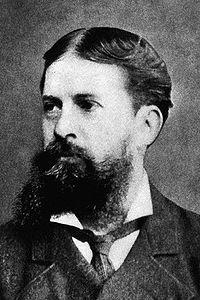
Charles Sanders Peirce
Also known as: Charles S. Peirce, Charles Sanders Pierce
Charles Sanders Peirce was born and raised in Cambridge, Massachusetts. He was the son Benjamin Peirce, a professor of astronomy and mathematics at Harvard University. At age 12, he read Richard Whately's Elements of Logic, and became fascinated with logic and reasoning. He received B.A. and M.A. degrees from Harvard. In 1863, the Lawrence Scientific School awarded him its first B.Sc. in chemistry. Between 1859 and 1891, Peirce was intermittently employed by the United States Coast Survey, which exempted him from serving in the Civil War. From 1869-1872 he worked as an Assistant in Harvard's astronomical observatory. In 1876 he was elected a member of the National Academy of Sciences. In 1879, he became lecturer in logic at Johns Hopkins University. During the 1880s, he wrote hundreds of logic, philosophy, and science entries for the Century Dictionary. In 1883 he published "Studies in Logic" which containing his own work as well as works by his graduate students. That same year he married his second wife, but information that he had travelled with her while unmarried led to his dismissal from Johns Hopkins University. In 1891 he resigned from the Coast Survey, and never again held regular employment. In 1887 Peirce spent part of his inheritance on 2,000 acres of land near Milford, Pennsylvania, where he had a large house built. The Peirces named the estate "Arisbe" and lived there for the rest of their lives. Living beyond their means at Arisbe sent the Peirces into debt, from which his brother and neighbours eventually rescued them. During this time, Peirce wrote prolifically, though much of his work remained unpublished. His friend William James arranging for him to give two two series of lectures at or near Harvard in 1898 and 1903. James also asked his own friends to contribute financially to support Peirce. In 1914, Peirce died destitute in Milford, Pennsylvania.
The word synechism is the English form of the Greek ouvexiouoc, from ouvexnc, continuous.
— from The Essential Peirce, 1992
Most acclaimed

Chance, love, and logic
Two of the most important and influential works by Charles Sanders Peirce (1839-1914) here in one volume. The first marks the beginning of pragmatism. His opening writings, The Fixation of Belief , How to Make Our Ideas Clear , and The Doctrine of Chances , are perhaps his most well-known and influential works, and serve to lay the groundwork for his concept of pragmatism. While any of Peirce's essays stand alone quite well, they become more powerful and prophetic when digested together. The second presents Peirce's innovative essays on scientific metaphysics. (Peirce was) "one of the most original thinkers and system builders of any time, and certainly the greatest philosopher the United States has ever seen".--Joseph Brent, biographer.
Collected Papers of Charles Sanders Peirce
1931
Volume VII contains papers on experimental science, scientific method, and philosophy of mind. Volume VIII contains selections from Peirce's reviews and correspondence and a bibliography of his published works, speeches and correspondence, and works by other authors which quote or describe manuscripts by Peirce which are not included in Volumes I-VI of "Collected Papers." Peirce's work in experimental science played an important role in his life and in the formation of his philosophy, and Volume VII is designed to show how the principal focus of his attention shifted from this sphere to the methods of science and finally to speculative metaphysics. Thus it includes his only published article in experimental psychology and two short pieces on gravity as well as the most important part of "The Logic of 1873" (in which pragmatism was first formulated in writing); "The Logic of Drawing History from Ancient Documents," discussion of the historical method; "Economy of Research" (1879), containing many pertinent reflections on scientific methodology of interest to research directors today; and much more. America's first original philosopher and logician, and the founder of the philosophy of pragmatism, Peirce was also influential in shaping the thinking of such figures as William James and John Dewey. The reviews and correspondence contained in Volume VIII show his attitude toward these philosophies and illustrate the nature of his relationships with the great thinkers of his day. The bibliography in Volume VIII lists chronologically all of Peirce's known published works, giving a clear picture of the development of his thought from 1860 through 1911.