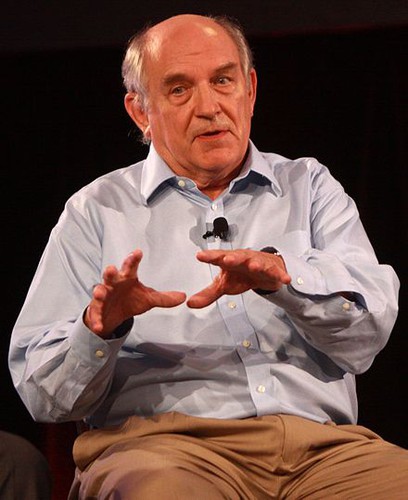
Charles A. Murray
Personal Information
Description
Charles Murray is a political scientist, author, and libertarian. He first came to national attention in 1984 with the publication of "Losing Ground," which has been credited as the intellectual foundation for the Welfare Reform Act of 1996. His 1994 New York Times bestseller, "The Bell Curve" (Free Press, 1994), coauthored with the late Richard J. Herrnstein, sparked heated controversy for its analysis of the role of IQ in shaping America's class structure. Murray's other books include "What It Means to Be a Libertarian" (1997), "Human Accomplishment" (2003), "In Our Hands" (2006), and "Real Education" (2008). His 2012 book, "Coming Apart" (Crown Forum, 2012), describes an unprecedented divergence in American classes over the last half century. His most recent book is "By the People: Rebuilding Liberty Without Permission" (Crown Forum, 2015).
Books
Apollo, the race to the moon
Describes how a group of men and women accomplished the feat of landing men on the moon and returning them to earth.
Real education
With four simple truths as his framework, Charles Murray, the bestselling coauthor of The Bell Curve, sweeps away the hypocrisy, wishful thinking, and upside-down priorities that grip America's educational establishment. Ability varies. Children differ in their ability to learn academic material. Doing our best for every child requires, above all else, that we embrace that simplest of truths. America's educational system does its best to ignore it.Half of the children are below average. Many children cannot learn more than rudimentary reading and math. Real Education reviews what we know about the limits of what schools can do and the results of four decades of policies that require schools to divert huge resources to unattainable goals. Too many people are going to college. Almost everyone should get training beyond high school, but the number of students who want, need, or can profit from four years of residential education at the college level is a fraction of the number of young people who are struggling to get a degree. We have set up a standard known as the BA, stripped it of its traditional content, and made it an artificial job qualification. Then we stigmatize everyone who doesn't get one. For most of America's young people, today's college system is a punishing anachronism.America's future depends on how we educate the academically gifted. An elite already runs the country, whether we like it or not. Since everything we watch, hear, and read is produced by that elite, and since every business and government department is run by that elite, it is time to start thinking about the kind of education needed by the young people who will run the country. The task is not to give them more advanced technical training, but to give them an education that will make them into wiser adults; not to pamper them, but to hold their feet to the fire. The good news is that change is not only possible but already happening. Real Education describes the technological and economic trends that are creating options for parents who want the right education for their children, teachers who want to be free to teach again, and young people who want to find something they love doing and learn how to do it well. These are the people for whom Real Education was written. It is they, not the politicians or the educational establishment, who will bring American schools back to reality.Twenty-four years ago, Charles Murray's Losing Ground changed the way the nation thought about welfare. Real Education is about to do the same thing for America's schools.From the Hardcover edition.
Human Accomplishment
A sweeping cultural survey reminiscent of Barzun’s From Dawn to Decadence.“At irregular times and in scattered settings, human beings have achieved great things. Human Accomplishment is about those great things, falling in the domains known as the arts and sciences, and the people who did them.”So begins Charles Murray’s unique account of human excellence, from the age of Homer to our own time. Employing techniques that historians have developed over the last century but that have rarely been applied to books written for the general public, Murray compiles inventories of the people who have been essential to the stories of literature, music, art, philosophy, and the sciences--a total of 4,002 men and women from around the world, ranked according to their eminence.The heart of Human Accomplishment is a series of enthralling descriptive chapters: on the giants in the arts and what sets them apart from the merely great; on the differences between great achievement in the arts and in the sciences; on the meta-inventions, 14 crucial leaps in human capacity to create great art and science; and on the patterns and trajectories of accomplishment across time and geography.Straightforwardly and undogmatically, Charles Murray takes on some controversial questions. Why has accomplishment been so concentrated in Europe? Among men? Since 1400? He presents evidence that the rate of great accomplishment has been declining in the last century, asks what it means, and offers a rich framework for thinking about the conditions under which the human spirit has expressed itself most gloriously. Eye-opening and humbling, Human Accomplishment is a fascinating work that describes what humans at their best can achieve, provides tools for exploring its wellsprings, and celebrates the continuing common quest of humans everywhere to discover truths, create beauty, and apprehend the good.
Coming apart
A critique of the white American class structure argues that the paths of social mobility that once advanced the nation are now serving to further isolate an elite upper class while enforcing a growing and resentful white underclass.