Bayard Taylor
Personal Information
Description
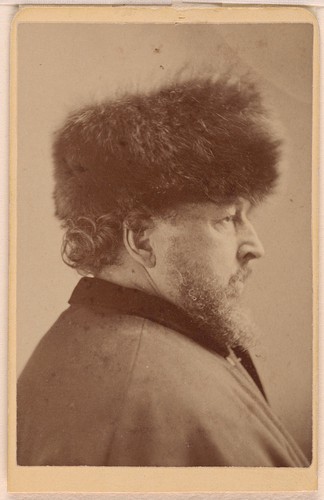
Bayard Taylor was an American poet, literary critic, translator, travel author, and diplomat.
Books
Beauty and the beast
Travels
In a near future United States where the subliminal power of television has been boosted to irresistible levels, Dodd Corely is a man increasingly at odds with the world. His live-in girlfriend, Sheila, is addicted to the popular Travels television station, which features 24-hour-a-day viewing of a hypnotically seductive sphere bouncing on an endless, surreal journey through a variety of unspoiled natural environments. His friend and fellow veteran of the South American War, Danny Marauder, has joined the Anarchists, a disreputable group dedicated to the overthrow of the established order. His best friend, Toby, is so busy watching the Travels station's #1 rival, Jesus TV--which has just announced the greatest live special in television history: the Second Coming of Jesus Christ--that he fails to notice his own daughter is pregnant . . . a crime punishable by sterilization in this overpopulated society.
Joseph and His Friend
Joseph and His Friend: A Story of Pennsylvania is an 1870 novel by American author Bayard Taylor, a prolific writer in many genres. It presented a special attachment between two men and discussed the nature and significance of such a relationship, romantic but not sexual. Critics are divided in interpreting Taylor's novel as a political argument for gay relationships or an idealization of male spirituality.
Hannah Thurston
"Hannah Thurston ... the daughter of Quaker parents, has herself been brought up a Quaker, but has strayed beyond the limits prescribed by George Fox and Robert Barclay, and can hardly be said to be a Quaker at all. She has made humanity her God, and philanthropy her worship. She has devoted herself body and soul to the assertion of woman's rights, and insists that woman has a right to be treated as a man, to enter public life, or to enter any public career, as a man, or to vote or be voted for as a man. She is, or wishes to be, a man-woman, and to force all men to recognize and respect her manly claims..."--Brownson's Quarterly Review, July, 1864
Eldorado Or Adventures In Path Of Empire
Bayard Taylor (1825-1878) was already a well-established writer when he traveled to California as special correspondent for the New York Tribune in the summer of 1849. On his return to New York, Taylor established himself not only as one of America's great travel writers but as a true man of letters, producing distinguished novels and poems as well as nonfiction for the next quarter century. Eldorado (1850) consists of Taylor's rewritten dispatches to his paper. Volume 2 tells of the 1849 elections, horseback tours of the Sierras, gold camps on the Mokelumne River, analysis of the 1849 overland emigration, San Francisco social and cultural life, and a return to the East with stops in Guadalajara, Mazatlàn, Mexico City, Popcateptel, and Vera Cruz. Thomas Butler King's official report on California, 22 March 1850, is printed as an appendix.
Eldorado or, Adventures in the path of empire
Bayard Taylor (1825-1878) was already a well-established writer when he traveled to California as special correspondent for the New York Tribune in the summer of 1849. On his return to New York, Taylor established himself not only as one of America's great travel writers but as a true man of letters, producing distinguished novels and poems as well as nonfiction for the next quarter century. Eldorado (1850) consists of Taylor's rewritten dispatches to his paper. The first volume contains his descriptions of his voyage to California via the Isthmus; the Pacific Coast of Mexico and California; the cities of San Francisco, Sacramento, Stockton, and Monterey; visits to gold fields at Sonora and the Mokelumne River; and the state Constitutional Convention.
A Visit to India, China, and Japan (Ganesha - Japan in English: Key Nineteenth-Century Sources on Japan)
The Annotated Joseph and His Friend
Bayad Taylor wrote the first American gay novel, but the nineteenth century book--Joseph and His Friend--is often unknown to contemporary readers of queer fiction. Author and researcher L.A. Fields seeks to remedy this with her newest release. The notes accompanying each chapter of this book move from the private life of the man who inspired the story (Halleck), through the secrets of its author (Taylor), noting especially his private love for and public rivalry with Walt Whitman (Leaves of Grass). The notes then expand on Whitman's unique position in gay and American history: the nascent coming-out letters Whitman called ''avowals'' from the likes of Bram Stoker and Oscar Wilde; Whitman's witnessing of the Civil War, the Lincoln presidency, and his lover's chance attendance at Ford's Theater the night of Lincoln's assassination; as well as Whitman's own understanding and defense for writing honestly about the love of men. The structure of the project combines Taylor's original 1870 novel with brief strings of American history, contemporary anecdote, and curiosities from a more secret history. A new topic is positioned behind every chapter, providing the background that reveals just how important this novel was at the time, how rare it is now, and how daring it's always been to tell the truth.
Blah, blah, blah
"This book compares and contrasts Christianity with other worldviews to better equip young people for the questions they will face in college and beyond"--Provided by publisher.
Beauty and The Beast, Etc.
We are about to relate a story of mingled fact and fancy. The facts are borrowed from the Russian author, Petjerski; the fancy is our own. Our task will chiefly be to soften the outlines of incidents almost too sharp and rugged for literary use, to supply them with the necessary coloring and sentiment, and to give a coherent and proportioned shape to the irregular fragments of an old chronicle. We know something, from other sources, of the customs described, something of the character of the people from personal observation, and may therefore the more freely take such liberties as we choose with the rude, vigorous sketches of the Russian original.
