
UNITED KINGDOM AUTHOR · PHILOSOPHY · RELIGION
Alan Watts
Also known as: Alan Wilson Watts, Alan W. Watts
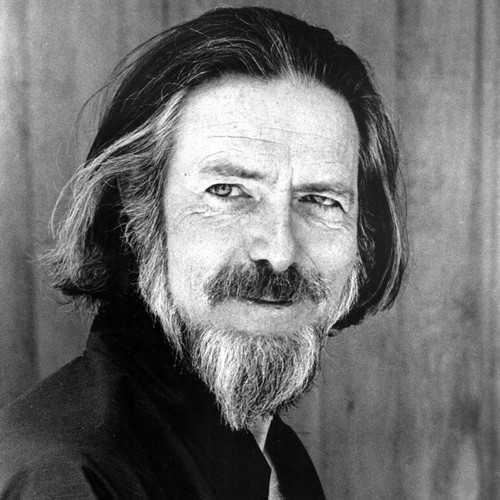
Alan Wilson Watts (January 6, 1915 – November 16, 1973) was a British philosopher, writer, and speaker, best known as an interpreter and popularizer of Eastern philosophy for a Western audience.
WHEN CHRISTIANS FIRST DISTINGUISHED themselves from pagans, the word "pagan" meant "country-dweller."
— from Nature, Man,& Woman, 1970
Most acclaimed

Psychotherapy, East and West
1972
Before he became a counterculture hero, Alan Watts was known as an incisive scholar of Eastern and Western psychology and philosophy. In this 1961 classic, Watts demonstrates his deep understanding of both Western psychotherapy and the Eastern spiritual philosophies of Buddhism, Taoism, Vedanta, and Yoga. He examined the problem of humans in a seemingly hostile universe in ways that questioned the social norms and illusions that bind and constrict modern humans. Marking a groundbreakingsynthesis, Watts asserted that the powerful insights of Freud and Jung, which had, indeed, brought psychiatry close to the edge of liberation, could, if melded with the hitherto secret wisdom of the Eastern traditions, free people from their battles with the self. When psychotherapy merely helps us adjust to social norms, Watts argued, it falls short of true liberation, while Eastern philosophy seeks our natural relation to the cosmos.
Nature, Man,& Woman
1970
"In this book, the author ... makes an important contribution to our understanding of man's place in the natural world. No man, he shows, is fit to control nature unless he feels himself to be a part of it, fully aware that seemingly individual things, including himself, are in fact inseparably related to events. Hostility to nature is characteristic of our culture, and is the root of our personal anxiety and loneliness, our fear of feeling, and our reluctance to love. Mr. Watts discusses the origins of this alienation from nature in Christianity and Western thought, contrasted with the Chinese philosophy of the Tao and its vision of nature as an organic whole in which man is fully included and feels at home. The love of man and woman is seen as a sacramental means of overcoming our estrangement from life, and Mr. Watts writes both as a poet and philosopher to give a deeply moving description of the sense of man's identity with nature in everyday life as well as in the act of love."--Page of cover.
Buddhism, the religion of no-religion
1996
In this dynamic series of lectures recorded in 1965 and 1969, Alan Watts joyfully takes us on an exploration of Buddhism, from its roots in India over 2,500 years ago to the explosion of interest in Zen and the Tibetan tradition in the West. These lectures have been transcribed and edited by the author's son, Mark Watts, who also provides an introduction that sets them in their historical context. This book then begins with Journey From India, which presents a brief explanation of the Indian worldview and cosmology followed by a discussion of the important differences between Hinduism and Buddhism. The Middle Way offers an insight into the radical methods of the Mahayana, or "great vehicle," and reviews the basic Buddhist terms and teaching, including the Four Noble Truths and the Eightfold Path. Alan Watts then turns his attention to Zen and Tibetan Buddhism in the remaining four chapters. In Religion of No-Religion he discusses how the Buddha taught the method of awakening through the experience of no-self, no-concept, and no-religion. This technique of short-circuiting the mind is seen today in the method of instruction centered upon Zen koans. In contrast to the intellectual methods of Zen, the Tibetan, or Vajrayana school, retained much more of the original Indian flavor of Mahayana Buddhism, and in Wisdom of the Mountains Watts provides an introduction to Tibetan Buddhism by explaining its unique practices. In the final chapter, Transcending Duality, Alan Watts explores the male and female symbolism of Tantric yoga and explores the unity of polar opposites as a form of resonance.