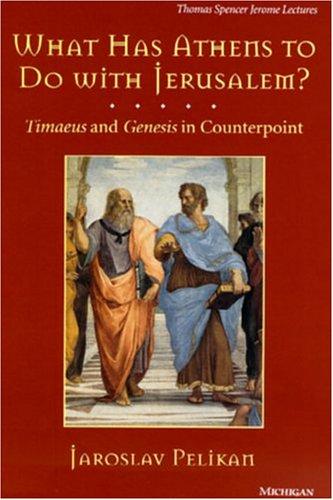
What Has Athens to Do with Jerusalem?
Description
The debates over teaching evolution and/or creationism in the public schools are striking evidence of the tensions between a biblical and a philosophical-scientific explanation of the origins of the universe and the human race. To make historical sense of such debates and those tensions, it is essential to put them into context. For most of the past twenty centuries, that context has been supplied by the relation (or "counterpoint") between two monumental texts: the Timaeus of Plato and the Book of Genesis. In What Has Athens to Do with Jerusalem? Jaroslav Pelikan examines the origins of this counterpoint. He reviews the central philosophical issues of origins as posed in classical Rome by Lucretius and then proceeds to an examination of each of the two texts with Plato representing Athens and Moses representing Jerusalem. He then follows the three most important case studies of the counterpoint - in the Jewish philosophical theology of Alexandria, in the Christian thought of Constantinople, and in the intellectual foundations of the Western Middle Ages represented by Catholic Rome, where Timaeus would be the only Platonic dialogue in general circulation. Pelikan's study leads to original findings that deal with Christian doctrine in the period of the church fathers, including the Three Cappadocians (Basil of Caesarea, Gregory of Nazianzus, and Gregory of Nyssa) in the East, and in the West, Ambrose, Augustine, and Boethius. All of these vitally important authors addressed the problem of the "counterpoint," and neither they nor these primary texts can become fully intelligible without attention to the central issues being explored here. What Has Athens to Do with Jerusalem? will be of interest to historians, theologians, and philosophers and to anyone with interest in any of the traditions addressed herein.