Discover

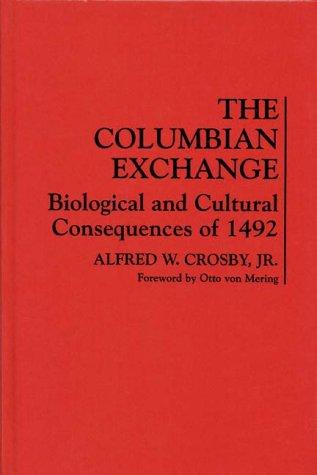
The Columbian exchange

Minsik readers
0.0
0 ratings
Other platforms
0.0
0 ratings
320
PAGES
~5h 20min
READING TIME
English
LANGUAGE
5
READERS
Published 1972 Praeger Paperback 6 views
ISBN
0837158214
Editions
Paperback
Hardcover
6 views
Minsik want to read: 0
Minsik reading: 0
Minsik read: 0
Open Library want to read: 4
Open Library reading: 1
Open Library read: 0

About Author

Alfred W. Crosby

Alfred Worcester Crosby (15 January 1931-) Alfred W. Crosby was born in Boston in 1931 where he still lives with his wife Barbara and daughter Carolyn Jane. He graduated from Harvard College in 1952 and served in the United States Army, stationed in Panama (1952-1955). After his army service he earned a Master in the Art of Teaching (M.A.T.) from the Harvard School of Education and a Doctor of Philosophy in history from Boston University in 1961. His dissertation was published as his first book, "America, Russia, Hemp, and Napoleon: a study of trade between the United States and Russia, 1783-1814" from the time of the American Revolution through the War of 1812. During his academic career he taught at Albion College, the Ohio State University, Washington State University, and finally the University of Texas at Austin. He retired from the University of Texas in 1999 as Professor Emeritus of Geography, History, and American Studies. His involvement in the Civil Rights movement, teaching Black Studies, helping to build a medical center for the United Farm Workers’ Union, and taking a leadership role in anti-Vietnam War demonstrations set him off in intellectually unorthodox directions. He became particularly interested in the histories of people who were victimized, economically exploited, or enslaved in the advance of European imperialism and capitalism, and thereby in the influence in that advance of nonpolitical, nonreligious, and largely ignored factors—especially infectious disease. All this did not make of him a Marxist radical, because—as he put it—he was not that much of an optimist. It did, however, inspire interest in demography and epidemiology, which led him to write several books—"The Columbian Exchange: Biological and Cultural Consequences of 1492" (1972); "America’s Forgotten Pandemic (originally Epidemic and Peace 1918)" (1976); and "Ecological Imperialism: The Biological Expansion of Europe, 900-1900" (1986). His fascination with several subdivisions of intellectual and technological history produced "The Measure of Reality: Quantification and Western Society, 1250-1600" (1997); "Throwing Fire: Projectile Technology Through History"; and "Children of the Sun: A History of Humanity’s Unappeasable Appetite for Energy". His work as a historian, he said, turned him from facing the past to facing the future.

First sentence

On the evening of October 11, 1492, Christopher Columbus, on board the Santa Maria in the Atlantic Ocean, thought he saw a tiny light far in the distance...

Description

There is no description yet, we will add it soon.

Detailed Ratings

0.0Emotional Impact
No ratings yet
0.0Intellectual Depth
No ratings yet
0.0Writing Quality
No ratings yet
0.0Rereadability
No ratings yet
0.0Pacing
No ratings yet
0.0Readability
No ratings yet
0.0Plot Complexity
No ratings yet
0.0Humor
No ratings yet