Discover

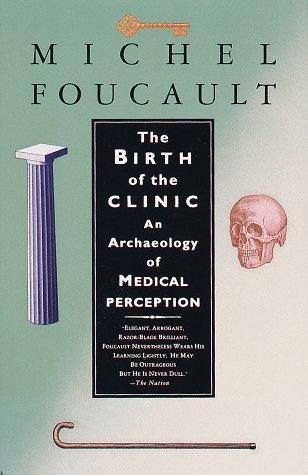
Naissance de la clinique

Minsik readers
0.0
0 ratings
Other platforms
0.0
0 ratings
352
PAGES
~5h 52min
READING TIME
English
LANGUAGE
1
READERS
Published 1963 Ediciones Akal, S.A. 5 views
ISBN
0422761907, 0422739405
Editions
Paperback
Mass Market Paperback
5 views
Minsik want to read: 0
Minsik reading: 0
Minsik read: 0
Open Library want to read: 1
Open Library reading: 0
Open Library read: 0

About Author

Michel Foucault

Paul-Michel Foucault (UK: FOO-koh, US: foo-KOH; French: [pɔl miʃɛl fuko]; 15 October 1926 – 25 June 1984) was a French historian of ideas and philosopher, who was also an author, literary critic, political activist, and teacher. Foucault's theories primarily addressed the relationships between power, knowledge and liberty, and he analyzed how they are used as a form of social control through multiple institutions. Though often cited as a structuralist and postmodernist, Foucault rejected these labels and sought to critique authority without limits on himself. His thought has influenced academics within a large number of contrasting areas of study, with this especially including those working in anthropology, communication studies, criminology, cultural studies, feminism, literary theory, psychology, and sociology. His efforts against homophobia and racial prejudice as well as against other ideological doctrines have also shaped research into critical theory and Marxism–Leninism alongside other topics.

Description

"In the eighteenth century, medicine underwent a mutation. For the first time, medical knowledge took on a precision that had formerly belonged only to mathematics. The body became something that could be mapped. Disease became subject to new rules of classification. And doctors begin to describe phenomena that for centuries had remained below the threshold of the visible and expressible. In The Birth of the Clinic the philosopher and intellectual historian who may be the true heir to Nietzsche charts this dramatic transformation of medical knowledge. As in his classic Madness and Civilization, Michel Foucault shows how much what we think of as pure science owes to social and cultural attitudes - in this case, to the climate of the French Revolution. Brilliant, provocative, and omnivorously learned, his book sheds new light on the origins of our current notions of health and sickness, life and death." --

Detailed Ratings

0.0Emotional Impact
No ratings yet
0.0Intellectual Depth
No ratings yet
0.0Writing Quality
No ratings yet
0.0Rereadability
No ratings yet
0.0Pacing
No ratings yet
0.0Readability
No ratings yet
0.0Plot Complexity
No ratings yet
0.0Humor
No ratings yet