Discover

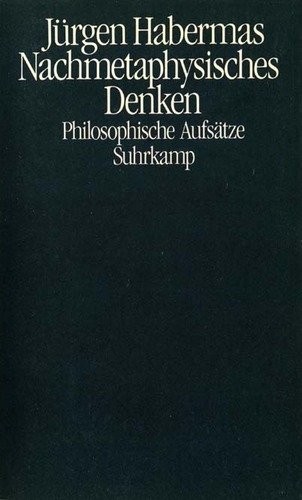
Nachmetaphysisches Denken

Minsik readers
0.0
0 ratings
Other platforms
0.0
0 ratings
285
PAGES
~4h 45min
READING TIME
German
LANGUAGE
Published 1993 Suhrkamp
ISBN
3518286048, 9783518286043
Editions
Paperback
Minsik want to read: 0
Minsik reading: 0
Minsik read: 0
Open Library want to read: 0
Open Library reading: 0
Open Library read: 0

About Author

Jürgen Habermas

Jürgen Habermas (18 June 1929 – 14 March 2026) was a German philosopher and social theorist in the tradition of critical theory and pragmatism. His work addressed communicative rationality and the public sphere. He held professorships at Heidelberg University and Goethe University Frankfurt and directed the Max Planck Institute in Starnberg. Associated with the Frankfurt School, Habermas's work focused on the foundations of epistemology and social theory, the analysis of advanced capitalism and democracy, the rule of law in a critical social-evolutionary context, and contemporary politics, particularly German politics. His major works include The Structural Transformation of the Public Sphere (1962), a social history of the emergence and decline of bourgeois public discourse, and The Theory of Communicative Action (1981), which advanced a theory of rationality grounded in interpersonal linguistic communication rather than in instrumental or strategic reason.

Description

Der Band enthält philosophische Aufsätze. Die ersten drei Beiträge reagieren auf neuere Versuche einer Rückkehr zu metaphysischen Denkformen. Die Aufsätze, die die pragmatische Wende in der Sprachanalyse nachvollziehen, entfalten den Begriff der kommunikativen Vernunft im Kontext zeitgenössischer Bedeutungs- und Handlungstheorien. Dasselbe Thema behandelt der siebte Beitrag aus größerer Distanz, und zwar in Auseinandersetzung mit den kontextualistischen Varianten einer heute dominierenden Vernunftkritik. In den beiden letzten Beiträgen werden zwei Fäden aus diesem Argumentationsgewebe aufgenommen und fortgesponnen: einmal geht es um das Problem der Unaussprechlichkeit des Individuellen, zum anderen um die Frage, warum philosophische Texte, ungeachtet ihres wesentlich rhetorischen Charakters, nicht in Literatur aufgehen. (Quelle: [Suhrkamp Verlag](

Detailed Ratings

0.0Emotional Impact
No ratings yet
0.0Intellectual Depth
No ratings yet
0.0Writing Quality
No ratings yet
0.0Rereadability
No ratings yet
0.0Pacing
No ratings yet
0.0Readability
No ratings yet
0.0Plot Complexity
No ratings yet
0.0Humor
No ratings yet