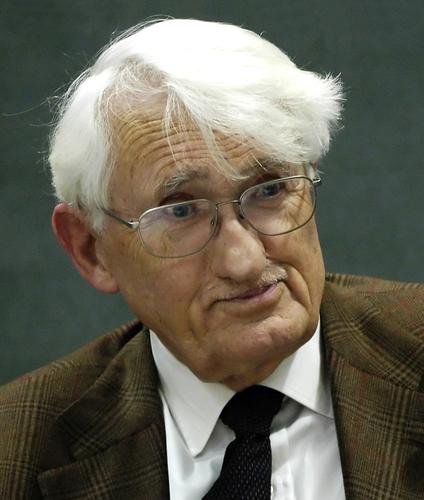
Jürgen Habermas
Personal Information
Description
German sociologist and philosopher in the tradition of critical theory and pragmatism.
Books
Between naturalism and religion
"Two countervailing trends mark the intellectual tenor of our age the spread of naturalistic worldviews and religious orthodoxies. Advances in biogenetics, brain research, and robotics are clearing the way for the penetration of an objective scientific self-understanding of persons into everyday life. For philosophy, this trend is associated with the challenge of scientific naturalism. At the same time, we are witnessing an unexpected revitalization of religious traditions and the politicization of religious communities across the world. From a philosophical perspective, this revival of religious energies poses the challenge of a fundamentalist critique of the principles underlying the modern West's postmetaphysical understanding of itself. The tension between naturalism and religion is the central theme of this major new book by JürgenHabermas. On the one hand he argues for an appropriate naturalistic understanding of cultural evolution that does justice to the normative character of the human mind. On the other hand, he calls for an appropriate interpretation of the secularizing effects of a process of social and cultural rationalization increasingly denounced by the champions of religious orthodoxies as a historical development peculiar to the West. These reflections on the enduring importance of religion and the limits of secularism under conditions of postmetaphysical reason set the scene for an extended treatment the political significance of religious tolerance and for a fresh contribution to current debates on cosmopolitanism and a constitution for international society."--Book cover.
Philosophy in a time of terror
"The idea for Philosophy in a Time of Terror was born hours after the terrorist attacks on 9/11 and came to realization just weeks later when Giovanna Borradori sat down with Jurgen Habermas and Jacques Derrida, in separate interviews, in New York City. Habermas and Derrida, guided by Borradori, evaluate the significance of the most destructive terrorist attack ever perpetrated. The book marks an unprecedented encounter between two of the most influential thinkers of our age: here for the first time Habermas and Derrida overcome their historical antagonism and agree to appear side by side." "In her introduction, Borradori contends that philosophy has an invaluable contribution to make to the understanding of terrorism. Just as the traumas produced by colonialism, totalitarianism, and the Holocaust wrote the history of the twentieth century, the history of the twenty-first century is already signed by global terrorism. Each dialogue here, accompanied by a critical essay, recognizes the magnitude of this upcoming challenge. Characteristically, Habermas's dialogue is dense, compact, and elegantly traditional. Derrida's, on the other hand, takes the reader on a long, winding, and unpredictable road. Yet unexpected agreements emerge between them: both have a deep suspicion of the concept of "terrorism" and both see the need for a transition from classical international law, premised on the model of nation-states, to a new cosmopolitan order based on continental alliances." "As Derrida and Habermas disassemble and reassemble what we think we know about terrorism, they break from the familiar social and political rhetoric increasingly polarized between good and evil. In this process, we watch two of the greatest philosophical minds at work."--Jacket.
A Berlin republic
A Berlin Republic (Die Normalitat einer Berliner Republik) brings together writings on the new, united Germany by one of that country's most original and trenchant commentators, Jurgen Habermas. Among other topics, Habermas addresses the consequences of German history, the challenges and perils of the post-Wall era, and Germany's place in contemporary Europe. Habermas insists that 1945 - not 1989 - was the crucial turning point in German history, since it was then that West Germany decisively repudiated certain aspects of its cultural and political past (nationalism and anti-Semitism in particular) and turned toward Western traditions of democracy, free and open discussion, and respect for the civil rights of all individuals. Similarly, Habermas deplores the renewal of nationalist sentiment in Germany and throughout Europe. Drawing upon his vast historical knowledge and contemporary insight, Habermas argues for heightened emphasis on trans-European and global democratic institutions - institutions far better suited to meet the challenges (and dangers) of the next century.
Debating the state of philosophy
Do we still need philosophical discourse as part of communication within our culture? Is philosophical endeavor still valid? This book offers the views of some of the most popular, distinguished contemporary philosophers who have placed their mark on philosophy. Jurgen Habermas, Richard Rorty, Leszek Kolakowski, and Ernest Gellner bring their ideas into confrontation in a unique debate devoted to the present state of philosophy. The future of Western culture may depend on the answers to the questions asked by these authors.
Nachmetaphysisches Denken
Der Band enthält philosophische Aufsätze. Die ersten drei Beiträge reagieren auf neuere Versuche einer Rückkehr zu metaphysischen Denkformen. Die Aufsätze, die die pragmatische Wende in der Sprachanalyse nachvollziehen, entfalten den Begriff der kommunikativen Vernunft im Kontext zeitgenössischer Bedeutungs- und Handlungstheorien. Dasselbe Thema behandelt der siebte Beitrag aus größerer Distanz, und zwar in Auseinandersetzung mit den kontextualistischen Varianten einer heute dominierenden Vernunftkritik. In den beiden letzten Beiträgen werden zwei Fäden aus diesem Argumentationsgewebe aufgenommen und fortgesponnen: einmal geht es um das Problem der Unaussprechlichkeit des Individuellen, zum anderen um die Frage, warum philosophische Texte, ungeachtet ihres wesentlich rhetorischen Charakters, nicht in Literatur aufgehen. (Quelle: [Suhrkamp Verlag](
Vorstudien und Ergänzungen zur Theorie des kommunikativen Handelns
Die Theorie des kommunikativen Handelns ist auf Bedürfnisse der Gesellschaftstheorie zugeschnitten. Zunächst leistet sie einen Beitrag zur Bedeutungstheorie. Wir verstehen einen Sprechakt, wenn wir wissen, was ihn akzeptabel macht. Ferner stellt sich die Theorie des kommunikativen Handelns die Aufgabe, die in die kommunikative Alltagspraxis eingelassene Vernunft aufzusuchen und aus der Geltungsbasis der Rede einen unverkürzten Begriff der Vernunft zu rekonstruieren. Schließlich nimmt die Theorie des kommunikativen Handelns bestimmte kritische Anstöße auf, die seit Humboldt (bis zu Austin und Rorty) von Seiten der Sprachphilosophie ausgegangen sind. Sie kritisiert die einseitige Ausrichtung der abendländischen Philosophie an der Welt des Seienden. (Quelle: [Suhrkamp Verlag](
Strukturwandel der Öffentlichkeit
*The Structural Transformation of the Public Sphere: An Inquiry into a Category of Bourgeois Society (German: Strukturwandel der Öffentlichkeit. Untersuchungen zu einer Kategorie der bürgerlichen Gesellschaft) is a 1962 book by the philosopher Jürgen Habermas. It was translated into English in 1989 by Thomas Burger and Frederick Lawrence. An important contribution to modern understanding of democracy, it is notable for "transforming media studies into a hard-headed discipline." (Source: [Wikipedia](
The philosophical discourse of modernity
A series of twelve lectures on Modern and Post Modern thinkers ranging from Hegel who critiqued subjective reason and sought to replace it with Absolute Knowledge to Nietsche who proclaimed the death of philosophy and on to thinkers like Habermas who believed that art might possess the capability of uniting our fragmented reasoning ability and finally to post modern thinkers like Bataille, Focault and Derrida
Eine Art Schadensabwicklung
Keine Normalisierung der Vergangenheit. (Rede). Über den doppelten Boden des demokratischen Rechtsstaates. (Rede). Heinrich Heine und die Rolle des Intellektuellen in Deutschland. Kritische Theorie und Frankfurter Universität. (Interview). Über Moral, Recht, zivilen Ungehorsam und Moderne. (Interview). Die Idee der Universität – Lernprozesse. Die Schrecken der Autonomie. Carl Schmitt auf englisch. Eine Art Schadensabwicklung. Apologetische Tendenzen – Vom öffentlichen Gebrauch der Historie – Nachspiel. Geschichtsbewußtsein und posttraditionale Identität. Die Westorientierung der Bundesrepublik. (Quelle: [Suhrkamp Verlag](