Discover

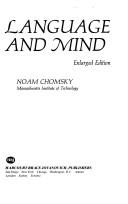
Language and mind

Minsik readers
0.0
0 ratings
Other platforms
0.0
0 ratings
210
PAGES
~3h 30min
READING TIME
English
LANGUAGE
3
READERS
Cambridge University Press 2 views
ISBN
0151478104, 0155492578
Editions
E-book
Paperback
Hardcover
2 views
Minsik want to read: 0
Minsik reading: 0
Minsik read: 0
Open Library want to read: 3
Open Library reading: 0
Open Library read: 0

About Author

Noam Chomsky

Avram Noam Chomsky (born December 7, 1928) is an American intellectual, philosopher, linguist, political activist, and social critic. Sometimes called "the father of modern linguistics", Chomsky is also a major figure in analytic philosophy and one of the founders of the field of cognitive science. He is a laureate professor of linguistics at the University of Arizona and an institute professor emeritus at the Massachusetts Institute of Technology (MIT). Among the most cited living authors, Chomsky has written more than 150 books on topics such as linguistics, war, and politics. In addition to his work in linguistics, since the 1960s, Chomsky has been an influential voice on the American Left as a consistent critic of the foreign policy of the United States, contemporary capitalism, and corporatocracy.

First sentence

In these lectures, I would like to focus attention on the question...

Description

This is the long-awaited third edition of Chomsky's outstanding collection of essays on language and mind. The first six chapters, originally published in the 1960s, made a groundbreaking contribution to linguistic theory. This new edition complements them with an additional chapter and a new preface, bringing Chomsky's influential approach into the twenty-first century. Chapters 1-6 present Chomsky's early work on the nature and acquisition of language as a genetically endowed, biological system (Universal Grammar), through the rules and principles of which we acquire an internalized knowledge (I-language). Over the past fifty years, this framework has sparked an explosion of inquiry into a wide range of languages, and has yielded some major theoretical questions. The final chapter revisits the key issues, reviewing the 'biolinguistic' approach that has guided Chomsky's work from its origins to the present day, and raising some novel and exciting challenges for the study of language and mind.

Detailed Ratings

0.0Emotional Impact
No ratings yet
0.0Intellectual Depth
No ratings yet
0.0Writing Quality
No ratings yet
0.0Rereadability
No ratings yet
0.0Pacing
No ratings yet
0.0Readability
No ratings yet
0.0Plot Complexity
No ratings yet
0.0Humor
No ratings yet