Discover

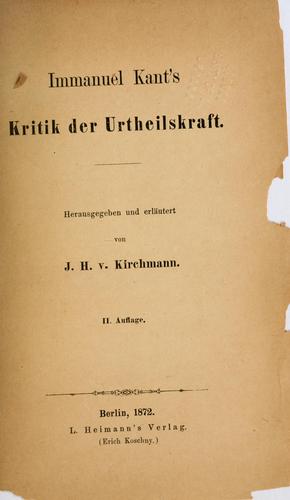
Kritik der Urteilskraft

Minsik readers
0.0
0 ratings
Other platforms
4.3
3 ratings
382
PAGES
~6h 22min
READING TIME
German
LANGUAGE
1
READERS
L. Heimann
ISBN
3518076574
Editions
Paperback
Hardcover
Minsik want to read: 0
Minsik reading: 0
Minsik read: 0
Open Library want to read: 1
Open Library reading: 0
Open Library read: 0

About Author

Immanuel Kant

Immanuel Kant was an 18th-century German philosopher from the Prussian city of Königsberg. Kant was the last influential philosopher of modern Europe in the classic sequence of the theory of knowledge during the Enlightenment beginning with thinkers John Locke, George Berkeley, and David Hume. Kant created a new perspective in philosophy which had widespread influences on philosophy continuing through to the 21st century. He published important works on epistemology, as well as works relevant to religion, law, and history. One of his most prominent works is the Critique of Pure Reason, an investigation into the limitations and structure of reason itself. It encompasses an attack on traditional metaphysics and epistemology, and highlights Kant's own contribution to these areas. The other main works of his maturity are the Critique of Practical Reason, which concentrates on ethics, and the Critique of Judgment, which investigates aesthetics and teleology.

Description

In THE CRITIQUE OF JUDGMENT (1790), Immanuel Kant (1724-1804) seeks to establish the a priori principles underlying the faculty of judgement, just as he did in his previous critiques of pure and practical reason. The first part deals with the subject of our aesthetic sensibility; we respond to certain natural phenomena as beautiful, says Kant, when we recognise in nature a harmonious order that satisfies the mind's own need for order. The second half of the critique concentrates on the apparent teleology in nature's design of organisms. Kant argues that our minds are inclined to see purpose and order in nature and this is the main principle underlying all of our judgements. Although this might imply a super sensible Designer, Kant insists that we cannot prove a supernatural dimension or the existence of God. Such considerations are beyond reason and are solely the province of faith.

Detailed Ratings

0.0Emotional Impact
No ratings yet
0.0Intellectual Depth
No ratings yet
0.0Writing Quality
No ratings yet
0.0Rereadability
No ratings yet
0.0Pacing
No ratings yet
0.0Readability
No ratings yet
0.0Plot Complexity
No ratings yet
0.0Humor
No ratings yet