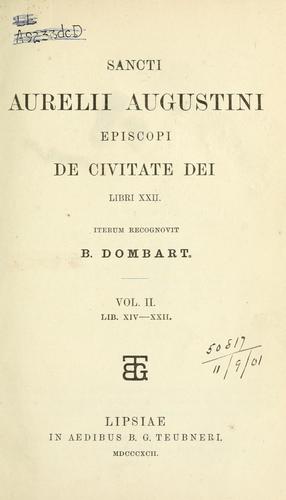
De civitate Dei

First sentence
One of the great cornerstones in the history of Christian philosophy, The City of God provides an insightful interpretation of the development of modern Western society and the origin of most Western thought. Contrasting earthly and heavenly cities--representing the omnipresent struggle between good and evil--Augustine explores human history in its relation to all eternity. In Thomas Merton's words, "The City of God is the autobiography of the Church written by the most Catholic of her great saints." This Modern Library Paperback Classics edition is a complete and unabridged version of the Marcus Dods translation...
Description
This is the first new rendition for a generation of The City of God, the first major intellectual achievement of Latin Christianity and one of the classic texts of Western civilisation. When he began to write The City of God in 413, St. Augustine's intention was to defend the Christian Church against the charge of having brought about the Sack of Rome in 410. Outgrowing this initial purpose, the work evolved into a detailed critique of the political and moral tradition of Rome and a synthesis of Platonism and Christianity which must stand as one of the most significant achievements in Western intellectual history. Apart from its intrinsic interest the Christian account of social and political relations which Augustine gives was to furnish one of the most fertile sources of material for the controversial literature of the middle ages. R. W. Dyson has produced a complete, accurate, authoritative and fluent translation of The City of God, edited together with full biographical notes, a concise introduction, bibliographical note and chronology of Augustine's life.