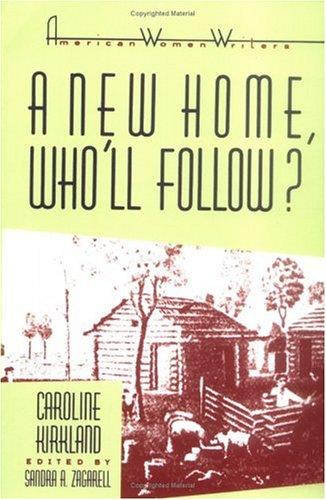
A new home--who'll follow? or, Glimpses of western life
First sentence
Here are seen No traces of man's pomp and pride; no silks Rustle, nor jewels shine, nor envious eyes Encounter * Oh, there is not lost earth's charms; upon her bosom yet After the flight of untold centuries The freshness of her far beginning lies...
Description
Caroline Matilda (Stansbury) Kirkland (1801-1864) was a middle-class white woman with a literary bent who moved with her husband and children to the woods of Michigan in the mid-1830s to settle a newly-planned village. In this book, first published in 1839, she offers what she claims to be "an honest portraiture of rural life in a new country" (p. 5). Through a series of vignettes and anecdotes strung loosely into a narrative, Kirkland brings to life the social and material culture of a community on what was perceived as the frontier, presenting her experiences with a sense of ironic amusement. She reveals much about social life, social roles and behavior, especially among women. She describes the business of settlement, including how land was purchased and towns planned, and the haste, confusion, speculation and fraud attendant on such transactions. She comments on the social shifts pioneer life made possible, especially the egalitarianism which poorer migrants claimed as their right in new settlements, and the tensions that resulted as migrants from wealthier classes struggled to maintain and adapt the ways of status and culture they had formerly known. Her narrative also dwells on the details of domestic life, showing how houses were constructed and furnished, depicting the difficulties of housekeeping in crudely-built settlements, and the physical challenges of disease, accidents, bad roads, and the exhausting labor of deforestation and new farming. For all its light-hearted tone, Kirkland's book suggests much about how human communities bound together by neighborhood and necessity began to coalesce in a challenging and drastically changing land.