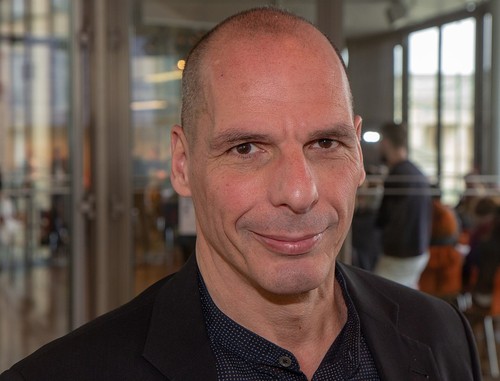
Yanis Varoufakis
Personal Information
Description
There is no description yet, we will add it soon.
Books
Rational conflict
The study of economic rationality is attracting increasing attention from other disciplines as well as continuing to be the subject of debate within economics. At its heart is the notion that, in a situation of choice or confrontation, knowledge of an individual's desires and beliefs will allow their actions to be predicted. Yanis Varoufakis argues that this is an ideal abstraction which is both inapplicable and ineffective. Using examples from industrial relations, diplomacy, hostage crises and the law, he shows that it is impossible to quantify the aspirations of individuals in these conflicts, and that traditional theory ignores both the wider context and the history of similar cases.
The Global Minotaur America The True Origins Of The Financial Crisis And The Future Of The World Economy
The author explodes the myth that financialization, ineffectual regulation of banks, greed and globalization were the root causes of the global economic crisis. Rather, they are symptoms of a much deeper malaise which can be traced all the way back to the Great Crash of 1929, then on through to the 1970s: the time when a 'Global Minotaur' was born. Just as the Athenians maintained a steady flow of tributes to the Cretan beast, so the 'rest of the world' began sending incredible amounts of capital to America and Wall Street. Thus, the Global Minotaur became the 'engine' that pulled the world economy from the early 1980s to 2008. Today's crisis in Europe, the heated debates about austerity versus further fiscal stimuli in the US, the clash between China's authorities and the Obama administration on exchange rates are the inevitable symptoms of the weakening Minotaur; of a global 'system' which is now as unsustainable as it is imbalanced. Going beyond this, the author lays out the options available to us for reintroducing a modicum of reason into a highly irrational global economic order.
Europe after the Minotaur
"Syriza's victory in the Greek general election in January 2015 is a truly historic and profound event -- the first government of the radical left in Europe since World War Two. In this short ebook, extracted from the updated edition of The Global Minotaur , Yanis Varoufakis, the new finance minister of Greece and a Syriza MP, outlines his economic and political thinking and how he believes Europe can move beyond cuts and austerity. Varoufakis shows how today's crisis in Europe is one inevitable symptom of a global 'system' which is now as unsustainable as it is imbalanced. With powerful clarity and conviction, he lays out the options available to us for reintroducing reason into a highly irrational global economic order. This is a unique insight into the thinking of a key figure in the Syriza government, who is set to become a hugely influential figure in European politics."--
Game Theory
This advanced text introduces the principles of noncooperative game theory in a direct and uncomplicated style that will acquaint students with the broad spectrum of the field while highlighting and explaining what they need to know at any given point. This advanced text introduces the principles of noncooperative game theory—including strategic form games, Nash equilibria, subgame perfection, repeated games, and games of incomplete information—in a direct and uncomplicated style that will acquaint students with the broad spectrum of the field while highlighting and explaining what they need to know at any given point. The analytic material is accompanied by many applications, examples, and exercises. The theory of noncooperative games studies the behavior of agents in any situation where each agent's optimal choice may depend on a forecast of the opponents' choices. "Noncooperative" refers to choices that are based on the participant's perceived selfinterest. Although game theory has been applied to many fields, Fudenberg and Tirole focus on the kinds of game theory that have been most useful in the study of economic problems. They also include some applications to political science. The fourteen chapters are grouped in parts that cover static games of complete information, dynamic games of complete information, static games of incomplete information, dynamic games of incomplete information, and advanced topics. source
And the weak suffer what they must?
""The strong do as they can and the weak suffer what they must." --Thucydides The fate of the global economy hangs in the balance, and Europe is doing its utmost to undermine it, to destabilize America, and to spawn new forms of authoritarianism. Europe has dragged the world into hideous morasses twice in the last one hundred years... it can do it again. Yanis Varoufakis, the former Finance Minister of Greece, shows here that the Eurozone is a house of cards destined to fall without a radical change in direction. And, if the European Union falls apart, he argues, the global economy will not be far behind. Once America abandoned Europe in 1971 from the dollar zone, Europe's leaders decided to create a monetary union of 18 nations without control of their own money, without democratic accountability, and without a government to support the Central Bank. This bizarre economic super-power was equipped with none of the shock absorbers necessary to contain a financial crisis, while its design ensured that, when it came, the crisis would be massive. When disaster hit in 2009, Varoufakis argues that Europe turned against itself, humiliating millions of innocent citizens, driving populations to despair, and buttressing a form of bigotry unseen since the Second World War. Here, Varoufakis offers concrete policies that the rest of the world can take part in to intervene and help save Europe from impending catastrophe, and presents the ultimate case against austerity. With passionate, informative, and at times humorous prose, he warns that the implosion of an admittedly crisis-ridden and deeply irrational European capitalism should be avoided at all cost"--
And the Weak Suffer What They Must?: Europe's Crisis and America's Economic Future
Citizens of Nowhere
Europe might appear like a continent pulling itself apart. Ten years of economic and political crises have pitted North versus South, East versus West, citizens versus institutions. And yet, these years have also shown a hidden vitality of Europeans acting across borders, with civil society and social movements showing that alternatives to the status quo already exist. This book is at once a narrative of the experience of activism and a manifesto for change. Through analysing the ways in which neoliberalism, nationalism and borders intertwine, Marsili and Milanese - co-founders of European Alternatives - argue that we are in the middle of a great global transformation, by which we have all become citizens of nowhere. Ultimately, they argue that only by organising in a new transnational political party will the citizens of nowhere be able to struggle effectively for the utopian agency to transform the world. --
Foundations of Economics
Introductory economics is often thought of as dull and unappetising. Beginners need inspiration and help. Foundations of Economics breathes new life into an often-times dry discipline by linking key economic concepts with wider debates and issues. By bringing to light delightful mind-teasers, philosophical questions and intriguing politics in mainstream economics, it promises to enliven an otherwise dry course whilst inspiring students to do well. The book covers all the main economic concepts and addresses in detail three main areas: consumption and choice production and markets * government and the State. Each is discussed in terms of what the conventional textbook says, how these ideas developed in historical and philosophical terms and whether or not they make sense. Assumptions about economics as a discipline are challenged, and several pertinent students' anxieties ('Should I be studying economics?') are discussed.
Talking to My Daughter About the Economy
In Talking to My Daughter About the Economy, activist Yanis Varoufakis, Greece's former finance minister and the author of the international bestseller Adults in the Room, pens a series of letters to his young daughter, educating her about the business, politics, and corruption of world economics. Yanis Varoufakis has appeared before heads of nations, assemblies of experts, and countless students around the world. Now, he faces his most important and difficult audience yet. Using clear language and vivid examples, Varoufakis offers a series of letters to his young daughter about the economy: how it operates, where it came from, how it benefits some while impoverishing others. Taking bankers and politicians to task, he explains the historical origins of inequality among and within nations, questions the pervasive notion that everything has its price, and shows why economic instability is a chronic risk. Finally, he discusses the inability of market-driven policies to address the rapidly declining health of the planet his daughters generation stands to inherit. Throughout, Varoufakis wears his expertise lightly. He writes as a parent whose aim is to instruct his daughter on the fundamental questions of our age and through that knowledge, to equip her against the failures and obfuscations of our current system and point the way toward a more democratic alternative.
Adults in the room
"After being swept into power with the left-wing Syriza party, Varoufakis attempts to renegotiate Greece's relationship with the EU--and sparks a spectacular battle, with global implications. Varoufakis's new position sends him ricocheting between mass demonstrations in Athens, closed-door negotiations in drab EU and IMF offices, and furtive meetings with power brokers in Washington, D.C. He consults and quarrels with Barack Obama, Emmanuel Macron, Christine Lagarde, the economists Larry Summers and Jeffrey Sachs, and others, as he struggles to resolve Greece's debt crisis without resorting to punishing austerity measures. But despite the mass support of the Greek people and the simple logic of his arguments, Varoufakis succeeds only in provoking the fury of Europe's elite. Varoufakis's unvarnished memoir is an urgent warning that the economic policies once embraced by the EU and the White House have failed--and spawned authoritarianism, populist revolt, and instability throughout the Western world."--Inside book jacket.
Another Now
Imagine a world with no banks. No stock market. No tech giants. No billionaires. Imagine if Occupy and Extinction Rebellion actually won. In Another Now world-famous economist Yanis Varoufakis shows us what such a world would look like. Far from being a fantasy, he describes how it could have come about - and might yet. But would we really want it? Varoufakis's boundary-breaking new book confounds expectations of what the good society would look like and reveals the uncomfortable truth about our desire for a better world...