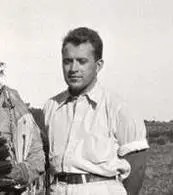

UNITED STATES AUTHOR · RELIGION · RELIGIOUS PSYCHOLOGY
Weston La Barre
Also known as: Weston LA Barre, La Barre,Weston
La Barre was born in Uniontown, Pennsylvania, the son of a banker. After graduating from Princeton University in 1933 he began field work with the Yale Institute of Human Relations. During this period, La Barre worked with one of his lifelong academic associates, Richard Evans Schultes of Harvard University. Travelling and sleeping in Schultes' old car, they traveled extensively throughout Oklahoma on their quest to study the peyote cult of the Plains Indians. La Barre received his doctorate from Yale in 1937 with a thesis on peyote religion. In a 1961 article, La Barre wrote that "It was [La Barre's teacher at Yale] Edward Sapir, more than any other person, who first effectively imported psychoanalysis into the body of American anthropology...At a time when the official anthropological journals were systematically ignoring psychoanalysis and the prevailing climate of opinion was chilly if not hostile, Sapir was giving his students as required reading the works of Abraham, Jones, Ferenczi and other classic writers." In the 1970s, La Barre taught those same classic psychoanalytic works to Duke medical students.
The topic of this book is our identity through time.
— from The human animal
Most acclaimed

The human animal
What does it take for you to persist from one time to another? What sorts of changes could you survive, and what would bring your existence to an end? What makes it the case that some past or future being, rather than another, is you? So begins Eric Olson's pathbreaking new book, The Human Animal: Personal Identity Without Psychology. You and I are biological organisms, he claims; and no psychological relation is either necessary or sufficient for an organism to persist through time. Conceiving of personal identity in terms of life-sustaining processes rather than bodily continuity distinguishes Olson's position from that of most other opponents of psychological theories. And only a biological account of our identity, he argues, can accommodate the apparent facts that we are animals, and that each of us began to exist as a microscopic embryo with no psychological features at all. Surprisingly, a biological approach turns out to be consistent with the most popular arguments for a psychological account of personal identity, while avoiding metaphysical traps. And in an ironic twist, Olson shows that it is the psychological approach that fails to support the Lockean definition of "person" as (roughly) a rational, self-conscious moral agent, an attractive view that fits naturally with a biological account.
Ghost Dance
"In Ghost Dance, it is through Chance’s keen eyes and weary heart that readers embark on a journey of discovery and sorrow. On the run across the plains, Chance stumbles upon Running Horse, a Sioux warrior enacting the sacred and violent ritual of the Sun Dance. Quickly, Chance is pulled into the world of the Sioux people. As their civilization teeters on the brink of destruction, the Sioux perform the mournful and frightening Ghost Dance. Clashes with the white man are frequent; the Wounded Knee Massacre approaches, still in the unknown distance; and violence and anger threaten the traditions of a proud and once‑great people. Nearby, in her quaint sod house, Miss Lucia Turner awaits the full impact of those clashes. Dust on the horizon signals great change coming to her once‑simple life. Lucia will soon become a different kind of woman." -- taken from Amazon.com
The Peyote Cult
For half a century, readers on peyotism have devoured La Barre’s fascinating original study, which began when the author, at age twenty-four, studied the rites of fifteen American Indian tribes using Lophophora williamsii, the small, spineless, carrot-shaped peyote cactus growing in the Rio Grande Valley and southward. Continuing his research from the 1930s through the 1980s, Weston La Barre reviews topics such as the Timothy Leary-Richard Alpert “experiments” with peyote and other psychotropic substances, the Carlos Castaneda phenomenon, the progress of the Native American Church toward acceptance as a religious denomination, the presumptions of the Neo-American Church, the legal ramifications of ritual drug use, and the spread of peyotism from the Southwest to other North American tribes. This new edition of La Barre’s classic study includes 334 new entries in the latest of his highly valued bibliographical essays on works relating to peyote, not just in anthropology but in a variety of fields including archeology, economics, botany, chemistry, and pharmacology. The bibliography lists important contributions in popular media such as newspapers, audiotapes, and films, as well as in scholarly journals.