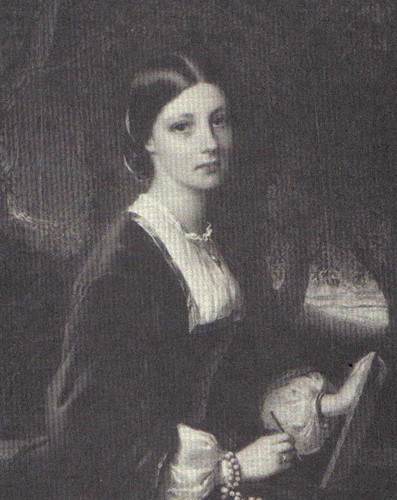
Victoria Welby
Personal Information
Description
Lady Victoria Welby, more correctly Lady Welby-Gregory, was a self-educated British philosopher of language, musician and watercolourist. Welby was born to the Hon. Charles Stuart-Wortley-Mackenzie and Lady Emmeline Stuart-Wortley, and christened Victoria Alexandrina Maria Louisa Stuart-Wortley. Following the death of her father in 1844, she travelled widely with her mother, and recorded her travel experiences in her diary. When her mother died on their travels in Syria in 1855, she returned to England to stay with her grandfather, John Manners, the 5th Duke of Rutland, at Belvoir Castle. In 1858 she moved to Frogmore to live with a friend of her mother's—the Duchess of Kent, Princess Victoria of Saxe-Coburg-Saalfeld, Queen Victoria's mother. On the death of the duchess she was appointed a maid of honour to her godmother, the Queen herself. In 1863 she married Sir William Earle Welby-Gregory, 4th baronet (1829–1898), who was active in British politics. She and Sir William lived together at Denton Manor in Lincolnshire. They had three children. Once her children were grown and had moved out of the house, Welby, who had had little formal education, began a fairly intense process of self-education. This included mixing, corresponding, and conversing with some of the leading British thinkers of her day, some of whom she invited to the Manor. It was not unusual for Victorian Englishmen of means to become thinkers and writers; Welby is one of the few women of her place and time to do the same. Source: [Wikipedia](
Books
What is meaning?
In "What is Meaning" (1903) the author elaborates on the fundamental tenets of her theory of sign, to which she give the overall term significs . One of the main obstacles to an adequate theory of meaning, in Lady Welby s opinion, is the unfounded assumption of fixed sign meaning. "There is, strictly speaking, no such thing as the Sense of a word, but only the sense in which it is used the circumstances, state of mind, reference, universe of discourse belonging to it. The Meaning of a word is the intent which it is desired to convey the intention of the user. The Significance is always manifold, and intensifies its sense as well as its meaning, by expressing its importance, its appeal to us, its moment for us, its emotional force, its ideal value, its moral aspect, its universal or at least social range." This facsimile of the 1903 edition of "What is Meaning" is accompanied by an essay on "Significs as a Fundamental Science" by Achim Eschbach, and "A Concise History of Significs" by G. Mannoury.