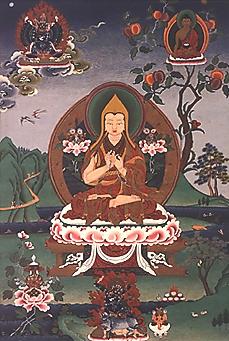
Tsongkhapa
Personal Information
Description
Tsongkhapa (1357–1419), whose name means “The Man from Onion Valley”, was a famous teacher of Tibetan Buddhism whose activities led to the formation of the Geluk school. He is also known by his ordained name Lobsang Drakpa (blo bzang grags pa) or simply as Je Rinpoche (rje rin po che). Tsongkhapa heard Buddha’s teachings from masters of all Tibetan Buddhist traditions, and received lineages transmitted in the major schools.
Books
Dbu ma rgyan gyi zin bris daṅ dbu ma rgyan gyi brjed byaṅ daṅ dkaʼ gnad brgyad kyi zin bris brjed byaṅ du bkod pa
Notes on Mādhyamika philosophy according to Dge-lugs-pa tradition.
Rje Tsoṅ-kha-pa Blo-bzaṅ-grags-pas mdzad paʾi Bla na med paʾi rin po che gsum gyi gtam gyi sbyor ba =
Tsongkhapa's teachings on proper analyzing, understanding, and practicing of Buddhist doctrines; includes Hindi and Sanskrit translation.
Rje Tsong-kha-pa chen poʼi gsung ʼbum pha
Selected works on various Buddhist philosophical doctrines of the Gelukpa sect.
Mñam med rje btsun Tsoṅ-kha-pa chen pos mdzad paʼi byaṅ chub lam rim chen moʼi dkaʼ baʼi gnad rnams mchan bu bźiʼi sgo nas legs par bśad pa theg chen lam gyi gsal sgron źes bya ba bźugs so
Critically edited Tsoṅ-kha-pa's Lam-rim (graded path) teachings with the interlineal notes by Blo-gliṅ Dge-bśes Tshul-khrims-rnam-rgyal.
Dpal rgyal ba Tsong-kha-pas mdzad paʼi Sngags rim chen mo zhes bya ba bzhugs so
Tsongkapa's teaching of stages of mantra. Tsongkapaʼs teaching of stages of mantra.
Rje thams cad mkhyen pa Tsoṅ-kha-pa chen poʼi bkaʼ ʼbum thor bu
Collected works (Bkaʼ ʼbum) of Tsoṅ-kha-paʼs minor writings chiefly on Lamaist doctrines of Tibet.
Rtsa śe tik chen rigs pa'i rgya mtsho
Root text of Madhyamakakārikā by Nāgārjuna, 2nd cent. with autocommentary by Tsongkhapa.
Uma-la hjugpa rgya char bshad pa dgoṅs pa rab gsal
Commentary on Madhyamakāvatāra-nāna text of Candrakīrti.
Khams gsum chos kyi rgyal po Rje Tsoṅ-kha-pa chen pos mdzad paʼi byaṅ chub lam rim che ba
Exegetical work on the graded path (lam-rim) teaching.
The Lam rim chen mo of the incomparable Tsong-kha-pa
Annotated edition of the Gelukpa summa of the exoteric approach to Mahayana philosophy.
Mnyam med Tsong-kha-pa chen pos mdzad paʼi Byang chub lam rim che ba bzhugs so
Teachings of Tsong-kha-pa on the stages of the path to enlightenment; includes root text of Atishaʼs Bodhipathapradīpa
Byaṅ chub lam gyi rim paʼi khrid chen brgyad phyogs gcig tu bsgrigs pa bzhugs so
Collection of texts on Lam-rim teaching of Dge-lugs-pa tradition for mental development.
Rtsom rig gces btus
Anthology of articles on Tibetan language and literature by eminent scholars.
The bridge of quiescence
This challenging new work examines practical techniques for training the attention. It will be of interest to seasoned contemplatives, to general readers concerned with meditation, to philosophers of mind, and to cognitive scientists. The book includes a translation, with commentary, of Tsongkhapa's classic fifteenth-century discussion of methods for developing exceptionally high degrees of attentional stability and clarity. Such enhancement and refining of the attention is an indispensable prerequisite to rigorous, introspective enquiry into the nature of the mind. Insights gleaned from such enquiry are instrumental in identifying and eliminating the inner sources of anxiety, frustration, and discontent. To place this training in its traditional context, Professor Wallace explains Tsongkhapa's methodology and presents an overview of Tsongkhapa's vision of reality. The Bridge of Quiescence affords a bridge from Eastern meditative practice to Western philosophy, science, and religion. Wallace's discussion draws upon his knowledge of experimental psychology (such as sensory deprivation studies) and relates Tibetan meditation to discussions of consciousness by such Western thinkers as William James, William Christian, and John Searle.
Rje yab sras gsum gyi tshad maʼi gzhung nyer mkho rnams dang rje Gung-thang Blo-gros-rgya-mtshos mdzad-paʼi bsdus sbyor snying bo kun ʼdus rigs paʼi mdzod kyi rnam bshad kun gsal me long bcas
Selected commentaries and instruction on the use of Buddhist logic (pramāṇa) in practice, written by [or at least attributed to] the Tibetan Buddhist scholar Tsongkapa Lozang Drakpa (1357-1419) and his two main students, and further curriculum by Gungtang Lodrö Gyatso (1851-1930) of Labrang Tashikyil Monastery.
Tarni mȯr-u̇n des daraġalal-un delgerengġu̇i ȯgu̇lel
Mongolian translations (from Tibetan) of Tsongkhapa's concepts and interpretations of Buddhist tantras.