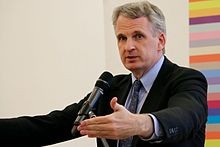
Timothy Snyder
Description
Timothy David Snyder (born August 18, 1969) is an American author and historian specializing in the history of Central and Eastern Europe, and the Holocaust. He is the Richard C. Levin Professor of History at Yale University and a Permanent Fellow at the Institute for Human Sciences in Vienna. Snyder is a member of the Council on Foreign Relations and the Committee on Conscience of the United States Holocaust Memorial Museum. Source: [Timothy Snyder]( on Wikipedia.
Books
The Red Prince
Biografie van de Habsburgse aartshertog Wilhelm (1895-1948) die tevergeefs tracht om koning van een onafhankelijk Oekraïne te worden.
Inhuman Land
"In 1941, when Germany turned against the USSR, tens of thousands of Poles--men, women, and children who were starving, sickly, and impoverished--were released from Soviet prison camps and allowed to join the Polish army being formed in the south of Russia. One of the survivors who made the difficult winter journey was the painter and reserve officer Józef Czapski. General Anders, the army's commander in chief, assigned Czapski the task of receiving the Poles arriving for military training; gathering accounts of what their fates had been; organizing education, culture, and news for the soldiers; and, most important, investigating the disappearance of thousands of missing Polish officers. Blocked at every level by the Soviet authorities, Czapski was unaware that in April 1940 the officers had been shot dead in Katyn forest, a crime for which Soviet Russia never accepted responsibility. Czapski's account of the years following his release from the camp, the formation of the Polish army, and its arduous trek through Central Asia and the Middle East to fight on the Italian front is rich in anecdotes about the suffering of the Poles in the USSR, quotations from the Polish poetry that sustained him and his companions, encounters with literary figures (including Anna Akhmatova), and philosophical thoughts about the relationships between nationalities"--
The Reconstruction of Nations
"In this pioneering book, Timothy Snyder traces the emergence of Polish, Ukrainian, Lithuanian, and Belarusian nationhood from the creation of the Polish-Lithuanian Commonwealth in 1569 to the enlargement of NATO in 1999. He provides original explanations for the atrocities of the twentieth century and the first scholarly account of the Ukrainian-Polish ethnic cleansings of the 1940s. Yet he begins with the principles of toleration that prevailed in much of early modern eastern Europe and concludes with the peaceful resolution of national tensions in the region since 1989.". "Snyder then follows transformed national ideas onto the new terrains presented by national independence after the revolutions of 1989. He reviews the threats to European security that arose in the early 1990s with the threats of breakaway minorities, provocations from Moscow, and popular fears of ethnic cleansing. Finally, he examines how a bold Polish eastern policy facilitated the peaceful end of Soviet rule in the region, prevented national disagreements from spilling into international conflict, and hastened European integration. After 1989, a Polish geopolitical vision channeled national interests toward peace."--BOOK JACKET.
The Road to Unfreedom
With the end of the Cold War, the victory of liberal democracy seemed final. Observers declared the end of history, confident in a peaceful, globalized future. This faith was misplaced. Authoritarianism returned to Russia, as Vladimir Putin found fascist ideas that could be used to justify rule by the wealthy. In the 2010s, it has spread from east to west, aided by Russian warfare in Ukraine and cyberwar in Europe and the United States. Russia found allies among nationalists, oligarchs, and radicals everywhere, and its drive to dissolve Western institutions, states, and values found resonance within the West itself. The rise of populism, the British vote against the EU, and the election of Donald Trump were all Russian goals, but their achievement reveals the vulnerability of Western societies. In this forceful and unsparing work of contemporary history, based on vast research as well as personal reporting, Snyder goes beyond the headlines to expose the true nature of the threat to democracy and law. To understand the challenge is to see, and perhaps renew, the fundamental political virtues offered by tradition and demanded by the future. By revealing the stark choices before us--between equality or oligarchy, individuality or totality, truth and falsehood--Snyder restores our understanding of the basis of our way of life, offering a way forward in a time of terrible uncertainty.
Bloodlands
Americans call the Second World War "The Good War." But before it even began, America's wartime ally Josef Stalin had killed millions of his own citizens -- and kept killing them during and after the war. Before Hitler was finally defeated, he had murdered six million Jews and nearly as many other Europeans. At war's end, both the German and the Soviet killing sites fell behind the iron curtain, leaving the history of mass killing in darkness.Bloodlands is a new kind of European history, presenting the mass murders committed by the Nazi and Stalinist regimes as two aspects of a single history, in the time and place where they occurred: between Germany and Russia, when Hitler and Stalin both held power. Assiduously researched, deeply humane, and utterly definitive, Bloodlands will be required reading for anyone seeking to understand the central tragedy of modern history. - Publisher.
Stalin and Europe
"The Soviet Union was the largest state in the twentieth-century world, but its repressive power and terrible ambition were most clearly on display in Europe. Under the leadership of Joseph Stalin, the Soviet Union transformed itself and then all of the European countries with which it came into contact. This volume considers each aspect of the encounter of Stalin with Europe: the attempt to create a kind of European state by accelerating the European model of industrial development in the USSR; mass murder in anticipation of a war against European powers; the actual contact with Europe's greatest power, Nazi Germany, first as ally and then as enemy; four years of war fought chiefly on Soviet territory and bringing untold millions of deaths, including much of the Holocaust; and finally the re-establishment of the Soviet system, not just in prewar territory of the USSR, but in Western Ukraine, Western Belarus, the Baltic Sttes, Poland, Czechoslovakia, Romania, Hungary, Bulgaria, and East Germany." --
On Tyranny
In previous books, Holocaust historian Timothy Snyder dissected the events and values that enabled the rise of Hitler and Stalin and the execution of their catastrophic policies. With Twenty Lessons, Snyder draws from the darkest hours of the twentieth century to provide hope for the twenty-first. As he writes, "Americans are no wiser than the Europeans who saw democracy yield to fascism, Nazism and communism. Our one advantage is that we might learn from their experience."
Black earth
"It comforts us to believe that the Holocaust was a unique event. But as Timothy Snyder shows, we have missed basic lessons of the history of the Holocaust, and some of our beliefs are frighteningly close to the ecological panic that Hitler expressed in the 1920s. As ideological and environmental challenges to the world order mount, our societies might be more vulnerable than we would like to think." --publisher's description "In this epic history of extermination and survival, Timothy Snyder presents a new explanation of the great atrocity of the twentieth century, and reveals the risks that we face in the twenty-first. Based on untapped sources from eastern Europe and forgotten testimonies from Jewish survivors, Black Earth recounts the mass murder of the Jews as an event that is still close to us, more comprehensible than we would like to think, and thus all the more terrifying. By overlooking the lessons of the Holocaust, Snyder concludes, we have misunderstood modernity and endangered the future. The early twenty-first century is coming to resemble the early twentieth, as growing preoccupations with food and water accompany ideological challenges to global order. Our world is closer to Hitler's than we like to admit, and saving it requires us to see the Holocaust as it was -- and ourselves as we are. Groundbreaking, authoritative, and utterly absorbing, Black Earth reveals a Holocaust that is not only history but warning."--Jacket.
Thinking the Twentieth Century
Thinking the Twentieth Century maps the issues and concerns of a turbulent age onto a life of intellectual conflict and engagement. Tony Judt presents the triumphs and the failures of prominent intellectuals, adeptly explaining both their ideas and the risks of their political commitments.--[book jacket]