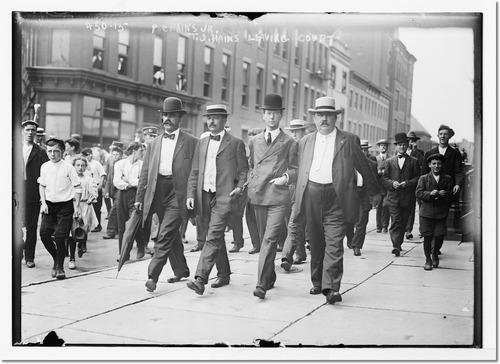
T. Jenkins Hains
Description
Popular American sea novelist, involved in a famous murder trial.
Books
The Chief Mate's Yarns
THE WHITE GHOST OF DISASTER (The Chief Mate's Yarn.) A sea story by CAPT. MAYN CLEW GARNETT. A story of an ocean liner, which betrays a marvellous similarity to the disaster that befell the ill-fated TITANIC. Thirteen short stories whose initial one, the story of the title, parallels in many points the Titanic catastrophe. The "white ghost" is a monster iceberg against which an ocean liner is driven with such force that her bows are jammed a hundred feet into seemingly impregnable ice. The other tales are: The light ahead; The wreck of the "Rathbone"; The after bulkhead; Captain Junard; In the wake of the engine; In the hull of the 'Heraldine'; A two-stranded yarn (2 pts.); At the end of the drag-rope; Pirates twain; The judgment of men; and On going to sea. — The Book Review Digest: Eighth Annual Cumulation, page 190. "All of Capt. Garnett's stories deal with exciting happenings at sea and most of them with shipwrecks. They show more sea knowledge than literary craft." — N. Y. Times.
Bahama Bill
The scene of Captain Hains's new sea story is laid in the region of the Florida Keys. His hero, the giant mate of the wrecking sloop, Sea-Horse, while not one to stir the emotions of gentle feminine readers, will arouse interest and admiration in men who appreciate bravery and daring. His adventures while plying his desperate trade are full of the danger that holds one at a sharp tension, and the reader forgets to be on the side of law and order in his eagerness to see the "wrecker" safely through his exciting escapades. Captain Hains's descriptions of life at sea are vivid, absorbingly frank and remarkably true. "Bahama Bill" ranks high as a stirring, realistic, unsoftened and undiluted tale of the sea, chock full of engrossing interest. "As for Bahama Bill, the reader will like him whether he will or no; he dominates the book, unscrupulous though he may be. Nevertheless there is not a mean streak in him. We shall be tempted to read 'Bahama Bill' several times." — Springfield Union. "Mr. Hains has done much to amuse and entertain those who like rollicking tales of the deep." — Boston Transcript.
The Voyage of the Arrow
The book might have just come into port, so redolent is it of the sea. It describes the wooing of one William Gore, formerly captain of the Southern Cross, then mate of the Conemaugh. On board this vessel, as passengers, are a trim young lady and her mother. When the good ship is taken by pirates, Gore wills to remain and run the risk of identification with the black flag, rather than desert the woman he loves. He has the reward he deserves. The book is written in a clean-cut, crisp style, and is a thoroughly good "book of a day." — Library of the World's Best Literature, Volume XLIV, page 281. Captain Gore tells why he shipped as mate of the Yankee clipper Conemaugh; of an encounter with an English convict ship, The Countess of Warwick, whose desperate crew overpowered their captain, and after burning their vessel boarded the Conemaugh, compelling the service of Gore, who gives in detail the thrilling adventures of himself and the second mate, not omitting the romantic part played by Miss Waters. — The Annual American Catalogue 1896, page 82. Another of Captain Hains's inimitable sea stories, in which piracy, storm, and shipwreck are cleverly intermingled with love and romance, and vivid and picturesque descriptions of life at sea. Mr. Hains's new story describes the capture on the high seas of an American vessel by a gang of convicts, who have seized and burned the English ship on which they were being transported, and their final recapture by a British man-of-war. "A capital story, full of sensation and excitement, and a rollicking sea story of the good old-fashioned sort. The reader who begins this exciting voyage will sail on at the rate of twelve miles an hour until it is finished." — Boston Transcript. "Bold in plot and told with spirit. Mr. Hains knows the sea and keeps its salt smell on every page." — Philadelphia Enquirer. "An all action sea tale of the first rank by a master of his craft." — New York World.
The Black Barque
The Black Barque, by T. Jenkins Hains, is, by way of contrast, to the last an out-and-out story of piracy, and the breezes that blow through its pages are laden, so we are constantly reminded, with the pestilent breath of the slave ship. It is claimed for this book that the descriptions of life on board ship are noteworthy for their realistic strength; and there seems to be no reason for questioning their accuracy. But taken altogether, the brutality of the officers toward their crew, the inhumanity meted out to the living cargo of slaves, the carnage of the encounter with rival pirates, and finally the wholesale massacre when the slaves break loose and run amuck, leave an impression of a needless surfeit of horrors, a sort of piratical Dance of Death. — The Bookman, Volume XXI, pages 518-9 "Captain Hains, the master of the straight sea story, has built a picture that teems with the sea life of the time, striking in its splendid details. The 'Black Barque' is a rattling tale of the sea, as rough as a storm-lashed shoal, as brutal as the sea itself, with a splendid swing, a range of rough characters, and adventures on every page." — Current Literature. Captain Hains is said to have drawn from a large fund of personal experiences for the material for his book. — The Bookman, Volume XXI, page 330. "One of the best sea stories ever published." — Chicago Tribune. A large number of excellent seamen are persuaded by the offer of extravagant wages to ship for a voyage in a vessel of which they really know nothing and find themselves when once she is afloat on a voyage to Africa in a slaver. A display of brutality on the part of the captain, a mutiny, a rising of the slaves, are among the incidents which leave only the heroine, the narrator and two of the crew as survivors. It is an unpleasant but possible story. — The Dolphin, Volume VII--April, 1905--No.4., page 509. "Shows the author's mastery of a craft that allows none to sail to windward." — Chicago News.
The Strife of the Sea
Stories of the sea by a man who has followed it as a business. These are imaginary tales of the whale, the shark, the penguin, the albatross, and others. Mr. Hains is the author of "The Wind-jammers." — The Bookman, Volume XVIII, page 441. In "The Strife of the Sea" (Baker & Taylor Co.) Mr. T. Jenkins Hains undertakes to do for the denizens of the sea and its shores what Mr. Ernest Thompson Seton has done for land animals and their human hunters and companions. He does it in practically the same manner, also, and seems to find it easy to assign a fairly human psychology to pelicans, penguins, and albatrosses on one side, and to rorquals, loggerhead turtles, sharks, albicore, and the giant rays or devilfish on the other. Most of the stories deal with mankind as well, but the essential thing is the sea bird, cetacean, or huge fish which he has described. As the inhabitants of the waters and their shores are predatory in the extreme, there is slaughter and to spare throughout the book, though lives are saved almost as often as they are lost. The book is striking, and in subject matter—though not in treatment—is sufficiently original. — The Dial, Volume XXXVI, page 24.
The Cruise of the Petrel
A novel of sea life during the war of 1812 when privateering was common and the "swift shuttles of an Empire's loom" had remarkable experiences around Cape Horn and in the Southern Pacific. The "Petrel" was one of the sailing craft of the day and the story relates the experiences of a lad who shipped upon her. A novel of the War of 1812, dealing largely with the privateering common at that time. The tale reaches its climax in the famous sea fight between the Essex and the Phœbe. The hero is a young American sailor who goes to sea on the Petrel to win fame, fortune, and the hand of his sweetheart. — Book News, Volume XIX, page 674. The loss of the "Essex" in Valparaiso, on March 28, 1814, is the crowning episode of Mr. T. J. Hains's sea-story, "The Cruise of the Petrel" (McClure, Phillips & Co.). The author has left the "love interest" where it belongs in a good sea-story — entirely out of it. A pair of villains of the good old sort, and a cheerful suggestion of piracy, make the book undeniably interesting. — The Dial, Volume XXXI, page 34.
The Wreck of the Conemaugh
The supposed writer, a consumptive baronet, describes a voyage undertaken to lengthen his days, but ending in virtual suicide, commited to allow a friend to marry the girl whom he loves, although she has a fancy for the hero. This friend vibrates between the peerage and the commonalty in an extraordinary fashion, sometimes being Lord John and Lord Esterbrook on the same page, and certain Cuban filibusters who adorn the tale are rather less real than wax figures. — American Ecclesiastical Review, Third Series--Vol. II.--(XXII).--April, 1900.--No. 4., page 447.
Mr. Trunnell
No more vivid and absorbing sea story has ever been written. Mr. Hains, with his yarns of the "Wind-Jammers," placed himself at once in the front rank of the tellers of sea tales, and his latest book "Mr. Trunnell," surpasses his first effort. Mr Hains knows the sea as one who has braved all its perils and tested all its adventures. In "Mr. Trunnell," he has a tale strong in its intensity, vivid in its realism, novel in plot and action and full of the taste of salt water from first to last. In this book the author writes of the same scenes and people he treated so successfully in The Wind-jammers. — The Bookman, Volume XI, page 278. "A rattling good sea story." — Boston Globe.
The Wind-Jammers
Mr. T. Jenkins Hains's volume of sea stories entitled The Wind-Jammers contains sixteen short sketches of sailor life which, plainly told, without attention to elaboration or detail, are all readable, and reveal a faculty for the choice of incident interesting in itself. If Mr. Hains had lengthened these episodes with such bits of description as only one who has traveled the seas could write, and had acquainted us more fully with the characteristics of the people of his stories we should have to thank him for a remarkable production. However his stories are well worth reading--full of action, excitement and the spirit of health, and his book will please those who like a frank expression of life in literature. —The Book Buyer, Volume XVIII, page 315. Strong sea tales that have had an unusual popularity. — The Bookman, Volume XI, page 101. "A collection of short sea stories unmatched for interest, ranging from the tragic to the humorous, and including some accounts of the weird, unexplainable happenings which befall all sailors. Told with keen appreciation, in which the reader will share." — N. Y. Sun. "Mr. Hains is to be congratulated upon writing a better, more natural, vigorous and thrilling yarn than any other writer of this class of fiction except Russell." — The New York World. "This is an absorbing story, with the full flavor of the sea, and will be enjoyed by all readers." — N. Y. World. "Mr. Hains knows a ship, and can tell a story; and has an adequate sense of the dramatic possibilities of sea life." — Daily Mail. "The author sees the ludicrous as well as the serious side of the sailor's life and his sketches abound in merriment." — The Chicago Inter-Ocean. "Written by a man who has been down to the sea in ships and who knows his business—the Wind-Jammers are mainly to be commended for their truth and dramatic power." — The San Francisco Chronicle.
Richard Judkins' Wooing
This is an OCR reprint. There may be numerous typos or missing text. There are no illustrations or indexes.