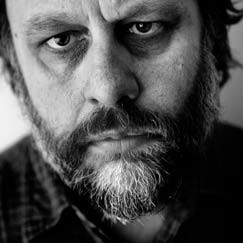
Slavoj Žižek
Personal Information
Description
Slavoj Žižek is Senior Researcher at the Institute for Social Sciences at the University of Ljubljana, Slovenia. He is a coeditor of Gaze and Voice as Love Objects and author of Tarrying with the Negative, both published by Duke University Press.
Books
Theology and the Political
The essays in Theology and the Political—written by some of the world’s foremost theologians, philosophers, and literary critics—analyze the ethics and consequences of human action. They explore the spiritual dimensions of ontology, considering the relationship between ontology and the political in light of the thought of figures ranging from Plato to Marx, Levinas to Derrida, and Augustine to Lacan. Together, the contributors challenge the belief that meaningful action is simply the successful assertion of will, that politics is ultimately reducible to “might makes right.” From a variety of perspectives, they suggest that grounding human action and politics in materialist critique offers revolutionary possibilities that transcend the nihilism inherent in both contemporary liberal democratic theory and neoconservative ideology. Contributors: Anthony Baker, Daniel M. Bell Jr., Phillip Blond, Simon Critchley, Conor Cunningham, Creston Davis, William Desmond, Hent de Vries, Terry Eagleton, Rocco Gangle, Philip Goodchild, Karl Hefty, Eleanor Kaufman, Tom McCarthy, John Milbank, Antonio Negri, Catherine Pickstock, Patrick Aaron Riches, Mary-Jane Rubenstein, Regina Mara Schwartz, Kenneth Surin, Graham Ward, Rowan Williams, Slavoj Žižek (Source: [Duke University Press](
What's the matter with Kansas?
One of "our most insightful social observers" cracks the great political mystery of our time: how conservatism, once a marker of class privilege, became the creed of millions of ordinary Americans With his acclaimed wit and acuity, Thomas Frank turns his eye on what he calls the "thirty-year backlash"—the populist revolt against a supposedly liberal establishment. The high point of that backlash is the Republican Party's success in building the most unnatural of alliances: between blue-collar Midwesterners and Wall Street business interests, workers and bosses, populists and right-wingers. In asking "what 's the matter with Kansas?"—how a place famous for its radicalism became one of the most conservative states in the union—Frank, a native Kansan and onetime Republican, seeks to answer some broader American riddles: Why do so many of us vote against our economic interests? Where's the outrage at corporate manipulators? And whatever happened to middle-American progressivism? The questions are urgent as well as provocative. Frank answers them by examining pop conservatism—the bestsellers, the radio talk shows, the vicious political combat—and showing how our long culture wars have left us with an electorate far more concerned with their leaders' "values" and down-home qualities than with their stands on hard questions of policy. A brilliant analysis—and funny to boot—What's the Matter with Kansas? presents a critical assessment of who we are, while telling a remarkable story of how a group of frat boys, lawyers, and CEOs came to convince a nation that they spoke on behalf of the People. Los Angeles Times
Kodi i familjes dhe legjislacioni për birësimet i Republikës së Shqipërisë
Reading Hegel
This book incorporates seven 'Introductions' that Hegel wrote for each of his major works: the Phenomenology, Logic, Philosophy of Right, History, Fine Art, Religion and History of Philosophy, and includes an Introduction and Epilogue by the Editors, serving to introduce Hegel to the reader and to situate him and his works into their wider context.
Absolute Recoil
"In this major new work the leading philosopher Slavoj Žižek argues that philosophical materialism has failed to meet the key scientific, theoretical and political challenges of the modern world, from relativity theory and quantum physics to Freudian psychoanalysis and the failure of twentieth-century Communism. To bring materialism up to date, Žižek proposes a new foundation for dialectical materialism. He argues that dialectical materialism is the only true philosophical inheritor of what Hegel designates as the speculative approach of thought - all other forms of materialism fail. In Absolute Recoil, Žižek offers a startling reformulation of the ground and possibilities of contemporary philosophy"--
Against the double blackmail
"Called "the Elvis of cultural theory" by The New York Times, popular philosopher and leftist rabble-rouser Slavoj Zizek, looks at one of the most desperate situations of our time: the current refugee crisis overwhelming Europe. In this short yet stirring book, Zizek argues that accepting all comers or blocking all entry are both untenable solutions ... but there is a third option. Today, hundreds of thousands of people, desperate to escape war, violence and poverty, are crossing the Mediterranean to seek refuge in Europe. Our response, from our protected Western European standpoint, argues Slavoj Zizek, offers two versions of ideological blackmail: either we open our doors as widely as possible; or we try to pull up the drawbridge. Both solutions are bad, states Zizek. They merely prolong the problem, rather than tackling it. The refugee crisis also presents an opportunity, a unique chance for Europe to redefine itself: but, if we are to do so, we have to start raising unpleasant and difficult questions. We must also acknowledge that large migrations are our future: only then can we commit to a carefully prepared process of change, one founded not on a community that see the excluded as a threat, but one that takes as its basis the shared substance of our social being. The only way, in other words, to get to the heart of one of the greatest issues confronting Europe today is to insist on the global solidarity of the exploited and oppressed. Maybe such solidarity is a utopia. But, warns Zizek, if we don't engage in it, then we are really lost. And we will deserve to be lost"--
Žižek on Race
"Slavoj Žižek's prolific comments on anti-Semitism, Islamophobia, scapegoating, popular nationalism, the refugee crisis, Eurocentrism, the War on Terror, neocolonialism, global justice, and rioting comprise a dizzying array of thinking. But what can we pull out of his various writings and commentaries on race in the contemporary world? Is there anything approaching a Žižekian philosophy of race? Zahi Zalloua argues here that there is and that the often polemical style of Žižek's pronouncements shouldn't undermine the importance and urgency of his work in this area. Zalloua not only examines Žižek's philosophy of race but addresses the misconceptions that have arisen and some of the perceived shortcomings in his work to date. Žižek on Race also puts Žižek in dialogue with critical race and anti-colonial studies, dwelling on the sparks struck up by this dialogue and the differences, gaps, and absences it points up. Engaging Žižek's singular contribution to the analysis of race and racism, Žižek on Race both patiently interrogates and critically extends his direct comments on the topic, developing more fully the potential of his thought. In a response to the book, Žižek boldly reaffirms his theoretical stance, clarifying further his often difficult-to-work-out positions on some of his more controversial pronouncements."--
Mapping ideology
This volume is one of the first titles in the series "Mappings", designed to offer readers surveys of new zones of cultural, social and political experience. This text surveys the development of the concept of ideology from Marx to the present.
